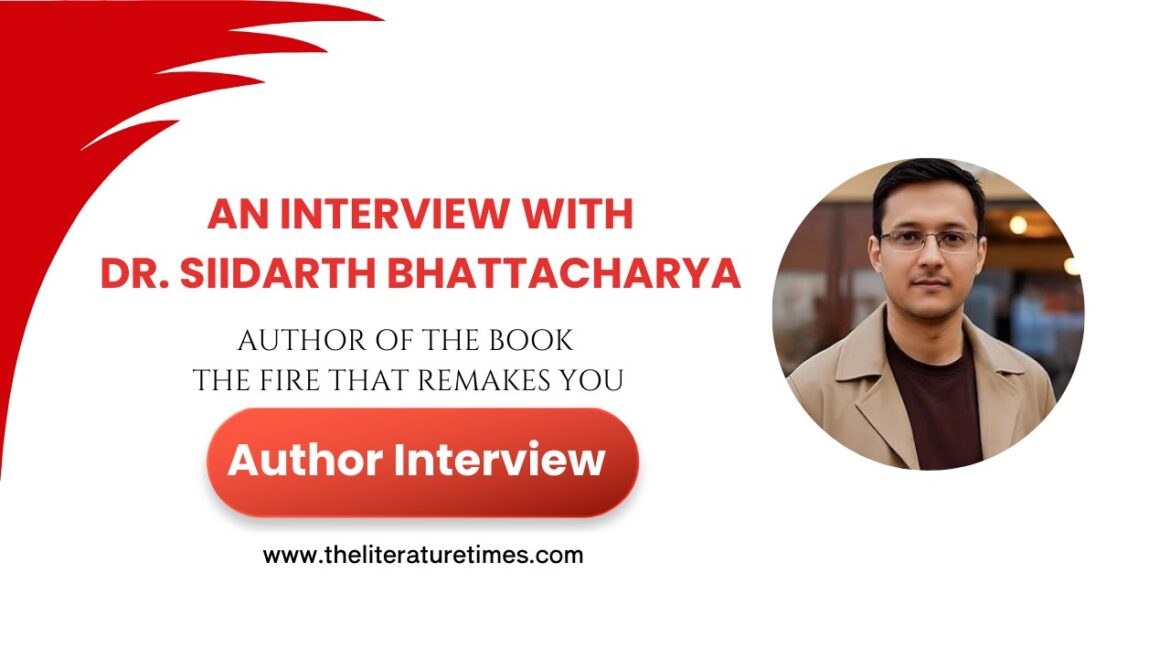
An Exclusive discussion with author Dr. Siidarth Bhattacharya on his book The Fire That Remakes You
Dr. Siidarth Bhattacharya is a global reinvention coach, life-transformation strategist, and author whose work helps people rebuild their identity after life’s most difficult collapses. Blending modern psychology, emotional intelligence, and lived human experience, he is known for translating complex inner struggles into practical, compassionate pathways for change.
With over two decades of leadership and corporate experience, Dr. Siidarth has guided professionals, leaders, and everyday seekers through burnout, grief, career disruption, identity loss, and deep personal reinvention. His approach does not teach strength as performance, but as emotional truth—honest, grounded, and sustainable.
He is the author of “The Fire That Remakes You: From Ashes to Abundance”, a deeply human guide to rising after breakdowns and rebuilding life with clarity and intention. Through reflective storytelling, journaling prompts, and structured reinvention tools, his work invites readers to reconnect with who they are beneath roles, labels, and expectations.
1. This book focuses on reinvention rather than recovery. Why is that distinction important?
Recovery implies returning to who you were before things fell apart. Reinvention acknowledges that the fire changes you. And that change isn’t something to resist — it’s something to honor. When I went through my own collapse, I kept asking, “How do I get back to normal?” But eventually I realized there was no going back. The experiences had reshaped me — my priorities, my identity, my understanding of success. Reinvention became liberating because it shifted the question from “How do I fix this?” to “Who am I becoming through this?” Many people try to recover the past version of themselves, and that creates suffering because life has already moved forward. Reinvention allows integration. It says: take what burned, take what remained, and build consciously from there. You’re not returning — you’re evolving. And that perspective transforms pain into possibility. The fire didn’t take your life away. It gave you the chance to rebuild it intentionally.
2. You explore identity collapse in several chapters. Why do people fear losing who they were?
Identity gives us psychological stability. We build our sense of self around roles — professional success, relationships, achievements, responsibilities. When those shift or disappear, it doesn’t just feel like change — it feels like disappearance. People fear identity collapse because they confuse roles with essence. Losing a job feels like losing worth. Losing a relationship feels like losing value. But what actually collapses is the structure around the self, not the self itself. During my own Ashes season, I experienced that fear deeply — the sense of not recognizing myself anymore. But over time I realized something profound: the parts that burned were the parts built on expectation, not authenticity. What remained was quieter, but more real. Identity collapse is frightening because it removes certainty. But it also removes illusion. And once illusion falls, truth has space to emerge. You don’t lose yourself in collapse — you lose what was never fully you.
3. How does the concept of choice shape the later stages of the book?
Choice is the turning point between Embers and Spark. In the Ashes phase, life feels like it’s happening to you. There’s shock, grief, confusion. But eventually awareness returns — and with awareness comes choice. Not control over everything, but choice over response. That realization is powerful. You may not have chosen what happened, but you can choose how you interpret it, what you learn from it, and what direction you move next. Choice restores agency. And agency rebuilds confidence. In the later stages of the book, readers begin making intentional decisions — boundaries, priorities, identity shifts, purpose alignment. Those choices create Flame. Transformation isn’t accidental. It’s cumulative decisions repeated over time. You don’t rise because life becomes easier. You rise because you choose differently.
4. What is the difference between surviving and intentionally living?
Survival is reactive. Intentional living is conscious. When we’re surviving, we operate from fear, urgency, and habit. We make decisions to avoid pain or maintain stability. There’s nothing wrong with survival — sometimes it’s necessary. But staying there long term creates disconnection. Intentional living begins when you pause and ask: What actually matters to me now? What kind of life am I choosing? After my own collapse, I noticed how much of my life had been driven by external validation — success markers, expectations, achievement. Intentional living meant redesigning from values instead of pressure. It’s slower, but deeper. You feel aligned instead of just accomplished. Survival keeps you alive. Intention makes you feel alive. The goal isn’t just to endure your life — it’s to inhabit it.
5. Can you explain how the Fire Ritual seals the transformation journey?
Transformation often happens internally, but without a marker, the mind struggles to recognize completion. The Fire Ritual creates that marker. It’s a symbolic and psychological act of release — letting go of identities, beliefs, or chapters that no longer serve you. During my own transition, I realized understanding something wasn’t enough. I needed to feel closure. Ritual engages emotion, memory, and embodiment simultaneously. When readers consciously release something through the ritual, they move from processing into integration. It’s not superstition — it’s neuroscience meeting symbolism. The ritual tells the nervous system: this chapter is complete. Now we begin the next one. And that shift is powerful. The ritual doesn’t change your past. It changes your relationship with it.
6. How do the four stages reflect real-life emotional cycles?
Real life rarely moves in straight lines. Emotional cycles are dynamic — sometimes messy, sometimes repetitive. The four stages — Ashes, Embers, Spark, and Flame — reflect patterns I observed in both personal experience and coaching work. Ashes is collapse and disorientation. Embers is reflection and meaning-making. Spark is renewed agency. Flame is intentional rebuilding. People often move back and forth between stages. That’s normal. What the framework provides is language. When you can name where you are emotionally, fear decreases. You realize: this phase has purpose. I’m not stuck — I’m transitioning. The stages don’t force progression. They illuminate it. Healing isn’t linear, but it is directional.
7. What advice would you give someone standing in the ashes of a broken dream?
First, breathe. When dreams collapse, the nervous system goes into shock. There’s grief, confusion, sometimes shame. Allow yourself to feel that without rushing forward. Broken dreams are losses, and losses deserve acknowledgment. Second, remember that dreams often reflect identity — so when they break, identity feels threatened. But identity is adaptable. New paths emerge when space opens. Third, focus on one small step instead of the entire future. Movement restores hope. I would also say this gently: what feels like the end of your story may actually be the end of one chapter. And chapters change. The ashes are not evidence that you failed — they are evidence that something mattered deeply. And that meaning will guide what comes next.
8. How can readers trust themselves again after loss or failure?
Self-trust breaks when expectations break. We begin questioning our judgment, our decisions, our instincts. Rebuilding trust starts small. Keep promises to yourself — even tiny ones. Notice moments when your intuition is accurate. Reflect on what you’ve learned from the experience rather than labeling it failure. Failure often contains wisdom we couldn’t access otherwise. Compassion is also essential. We judge ourselves more harshly than we judge anyone else. But mistakes don’t erase capability. They expand it. Over time, repeated self-honoring actions rebuild trust. Self-trust isn’t restored by perfection — it’s restored by consistency with yourself.
9. What kind of emotional shift do you hope readers experience after finishing the book?
I hope readers move from self-doubt to self-understanding. From believing something is wrong with them to recognizing something is changing within them. I hope they feel permission — permission to grieve, to pause, to redefine success, to rebuild differently. Most importantly, I hope they leave with agency. The realization that they are not passive recipients of life. They are participants in their becoming. When someone closes the book, I want them to feel quieter inside — but stronger. Less afraid of uncertainty. More connected to their own voice. Transformation begins the moment you believe your story is still unfolding.
10. If you could leave readers with one truth from this book, what would it be?
The one truth I would leave is this: you are not the ashes you survived — you are the fire you chose to become. Life will break expectations. It will dismantle identities. It will create moments where you question everything. But collapse is not the opposite of growth. It is often the doorway to it. You don’t have to rush your healing. You don’t have to prove strength. You only need willingness — the willingness to feel honestly, to listen inwardly, and to choose intentionally when the time comes. Your life is not over because something ended. Your life is evolving because something changed. Your rise begins the moment you decide it does.
Book Title: The Fire That Remakes You