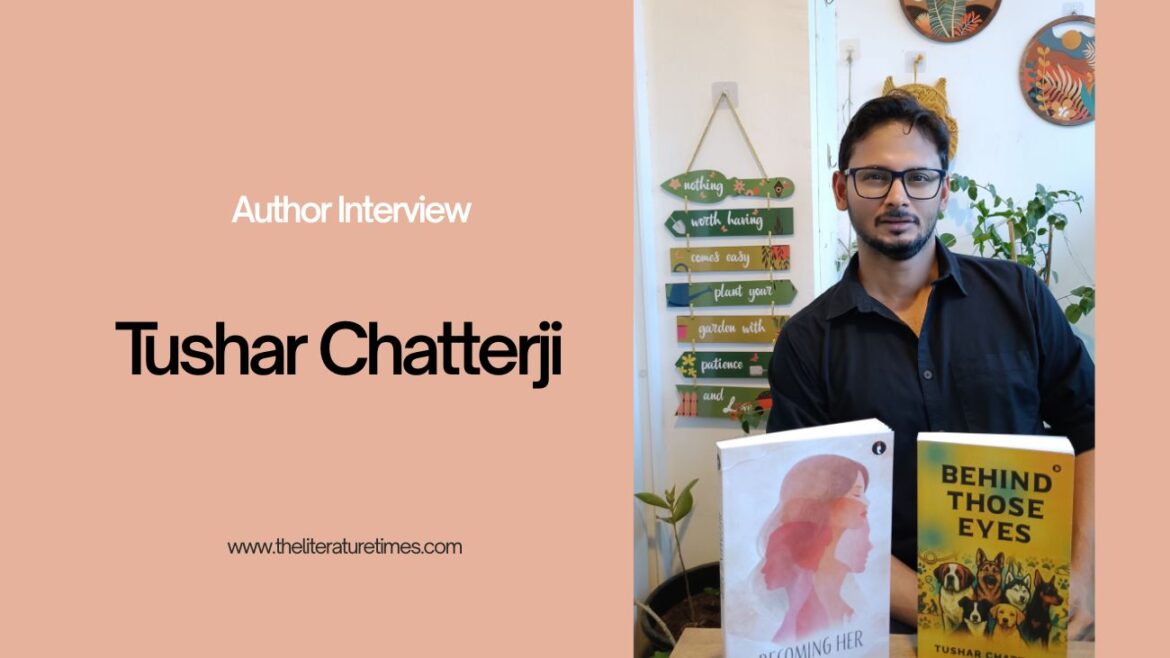
The Literature Times: Congratulations on winning the Sahitya Sparsh Awards Season 4 for Behind Those Eyes. What does this recognition mean to you?
Tushar-Chatterji: Thank you so much. This recognition is deeply meaningful because Behind Those Eyes began as a very personal attempt to give a voice to those who communicate without words, yet often understand us more completely than we understand ourselves.
When I began writing the book, I did not know how readers would respond to stories narrated through the perspectives of dogs. I only knew that these stories came from a place of honesty, affection, and emotional conviction. To see the book receive the Sahitya Sparsh Award reassures me that readers are willing to embrace unconventional voices when the emotions behind them are sincere.
The award is not merely a validation of the book; it is also a celebration of every animal that has entered a human life and changed it. I see this recognition belonging to Piku, Nala, Laila, Chelsea, Dolly, and Rani, and, through them, to countless animals whose love is felt deeply even when their stories remain untold.
It also motivates me to continue writing stories that may not always follow familiar paths but have something meaningful to say.
The Literature Times: What inspired you to write Behind Those Eyes, and why did you choose to tell the story through the eyes of dogs?
Tushar-Chatterji: The inspiration came from observing the extraordinary emotional intelligence of dogs. They may not understand every word we speak, but they often recognize our silences, anxieties, and grief long before the people around us do. They notice the emotions we conceal and remain beside us without demanding explanations.
I wanted to explore what human beings might look like when observed by animals who love us without being influenced by our social identities, accomplishments, failures, or pretenses. A dog does not care about the version of ourselves we present to the world. It responds to who we are at the end of the performance.
Telling the stories through the eyes of dogs allowed me to reverse the usual perspective. Instead of humans describing animals, the animals observe us: our contradictions, loneliness, kindness, selfishness, and capacity for transformation.
Their voices are innocent but not simplistic. They may not understand the vocabulary of grief, abandonment, aging, or betrayal, but they understand what these experiences feel like. That emotional instinct became the foundation of the book.
The Literature Times: Piku, Nala, Laila, Chelsea, Dolly, and Rani each have unique personalities. Which character was the most challenging or rewarding to write?
Tushar-Chatterji: Each character challenged me differently because I wanted every dog to possess an individual emotional voice rather than sound like the same narrator placed in different circumstances.
Piku was especially rewarding because that voice became an emotional doorway into the book’s world. Through Piku, I began discovering how much could be communicated through observation, instinct, and unconditional companionship.
Rani, however, was among the most challenging to write. Her emotional world required restraint. Certain experiences become less powerful when they are overexplained, and I had to trust the reader to recognize the pain beneath what she observes. Writing from an animal’s perspective means finding a balance between what the animal understands and what the reader understands more fully.
Ultimately, I do not see these six characters merely as dogs belonging to six different stories. Each one represents a distinct way of loving, enduring, and remembering. Together, they reflect different shades of what it means to be human.
The Literature Times: Your book beautifully explores themes of love, loyalty, grief and healing. Which of these themes is closest to your heart, and why?
Tushar-Chatterji: Healing is perhaps the theme closest to my heart because it contains all the others. We often imagine healing as a dramatic moment when pain disappears, and life begins again. In reality, healing is usually much less visible. It may be the first morning when a memory no longer feels unbearable, the decision to trust someone after being hurt, or simply finding the courage to remain present, even as withdrawing would be easier.
The dogs in Behind Those Eyes do not heal people by offering advice or solving their problems. They heal them through constancy. They stay. They listen without interrupting. They do not ask people to become less complicated before offering affection.
That form of companionship inspires me because it reminds us that healing does not always require the perfect words. Sometimes, it begins when another living being silently communicates: “You do not have to face this alone.”
The Literature Times: Your writing is both emotional and poetic. What was your writing process while creating this book?
Tushar-Chatterji: The process began with emotion rather than plot. For every story, I first asked myself what the central human wound was. Was it grief, abandonment, loneliness, guilt, aging, or the fear of being forgotten? I then considered how a dog living alongside that person might experience the same situation.
Once I discovered that emotional center, I built the characters and narrative around it.
The most important part of the process was maintaining authenticity in the dogs’ voices. I did not want them to sound like human philosophers disguised as animals. Their understanding had to emerge through sensory details, routines, scents, gestures, and changes in human behavior. A dog may not understand why someone is grieving, but it notices that the person no longer opens the curtains, leaves food untouched, or sits beside an empty chair.
I also revised extensively. Emotional writing requires discipline because there is a fine line between moving the reader and instructing the reader to feel moved. I tried to remain on the side of honesty and restraint, allowing small moments to carry the emotional weight.
The Literature Times: What do you hope readers will feel or learn after finishing Behind Those Eyes?
Tushar-Chatterji: I hope readers finish the book with a renewed sensitivity towards the animals around them.
Dogs are frequently described in terms of what they provide to human beings: companionship, loyalty, security or comfort. I want readers to pause and consider the emotional worlds these animals possess themselves. They experience attachment, fear, confusion, loss and joy. They remember kindness, recognize neglect and form relationships that are far deeper than convenience.
Beyond that, I hope the stories encourage readers to look at their own relationships differently. Animals remind us that love does not always need to be grand or eloquent. It can exist in waiting near a doorway, recognizing someone’s footsteps, sitting beside a person in silence, or returning affection despite having once been hurt.
Most of all, I hope readers feel understood. The human characters in these stories are imperfect and often emotionally lost. Yet they remain capable of healing and being loved. That possibility lies at the heart of the book.
The Literature Times: You have also written Becoming Her. How was writing Behind Those Eyes different from your second book?
Tushar-Chatterji: The two books are connected by their emotional focus, but they required very different creative approaches.
Behind Those Eyes views human life through the instinctive and unfiltered perspectives of dogs. Its emotional power often lies in what the narrators sense without fully understanding. The writing demanded innocence, restraint, and close observation.
Becoming Her, on the other hand, enters the inner worlds of women as they confront expectations, relationships, identity, and the difficult process of reclaiming themselves. Those stories required a more direct engagement with social conditioning, gendered experiences, and the choices women are often encouraged or compelled to make.
Writing Behind Those Eyes taught me how to observe human beings from the outside. Writing Becoming Her required me to enter complex interior lives with empathy and responsibility.
Despite these differences, both books ask a similar question: Who are we beneath the roles the world gives us? One explores that question through animals who see beyond human pretense, while the other explores it through women learning to see themselves beyond society’s expectations.
The Literature Times: Are you currently working on your next book or any new writing projects that readers can look forward to?
Tushar-Chatterji: Yes, I am working on several new writing projects and ideas, each exploring human relationships through a distinctive setting and narrative lens. Besides curating an intriguing collection of stories, one of my major works in progress is a literary fiction novel set on the Konkan coast, exploring themes of silence, compromise, and unspoken resentments that shape and define human relationships.
The Literature Times: Are you active on social media or other online platforms? How can readers connect with you and follow your work?
Tushar-Chatterji: Yes, I enjoy connecting with readers, fellow authors, and everyone who believes that stories can begin meaningful conversations. Readers can visit my official website at www.tusharchatterji.com to learn more about my books, upcoming projects, media features, events, and writing journey. I am also active on LinkedIn, where I share reflections on my journey and accomplishments as an author while continuing a professional career.
Readers can also find me on Instagram at @tuchat_is_to_err_ji. I always value thoughtful feedback and enjoy hearing how readers interpret the characters and emotions in my stories.
Writing may begin as a solitary act, but a book acquires a larger life through its readers. Every message, review, and conversation helps me understand how a story has traveled beyond the page.
The Literature Times: Where can readers purchase Behind Those Eyes? Is it available in both print and digital formats?
Tushar-Chatterji: Behind Those Eyes is available in both paperback and Kindle editions (https://mybook.to/behindthoseeyes), making it accessible to readers who enjoy holding a physical book as well as those who prefer reading digitally.
Readers can purchase the paperback through Amazon and Notion Press, while the digital edition is available on Amazon Kindle.
The Literature Times: What advice would you give aspiring authors who want to write stories that leave a lasting emotional impact?
Tushar-Chatterji: Begin by pursuing emotional truth rather than emotional effect. Writers sometimes try so hard to make readers cry that the characters themselves stop feeling real. Lasting emotional impact rarely comes from dramatic language alone. It comes from recognizable human details: a person preparing two cups of tea after forgetting that someone is gone, a message typed but never sent, or an animal continuing to wait beside a door that will no longer open.
Observe people closely. Listen not only to what they say but also to what they avoid saying. Contradictions make characters believable. A loving person can behave selfishly. A courageous person can remain silent at the wrong moment. A deeply hurt person may still hurt someone else.
Do not be afraid of simplicity, and do not explain every emotion. Trust your readers to meet the story halfway.
Most importantly, write the story that matters to you even when it does not resemble what appears fashionable or commercially predictable. Readers may forget an elaborate plot, but they rarely forget a character who made them feel less alone.
The Literature Times: Thank you for taking the time to answer our questions. Is there anything you would like to say to your readers and everyone who has supported your writing journey?
Tushar-Chatterji: I want to offer my heartfelt gratitude to every reader who has opened Behind Those Eyes and allowed its characters into their emotional world.
A writer creates the words, but readers create the life of a book. Every review, recommendation, message, and conversation has helped these stories travel farther than I could have imagined when I first began writing them.
I am equally grateful to the literary platforms, reviewers, booksellers, fellow authors, friends, and family members who believed in the book and supported its journey. Recognition such as the Sahitya Sparsh Award reminds me that stories written with sincerity can find their readers, even when they arrive through unexpected voices.
To anyone carrying a story but hesitating to write it, I would say: begin before you feel completely ready. Your first sentence does not need to be perfect. It only needs to be honest.
And to my readers, thank you for looking beyond the muddy paws and playful eyes to discover the love, grief, loyalty, and humanity within these stories. I hope Piku, Nala, Laila, Chelsea, Dolly, and Rani remain with you long after the final page, gently reminding you that some of life’s deepest connections are formed without a single spoken word.