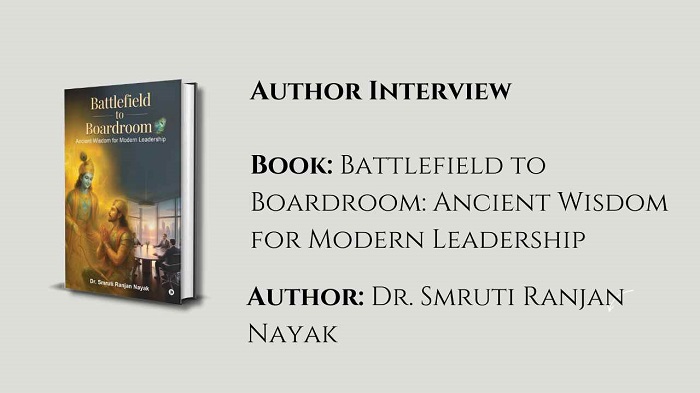
Dr. Smruti Ranjan Nayak, an Oxford- and Harvard-educated management professional, is a thought leader blending ancient wisdom with modern leadership. Creator of the Gita Grid, he pioneers frameworks for decision-making, strategy, and ethical leadership, guiding organizations and leaders to transform challenges into opportunities, pressure into purpose, and vision into impact.
The Literature Times: What inspired you to connect ancient battlefield wisdom with modern leadership principles?
Dr. Smruti Ranjan Nayak: The inspiration came from a simple yet unsettling observation: despite unprecedented access to technology, data, and management tools, modern leaders are more stressed, conflicted, and ethically strained than ever before. When I revisited the Bhagavad Gita—not as scripture, but as a decision-making dialogue—I realised it was essentially a leadership coaching session with wisdom for every soul held under extreme pressure. The battlefield was not just about war; it was about doubt, responsibility, fear, and clarity. That is precisely where today’s leaders stand—only the battlefield has moved from Kurukshetra to the boardroom.
The Literature Times: How does the Gita Grid help leaders make better decisions under pressure?
Dr. Smruti Ranjan Nayak: The Gita Grid translates timeless wisdom into a structured, practical decision framework. Under pressure, leaders often oscillate between impulse and paralysis. The Grid helps them pause, detach from emotional noise, and realign with purpose before acting. It doesn’t remove pressure—it teaches leaders how to stand steady within it. By balancing intent, action, and consequence, leaders move from reactive decision-making to response-conscious leadership.
The Literature Times: Can you share a real-world example where ancient strategies transformed a modern business challenge?
Dr. Smruti Ranjan Nayak: In one organisation facing aggressive market competition and internal burnout, leadership was tempted to pursue short-term wins at the cost of trust and sustainability. By applying principles of Nishkama Karma—Karma Yoga, focused action without result & ego-driven attachment—the leadership shifted strategy from fear-based decisions to purpose-driven execution. The result was not just improved performance, but also a visible rise in employee engagement, clarity of priorities, and long-term resilience.
The Literature Times: What are the most common leadership dilemmas today, and how can timeless wisdom address them?
Dr. Smruti Ranjan Nayak: Today’s leaders struggle most with ethical ambiguity, constant distractions, and identity conflict—between who they are and what the system demands. Timeless wisdom reminds leaders that clarity precedes control, and integrity precedes influence. Ancient wisdom & teachings don’t offer quick fixes; they offer inner alignment. When leaders know why they act, the how becomes far more effective.
The Literature Times: How do you balance profit and principle in leadership?
Dr. Smruti Ranjan Nayak: Profit and principle are not opposites—they are partners across time. Profit achieved without principle is fragile; principle without performance is unsustainable. The Gita teaches balance—right action, right intent, right outcome. Leaders who anchor decisions in values often discover that trust, loyalty, and long-term profitability naturally follow.
The Literature Times: What daily practices do you recommend for leaders seeking clarity and purpose?
Dr. Smruti Ranjan Nayak: Three simple practices:
First, intentional pauses before critical decisions.
Second, reflection—asking not just what succeeded, but why.
Third, disciplined detachment—doing one’s best without being consumed by outcomes. These practices recalibrate the mind daily, much like tuning an instrument before a performance.
The Literature Times: How can aspiring leaders cultivate courage and integrity in high-stakes situations?
Dr. Smruti Ranjan Nayak: Courage is not the absence of fear; it is clarity in the presence of fear. Integrity emerges when leaders choose what is right even when it is uncomfortable. Ancient wisdom teaches leaders to anchor courage not in dominance, but in responsibility—to people, purpose, and the future they are shaping.
The Literature Times: Were there any surprising lessons from your research at Oxford and Harvard that shaped this book?
Dr. Smruti Ranjan Nayak: Yes—what surprised me most was how often modern leadership research echoed ancient insights using different language. Concepts like emotional regulation, ethical decision-making, and cognitive resilience were already articulated thousands of years ago. The real gap was not knowledge, but application. This book became my attempt to bridge that gap.
The Literature Times: How do you envision the future of leadership evolving in a rapidly changing world?
Dr. Smruti Ranjan Nayak: The future of leadership will favour those who can integrate speed with stillness, data with discernment, and ambition with accountability. As process automation takes centre stage, human qualities—wisdom, empathy, ethical judgment—will become the true differentiators. Leadership will shift from control to consciousness.
The Literature Times: If you could summarise the essence of Battlefield to Boardroom in one sentence, what would it be?
Dr. Smruti Ranjan Nayak: Battlefield to Boardroom is a guide & wisdom for leaders to master themselves first—so they can lead others with clarity, courage, and purpose in any arena of life.