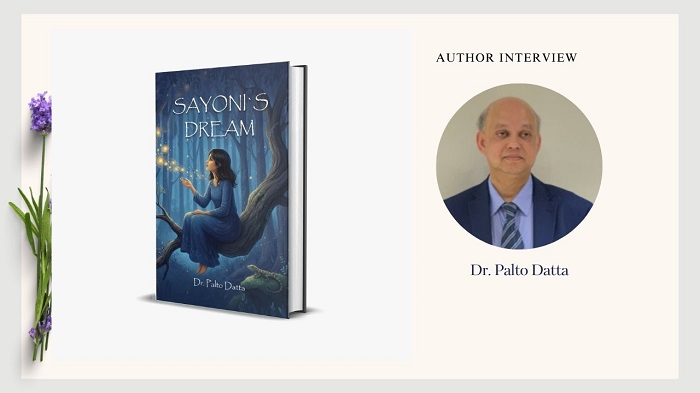
Literature Times: Dr. Palto Datta, what inspired you to write Sayoni’s Dream, and how did the idea of portraying the inner world of an autistic child first take shape for you?
Dr. Palto Datta: Sayoni’s Dream is a synthesis of reflective concern over the years rather than a single influence, both personal and social. Living abroad for many years who spent his childhood in Bangladesh, and observing various societies over the years, I noticed a pattern where children who do not adhere to “norms” are silenced, misunderstood, or made invisible. I must say that the idea about this book is not mine. I am really inspired by a 12-year-old schoolboy who is my grandchild. During my visit to Bangladesh, he once narrated a short episode from his educational experience where he went through some bullying. I spent a lot of time conversing with him. My inspiration for Sayoni’s Dream is my grandson. One day while he was reading my writing, I asked him what he thought would be a suitable story for children. He was very candid but made a good point. He said I should write an inspiring story for children about a young person with a disability. I started thinking about the issues of disabled children. The most difficult of these is autism, especially in a country like Bangladesh where autism is known but not understood. I have a few friends with autistic children, and they have narrated very painful stories to me. This is how I came to have a special interest in the issues of autism and the desire to write about it.
The concept of autism is viewed in Bangladesh in a clinical, and even stigmatised lens, rarely humane. Someone needs to break that silence, I thought. Sayoni is a space I could dedicate to examining the inner life of an autistic child, her fears, tenderness, questions, quiet resilience, and defiant spirit. Over the years, the idea took shape with the foundation that autism is not just a diagnosis, autism is a lived human experience that deserves respect.
Literature Times: Sayoni’s character is deeply introspective and emotionally nuanced. How did you approach capturing her inner voice with authenticity and sensitivity?
Dr. Palto Datta: Being genuine also meant holding back. I tried not to go overboard on the dramatics. I spent my time trying to get interiority on Sayoni, on the way she moved, the way she felt, the way she perceived things in her mind, and the way she emoted. I tried to keep her duality of the layers of voice and silence, the complexities of repetition and the deliberateness that is so characteristic of selves that experience the world in the way that she does. I tried to keep the balance as much as I could in the silence of the double protection of character autonomy and the absence of explaining her to the reader. I crafted this so that the reader is not instructed about her, but so that the reader can walk alongside her, and carry the weight of her isolation, the crux of her uncertainty, and the soft aspects of her happiness.
Literature Times: Nature plays a significant role in the story, with insects and animals offering Sayoni comfort and companionship. What symbolism do these elements hold for you?
Dr. Palto Datta: Sayoni develops a unique bond with nature. Sayoni views nature as a judgment-free zone. Insects, fireflies, lizards and birds are free to exist without the burdens of social construct, and as such, are symbolic of unsullied character, emotional safety, and honesty. The fireflies are a beacon of light during her dark times, while the discipline and order from the ants are welcomed. The peaceful and quiet company of the animals provides her with acceptance without conditions. The insight of nature forming an empathetic bond with those who feel isolated in a society lacking in social and emotional empathy is something I wanted to express.
Literature Times: The novel highlights societal misconceptions about autism in Bangladesh. What kind of research or real-life experiences informed this aspect of the narrative?
Dr. Palto Datta: The story is based on many years of watching, talking to teachers, parents, specialists, and my own experiences in Bangladeshi culture. It did not come exclusively from literature. I learned and listened to narratives: tales of absence and stories of denial and stigma. It is still the case in Bangladesh that many people view autism as a deficiency in parenting or a moral problem. Educational institutions and families often do not have the skills or the tolerance needed to include people with autism. These events influenced the social background in which Sayoni was located, which is why the novel is as much a social piece as it is a work of literature.
Literature Times: As an academic with a background in marketing and science, how did your professional journey influence your approach to writing literary fiction?
Dr. Palto Datta: My academic background trained me to observe systems, patterns, and behaviors critically. Marketing, at its core, is about understanding human needs, perceptions, and relationships. Science taught me discipline and structure, while academia instilled ethical responsibility. When writing fiction, I carried these perspectives with me. I approached Sayoni’s world analytically but wrote it emotionally. The balance between structure and empathy allowed me to craft a narrative that is both socially grounded and emotionally resonant.
Literature Times: Sayoni’s relationship with her grandmother is one of the few sources of warmth in the story. What does this bond represent within the larger theme of the novel?
Dr. Palto Datta: To her family, Sayoni is an enigma. The complexities of her nature, the oddity of her behavior all creates a sense of annoyance and helplessness in others. So, while everyone else avoids Sayoni, her grandmother becomes her confidante. Her grandmother is her only sanctuary, the one who gives her love, affection, and listens to what she has to say. The grandmother stands for unwarranted affection and cultural recollection. In Sayoni’s life, she is a beacon of virtue and a reminder that even in a callous world, empathy can be found. This relationship is a manifestation of optimism, unbroken continuity, and the chance of comprehension transcending age boundaries. Within the wider scope of the narrative, it insinuates that sometimes the process of incorporating others is initiated, not by organizations, but by the singular devotion and forbearance of a human being.
Literature Times: What were the emotional challenges you faced while writing about isolation, exclusion, and silent suffering through a child’s perspective?
Dr. Palto Datta: The heaviest burden was controlling my emotions. Analysing experiences from the viewpoint of a child requires addressing pain directly without the ability to process the pain from a distance. I felt overwhelmed by Sayoni’s solitude. I was required to embrace her silence, her questions left unanswered, and her stoic suffering. However, the emotional burden was certainly something that I required to carry. By downplaying the emotional suffering, I would have betrayed the truth of the lived experience that the book represents.
Literature Times: Sayoni’s Dream strongly advocates for neurodiversity and inclusion. What key message do you hope readers take away after finishing the book?
Dr. Palto Datta: It is my sincere hope that my readers achieve this desired effect. Neurodiversity is not something that needs a resolution. It is a variation deserving of respect. Sayoni’s story implores readers to, as a parent or teacher or peer or member of society, consider their own actions. Inclusion should not be relegated to mere tolerance. It is a proactive endeavor that requires empathy and patience. It is my hope that readers internalize the idea that autistic children are not different in an othering sense, but are equally deserving of love, that this book has achieved its objective.
Literature Times: How do you see literature contributing to greater awareness and empathy toward autism and other neurodivergent conditions?
Dr. Palto Datta: The Humanities elucidate what science abstracts. While medical literature describes a medical condition, a literary account conveys what it might feel like. Readers can enter the consciousness of a character through narrative, if only for a moment. This type of emotional engagement cultivates empathy in a way that policy or advocacy efforts do not. Literature can conquer fear, transform prejudiced perceptions, and construct emotional connections between the neurotypical and neurodivergent.
Literature Times: Having traveled extensively and engaged with diverse cultures, how have your global experiences shaped your understanding of empathy, inclusion, and storytelling in this novel?
Dr. Palto Datta: Travel has taught me that exclusion exists everywhere, though it wears different cultural masks. At the same time, I have seen inspiring examples of inclusion and kindness across the world. These global experiences reinforced my belief that empathy is universal, even if its expressions differ. In Sayoni’s Dream, I combined local realities with universal emotions, ensuring that Sayoni’s story, while rooted in Bangladesh, speaks to readers across cultures. Her longing to be understood is a human longing shared by us all.