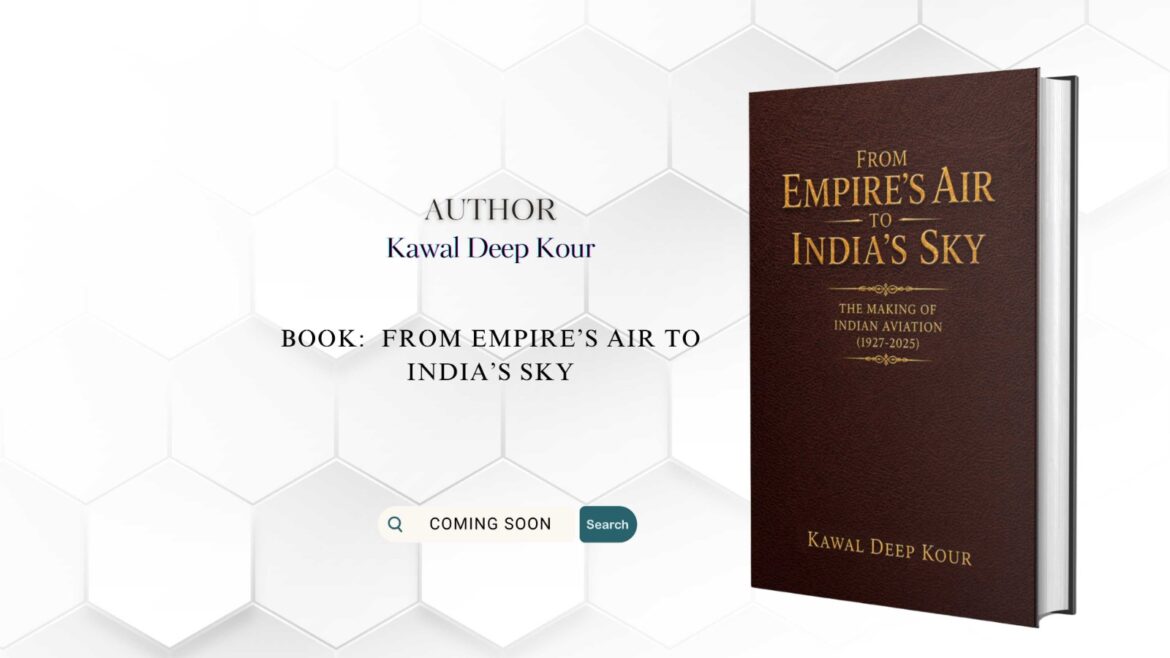
From the first fragile flights over colonial India to the rise of one of the world’s fastest-growing aviation sectors, a remarkable new book is preparing to take readers on an unforgettable journey through the skies of history, governance, ambition, and national transformation. From Empire’s Air to India’s Sky: The Making of Indian Aviation (1927–2025) by Kawal Deep Kour is an upcoming work that promises to offer a deeply researched and thought-provoking exploration of Indian civil aviation unlike anything readers have seen before.
More than just a history book, this upcoming release captures the evolution of India itself through the lens of aviation. It traces how flight in India transformed from an imperial symbol of colonial power into a vital instrument of democracy, national integration, economic growth, and public accountability. Through parliamentary debates, committee reports, archival records, government proceedings, and historical investigations, the book reveals how the Indian sky became a reflection of the Republic’s aspirations and anxieties across nearly a century.
The narrative begins in the early decades of aviation, when flying was still viewed as an experiment filled with wonder and uncertainty. As India moved toward independence, aviation slowly evolved from a private and elite enterprise into a public necessity. The book highlights how aircraft, airports, and air routes came to symbolize progress and modernity for a newly independent nation eager to connect its vast geography and diverse population. Regions that once remained isolated by terrain and distance gradually became linked through the promise of flight.
What makes this work particularly compelling is its focus on Parliament as the central stage where India’s aviation story unfolded. The book demonstrates that aviation in India was never simply about machines or transport policy; it was also about ethics, governance, safety, regulation, and the responsibility of the state. Parliamentary discussions, questions, and committee investigations form the moral backbone of the narrative, showing how lawmakers repeatedly confronted issues ranging from infrastructure and modernization to accidents and accountability.
As decades passed, the optimism of the early years gave way to difficult questions about institutional efficiency and safety oversight. The book carefully examines periods of turbulence in Indian aviation, including concerns over bureaucratic fragmentation, outdated systems, rising accidents, and policy conflicts between public ownership and private expansion. Yet, rather than presenting aviation history as a collection of technical events, the author transforms it into a human and political story — one shaped by pilots, engineers, investigators, parliamentarians, civil servants, and ordinary citizens whose lives intersected with the skies above them.
Readers can expect the book to delve into some of the most defining moments in India’s aviation history, from the nationalisation era of the 1950s to the liberalisation wave of the 1990s and the rapid expansion of the twenty-first century. It also reflects on the emotional and institutional impact of aviation tragedies, reminding readers that every reform in aviation is often written in the memory of lives lost. The work approaches these incidents with sensitivity and scholarly seriousness, emphasizing how safety and accountability remain the foundation of public trust.
One of the strongest aspects of the upcoming release is its literary depth. The writing goes beyond statistics and technical analysis, presenting aviation as a metaphor for India’s democratic journey. The airplane emerges not only as a machine of transport but as a symbol of discipline, ambition, coordination, and national purpose. Through elegant prose and meticulous research, the author paints the Indian sky as both a frontier of possibility and a mirror reflecting the strengths and weaknesses of governance itself.
For readers interested in history, politics, public policy, transportation, governance, or modern India, this book is expected to become an important addition to contemporary non-fiction. It combines archival rigor with narrative storytelling, making complex institutional histories accessible and engaging for a wider audience. Scholars, aviation enthusiasts, students, and general readers alike may find themselves drawn into a story that is at once historical, political, emotional, and deeply relevant to present-day conversations about infrastructure, safety, and public accountability.
At a time when India’s aviation sector continues to expand rapidly and conversations around modernization and safety dominate public discourse, From Empire’s Air to India’s Sky: The Making of Indian Aviation (1927–2025) arrives as a timely and significant work. It reminds readers that aviation is not only about reaching destinations but also about the systems, values, and responsibilities that keep a nation airborne.
With anticipation already building around this ambitious release, the book is poised to spark meaningful discussions among readers, researchers, policymakers, and aviation observers. Rich in historical insight and driven by a powerful sense of national memory, this upcoming title promises to stand as both a chronicle of India’s aviation journey and a meditation on the Republic’s continuing pursuit of progress.
Coming soon, this is more than a book about aviation — it is a story about India learning to fly.