Title: Smart Botany:AI in Plant Science Research
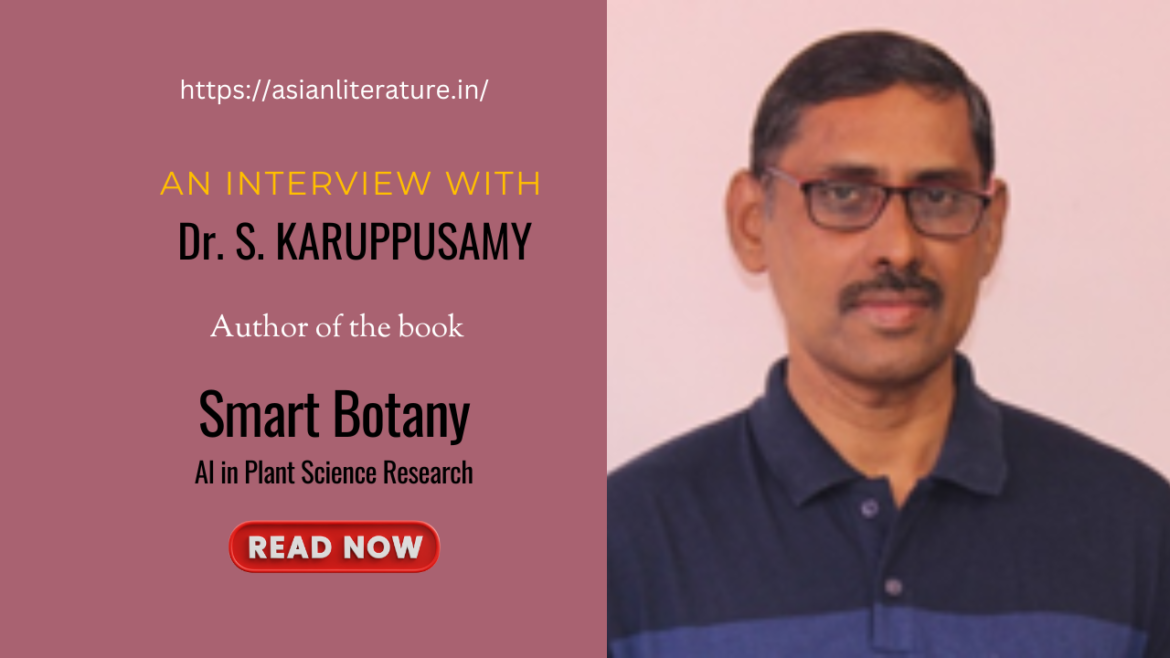
Author: Dr. S. Karuppusamy
ISBN: 978-93-7900-403-1
Publisher: Inksight Publishers
About The Author
Dr. S. Karuppusamy obtained his M.Sc. (1996) degree from the Madurai Kamaraj University, Madurai and Ph.D. (2003) from the Gandhigram University, Dindigul, Tamil Nadu. He was a Post-Doctoral Fellow of Sri Krishnadevaraya University (2004-2008), Anantapur. At present he is working as Associate Professor of Botany, The Madura College, Madurai, Tamil Nadu State. He has published more than 200 research papers in nationally and internationally reputed journals. He is the co-author of Flora of Andhra Pradesh (Volumes 3 and 5), Flora of Eastern Ghats (India) (Volumes 3-7), Monograph on Caralluma in India, Brachystelma and Ceropegia in India and many other 15 books. More recently he has published 2 volumes of Trees of Western Ghats, India (2025 & 2026). He is also a co-author of monographs on the medicinal compounds Andrographolide and Camptothecin published from Apple Academic Press (USA) and Bentham Science (USA) respectively. He is the recipient of Young Scientist Award from the Indian Botanical Society (2006) and Rolla S Rao Award from the Indian Association of Angiosperm Taxonomy (2012). He also receives the Prof. Y.S. Murthy gold medal award from Indian Botanical Society for contribution of Angiosperm Taxonomy in India. He is the member of Species Survival Commission (IUCN) and Member of Western Ghats Species Specialist Group (IUCN). More than 15 books published in both National and International publishers like Elsevier, Springer, CRC press, Apple Academics, Bentham Science, Astral International Pvt.Ltd., and Scientific publishers.
About The Book
Smart Botany: Artificial Intelligence (AI) in Plant Science Research by Dr. S. Karuppusamy presents a pioneering exploration of the convergence between artificial intelligence and plant science. The book highlights how AI technologies such as machine learning, deep learning, data analytics, robotics, and remote sensing are transforming traditional plant research into a predictive, data-driven discipline. It explains the application of AI in diverse areas including plant phenotyping, genomic prediction, disease and pest detection, precision agriculture, crop monitoring, and ecological conservation. By addressing global challenges such as food security, climate change, and sustainable agriculture, the book demonstrates the immense potential of AI to revolutionize plant science research and agricultural innovation.
Designed as an accessible and interdisciplinary resource, the book serves students, researchers, academicians, and agri-tech professionals who seek to understand the integration of computational intelligence with biological sciences. It provides foundational AI concepts in a plant science context without demanding advanced programming knowledge, while also presenting practical case studies and emerging technological applications. Smart Botany bridges a significant gap in existing literature by offering a learner-friendly guide that combines botany and artificial intelligence in a single framework. As one of the earliest comprehensive works in this emerging field, the book aims to inspire future scientists and innovators to apply AI-driven solutions for sustainable crop production, biodiversity conservation, and advanced plant research.
Neel Preet: What inspired you to write Smart Botany: AI in Plant Science Research?
Dr. S. Karuppusamy: I was inspired to write Smart Botany: AI in Plant Science Research because I saw how rapidly artificial intelligence is transforming every scientific field, including botany and plant research. While AI is already widely discussed in medicine, engineering, and technology, there are still very few accessible resources that explain its role in plant science in a simple and practical way. As a botany enthusiast and author, I wanted to bridge the gap between traditional botanical knowledge and modern technological innovation. My goal was to help students, researchers, and educators understand how AI can be applied in areas such as plant disease detection, crop improvement, biodiversity conservation, data analysis, and precision agriculture. Another major inspiration was the growing need for interdisciplinary learning. Today’s students must not only understand biology but also be aware of emerging technologies that will shape future research. Through this book, I wanted to make advanced concepts easier to understand and encourage young scientists to explore the connection between botany and artificial intelligence.
Neel Preet: How do you think Artificial Intelligence is transforming traditional botanical research and plant science?
Dr. S. Karuppusamy: Artificial Intelligence is transforming botanical research by making plant analysis faster, smarter, and more accurate. It helps scientists detect plant diseases, predict crop yields, and analyze large biological datasets efficiently. AI-powered imaging and sensors improve plant identification and monitoring in real time. It also supports precision agriculture, reducing resource waste and improving productivity. Overall, AI is bridging technology and botany to create more innovative and sustainable plant science research.
Neel Preet: Your book explains AI tools like TensorFlow, GIS, remote sensing, and IoT in simple terms. Was making advanced technology accessible to students one of your main goals?
Dr. S. Karuppusamy: Yes, one of my main goals was to make advanced technologies understandable and approachable for students and beginners in plant science. I wanted readers to realize that tools like TensorFlow, GIS, remote sensing, and IoT are not complicated when explained with practical botanical applications. The book was designed to bridge the gap between traditional botany education and modern technological innovation.
Neel Preet: Which AI application in botany do you believe has the greatest potential for the future disease detection, smart farming, genomics, or something else?
Dr. S. Karuppusamy:
I believe AI-powered disease detection and smart farming have the greatest potential for the future of botany and agriculture. These technologies can help identify plant diseases early, improve crop productivity, and reduce the excessive use of water, fertilizers, and pesticides. In the long term, combining AI with genomics and precision agriculture could revolutionize sustainable food production worldwide.
Neel Preet: The book highlights real-world case studies with very high accuracy in plant disease detection. What excites you most about these advancements?
Dr. S. Karuppusamy:
What excites me most is that AI can now detect plant diseases quickly and with remarkable accuracy, often before visible damage becomes severe. These advancements can help farmers take early action, reduce crop losses, and improve food security on a large scale, I am especially inspired by how technology is making scientific solutions more practical and accessible for real-world agriculture.
Neel Preet: How can AI and Big Data help address global challenges such as food security and climate change?
Dr. S. Karuppusamy:
AI and Big Data can help improve food security by predicting crop performance, detecting diseases early, and optimizing farming practices. They also support climate-smart agriculture by analyzing weather patterns, soil conditions, and resource usage more efficiently. Together, these technologies can increase sustainable food production while reducing environmental impact and climate-related risks.
Neel Preet: What challenges do researchers and farmers face while adopting AI technologies in agriculture and plant biology?
Dr. S. Karuppusamy: One major challenge is the lack of technical knowledge and training needed to use AI tools effectively in agriculture and plant research. High costs, limited digital infrastructure, and poor access to quality data also slow down adoption, especially in rural areas. Additionally, researchers and farmers must learn to balance technological innovation with practical field conditions and sustainability.
Neel Preet: Your work combines field methods, laboratory analysis, and remote sensing. Why is this integrated approach important in modern botany?
Dr. S. Karuppusamy: An integrated approach is important because modern botany requires both accurate field observations and advanced technological analysis. Combining field methods, laboratory research, and remote sensing provides more reliable data and a deeper understanding of plant systems. This multidisciplinary approach helps scientists make better decisions in conservation, agriculture, and plant health management.
Neel Preet: How do you see the future relationship between botanists and AI systems evolving in the next decade?
Dr. S. Karuppusamy: In the next decade, AI systems will become powerful research partners that assist botanists in data analysis, prediction, and decision-making. Botanists will still provide scientific expertise and ecological understanding, while AI will handle large-scale pattern recognition and automation. Together, this collaboration will accelerate discoveries in plant science, sustainable agriculture, and biodiversity conservation.
Neel Preet: If readers take away one important message from Smart Botany: AI in Plant Science Research, what would you want it to be?
Dr. S. Karuppusamy:
I want readers to understand that the future of botany lies in combining scientific knowledge with modern technologies like AI and data science. Technology should not replace botanists, but empower them to solve real-world challenges in agriculture, conservation, and sustainability. Most importantly, I hope the book inspires students and researchers to innovate fearlessly and explore the limitless possibilities of plant science.