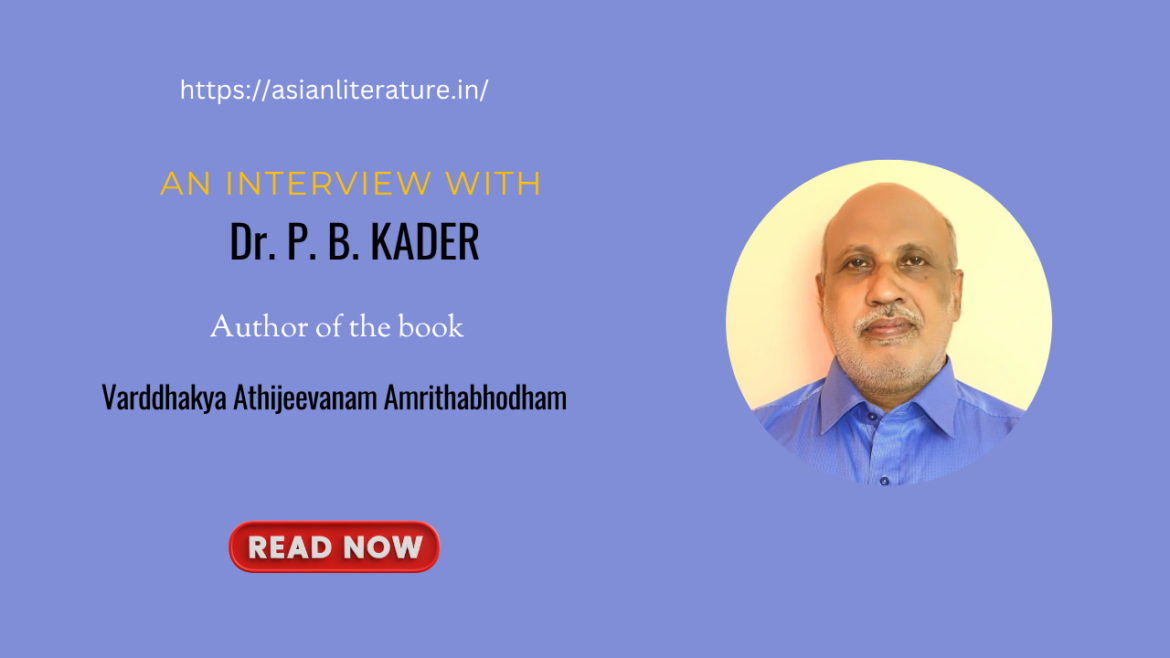
Title: Varddhakya Athijeevanam Amrithabhodham
Author: Dr. P. B. KADER
ISBN: 978-93-4726-329-3
Publisher: Inksight Publishers
Neel Preet: What inspired you to write Varddhakya Athijeevanam Amrithabhodham, and what gap did you hope to address through this book?
Dr. P. B. KADER: Modern medicine often treats ageing merely as a series of physical ailments to be managed pharmaceutically. I was inspired to write this book because I saw a profound gap in holistic literature that addresses the emotional, mental, and spiritual dimensions of growing old. I wanted to bridge this gap by offering a comprehensive guide that empowers senior citizens to view their later years not as a period of passive decline, but as a celebratory phase of life filled with purpose, wisdom, and vitality.
Neel Preet: The book presents ageing as a journey of awareness and self-development rather than decline. What motivated this perspective?
Dr. P. B. KADER: My motivation stems from witnessing how societal narratives negatively condition people to fear old age. Ageing is an inevitable biological process, but suffering through it is optional. If we shift our focus from what the body loses to what the consciousness gains, old age becomes the ultimate stage for self-development. I wanted to reframe this journey as a transition into Amrithabhodham—a state of nectar-like higher awareness where a person reclaims their inner peace and mental strength.
Neel Preet: You emphasize the harmony of the body, mind, and life force as the foundation of health. How can readers cultivate this balance in their daily lives?
Dr. P. B. KADER: True health is an equilateral triangle of the physical body, the vital life force (Prana) and the psychological mind, and Readers can cultivate this balance daily through three simple practices:
- Body: Nutritious, easily digestible food and moderate physical movement.
- Life Force: Practicing conscious deep breathing (Pranayama) and spending quiet moments in nature to recharge their vital energy.
- Mind: Engaging in uplifting literature, creative hobbies, letting go of past regrets and correcting dehydration.
Neel Preet: In the book, you discuss the importance of self-awareness and spiritual growth. Why do you believe these are essential for successful ageing?
Dr. P. B. KADER: Physical strength naturally diminishes with time, but spiritual strength has no expiry date. Self-awareness allows elders to detach from their changing physical limitations and anchoring roles of the past. Spiritual growth provides an inner anchor, helping individuals face mortality without fear, overcome loneliness, and find deep contentment within their own being. It transforms the fear of the unknown into a peaceful acceptance of life’s natural flow.
Neel Preet: Your work explores the relationship between physical health and mental well-being. How closely do you think these two aspects are connected?
Dr. P. B. KADER: They are inextricably linked; the body is merely the physical manifestation of the mind. Chronic anxiety, unresolved anger, fear and loneliness manifest directly as physical illnesses like hypertension, digestive disorders, and weakened immunity. Conversely, a joyful, peaceful mind secretes healing hormones that accelerate physical recovery. You cannot treat the vessel (the body) while ignoring the liquid inside it (the mind).
Neel Preet: The concept of the mind occupies a central place in your book. How do thoughts, emotions, and desires influence a person’s health and quality of life?
Dr. P. B. KADER: Our thoughts form the architectural blueprint of our daily reality. Persistent negative thoughts and unfulfilled, obsessive desires create internal stress, which drains our life force. When we learn to discipline our thoughts and cultivate desires that are selfless and spiritual, our emotional quality of life elevates instantly. By mastering our emotions, we protect our physical health from the toxic wear-and-tear of stress.
Neel Preet: What were the most challenging aspects of researching and writing a book that combines health, philosophy, and spirituality?
Dr. P. B. KADER: The greatest challenge was maintaining a fine balance between scientific medical accuracy, complementary medicine, homeopathy and profound spiritual philosophy, ensuring the language remained accessible to a layperson. Health is measurable, whereas spirituality is experiential. Blending clinical insights on ageing with ancient philosophical wisdom required deep reflection so that the book did not read like a rigid medical textbook or an abstract philosophical treatise, but rather as a practical roadmap for life.
Neel Preet: How can modern readers apply the wisdom presented in the book while living in a fast-paced and technology-driven world?
Dr. P. B. KADER: Technology should be a tool we use, not a master we serve. Modern readers can apply this wisdom by practicing intentional disconnection—setting aside “digital-free” hours daily to reconnect with themselves and their families. Even in a fast-paced world, one can pause for five minutes of mindful breathing, practice gratitude before meals, and consciously slow down their reactions to external chaos.
Neel Preet: What role do discipline, mindfulness, and positive thinking play in achieving a fulfilling and healthy life in old age?
Dr. P. B. KADER:
- Cleanliness, Discipline and Homeostasis are the framework that protects our daily routines, sleep patterns, and dietary habits.
- Mindfulness keeps us anchored in the present moment, saving us from the grief of the past and the anxiety of the future.
- Positive thinking acts as an emotional shield, converting every age-related challenge into an opportunity for graceful endurance. Together, they form the ultimate toolkit for active survival (Athijeevanam).
Neel Preet: If readers remember only one message from Varddhakya Athijeevanam Amrithabhodham, what would you like that message to be?
Dr. P. B. KADER: I want readers to remember that old age is not the sunset of life, but the golden hour of human consciousness. You are not a decaying body losing its utility; you are an evolving soul ripening into pure wisdom. Embrace your ageing process with dignity, master your mind, and live your later years as a celebration of awareness. Ultimately, a graceful old age is built on the foundation of preventive care that we must practice from childhood onward.