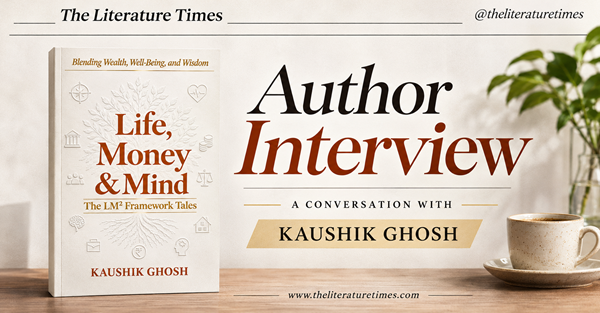
Kaushik Ghosh is a postgraduate engineer with over three decades of experience in consulting, training, business transformation, and management, having worked with leading global organisations. Certified in personal finance, wealth management, and retirement planning, as well as a trained life coach, he brings a multidisciplinary perspective to understanding the interplay of career, money, wellbeing, and human psychology.
His book, Life, Money & Mind: The LM² Framework Tales offers real-life-inspired stories, reflections, dilemmas and perspectives to help readers make more informed and meaningful life choices and holistic wealth. Its underlying philosophy is to view wealth as a blend of Wealth, Wellbeing, and Wisdom.
Interview Questions
1. What inspired you to develop the LM² Framework and bring life, money, and mind together in one book?
Kaushik Ghosh: The inspiration came from observing how closely our decisions around career, money, relationships, and personal wellbeing are interconnected. Over three decades of professional experience, I noticed that people often approach these aspects of life in isolation, overlooking how their beliefs, emotions, biases, and thought processes shape their choices.
I felt that financial success alone does not necessarily translate into a meaningful and fulfilling life. This led me to develop the LM² Framework, bringing together Life, Money, and Mind as interconnected dimensions of overall wealth and wellbeing.
Through real-life-inspired stories and reflections, the book explores these connections across different life stages—from young professionals and mid-career individuals to those approaching or experiencing retirement. My intention is not to prescribe a formula for living, but to encourage readers to pause, reflect, ask the right questions, and make more conscious choices.
Ultimately, the book embraces a broader understanding of wealth—Wealth, Wellbeing, and Wisdom.
2. How would you explain the idea of “360-degree wealth” to someone who primarily measures success through financial assets?
Kaushik Ghosh: I would explain 360-degree wealth as looking beyond what we own to what we experience and who we become. Financial assets are undoubtedly important because they provide security, independence, and choices. However, they represent only one dimension of wealth.
True wealth also encompasses physical and mental wellbeing, meaningful relationships, fulfilling work, personal growth, time freedom, and a sense of purpose. One may have substantial financial assets but lack good health, peace of mind, meaningful relationships, or the time to enjoy life.
Through the LM² Framework, I encourage readers to view wealth holistically- a 360-degree view—not just in terms of how much they accumulate, but also in how meaningfully they live and what they contribute to others.
A simple thought captures this philosophy: The real measure of wealth is not just what you have, but how well you live.
3. Why did you choose Wisdom San, a fictional 360° wealth coach, to guide readers through the book?
Kaushik Ghosh: I wanted readers to experience the LM² Framework through a relatable guide, not a conventional textbook-style narrative. That is how Wisdom San, a fictional, gender-agnostic 360° wealth coach, came into being.
Wisdom San represents a blend of experience, financial awareness, life perspectives, and practical wisdom – a coach all will love to have. He isn’t meant to have all the answers or prescribe solutions. Instead, he encourages the characters to reflect, question their assumptions, recognize their biases, and discover answers that make sense for their own circumstances.
I also wanted to make complex subjects around money, career, relationships, wellbeing, and life choices more engaging through conversations and stories. Wisdom San acts as a common thread connecting different characters and life stages, helping readers explore the idea that wealth is much more than financial accumulation.
In essence, the name Wisdom San, which reflects the spirit behind this book, is not meant to tell readers how to live, but to help them discover how to live more wisely.
4. Which common beliefs about money do you think most often prevent people from making conscious financial decisions?
Kaushik Ghosh: I believe one of the biggest obstacles to conscious financial decision-making is that people often act on beliefs, emotions, recent experiences, and assumptions rather than informed judgment. Some common beliefs include:
- More money means more happiness, ignoring other factors that matter too.
- A higher income automatically leads to wealth; people often fail to recognize that income and wealth are different.
- Investing requires deep knowledge and is only for experts or the wealthy.
- Retirement planning is only about creating a monetary corpus.
- Why waste money in addressing risks, thereby lacking a recovery plan and resilience when hit hard.
I feel the underlying issue is not always a lack of financial knowledge, but a lack of awareness of how our life situations and other spheres of wealth, e.g., emotional, health, occupational, cultural wealth, influence our decisions.
The first step toward financial wisdom is understanding our relationship with money, making changes if required, recognizing what influences our approach to life before deciding what to do with our money.
5. How can young professionals balance career ambitions, financial planning, and personal wellbeing from the beginning?
Kaushik Ghosh: I believe young professionals should view life as a multi-asset portfolio rather than focusing exclusively on career and financial wealth, with the weight of each asset shifting as they move through life stages. While building occupational and intellectual wealth and financial assets matters, they should invest equally in health, relationships, experiences, and self-development. The outcome is wisdom.
The key is to start early, keep a compass in life, build good financial habits, keep accumulating occupational wealth, plan for long-term goals, and aim for well-being, which may mean different things for different people. These different assets need attention at different stages of life, just as a financial portfolio requires balance and periodic reallocation.
The idea of Multi-Asset Life is to build wealth across multiple dimensions, so that while we earn a living, we also build a life worth living.
6. What changes in financial priorities should people consider as they move through midlife and approach retirement?
Kaushik Ghosh: As people move through midlife, the focus should gradually shift from creating wealth to consolidating, protecting, and purposefully using it. Responsibilities increase, but careers may stagnate in today’s employment environment. They need to realize that financial independence and financial stability are not the same. Priorities should include reducing financial liabilities, strengthening emergency and healthcare provisions, reviewing insurance, diversifying investments, and ensuring that retirement planning adequately accounts for inflation and longevity. The stage should not become a cage.
As retirement approaches, generating sustainable income and maintaining liquidity, managing risks, preserving purchasing power, and planning for a meaningful post-retirement life become increasingly important.
However, I believe the transition is not just financial; it is much more than that. It is also a transition of identity, engagement, and time-relationship. One needs to reassess the relationship between life, money, and mind periodically.
The larger message of the LM² Framework is that retirement should not be merely about having enough money to stop working, but about having the freedom, engagement, health, and wisdom to enjoy the next chapter of life.
7. How have your experiences in consulting, life coaching, and wealth management shaped the stories and lessons in this book?
Kaushik Ghosh: My three decades of consulting and management experience, particularly in the field of excellence, combined with my learning in personal finance, wealth management, retirement planning, and life coaching, have shaped the book in several ways:
- My consulting experience helped me understand organizational dynamics, career challenges, the diverse thought processes within an organization, the need for a career compass and an occupational wealth plan, and how people make decisions.
- Life coaching reinforced the importance of self-awareness, beliefs, behavioural patterns, varied life situations, and, most importantly, asking the right questions.
- Financial learning and wealth management provided perspectives on financial planning, the beliefs behind investment, risk & resilience, and relying on a person-specific long-term wealth plan.
I have brought these perspectives together through relatable, real-life-inspired characters and situations, making the lessons practical rather than theoretical.
Ultimately, the book reflects my belief that better decisions emerge when we understand not just our money, but also our lives and our minds.
8. What role do technology and behavioural finance play in the way we make everyday life and money decisions?
Kaushik Ghosh: Technology and behavioural finance influence our everyday decisions more than we often realize.
Technology has made financial information, investment platforms, digital payments, and AI-powered tools easily accessible, helping us make faster, more informed decisions. However, easy access to information does not necessarily translate into better decisions. At times, it becomes a problem of plenty; other times, it pushes us to decide quickly when deep thinking is required.
Behavioural finance helps us understand how emotions, beliefs, biases – developed over time, fear, greed, and herd mentality influence our financial choices. The same behavioural patterns also affect our career, relationships, and other life decisions.
I believe the real opportunity lies in combining technology with self-awareness and sound judgement.
Technology can provide the tools and information, but our wisdom determine how effectively we use them.
9. Why do you prefer helping readers ask better questions rather than offering one-size-fits-all financial answers?
Kaushik Ghosh: I believe no universal formula exists for managing money or living a meaningful life. Every individual has different goals, circumstances, priorities, and risk appetites. What works for one person may not work for another.
Rather than prescribing solutions, I prefer encouraging readers to question their assumptions, understand their priorities and relationships, including with money, work on changes wherever required, and make informed choices.
Knowledge leads to the right questions, which in turn lead to better understanding, and better understanding leads to wiser decisions.
10. What is the one idea you hope readers carry into their lives after finishing Life, Money & Mind?
Kaushik Ghosh: I encourage the readers to view the LM² Framework as a compass for navigating life, not a formula to follow. Embrace the idea of a Multi-Asset Life by investing not just in financial assets but also consciously in other assets – health, emotional, occupational, intellectual, and cultural- thereby building a well-rounded portfolio with at least a minimum threshold in each area.
I hope that each reader discovers their own path to Wealth, Wellbeing, and Wisdom.





Your perspective matters
Share your thoughts respectfully. Comments are moderated.