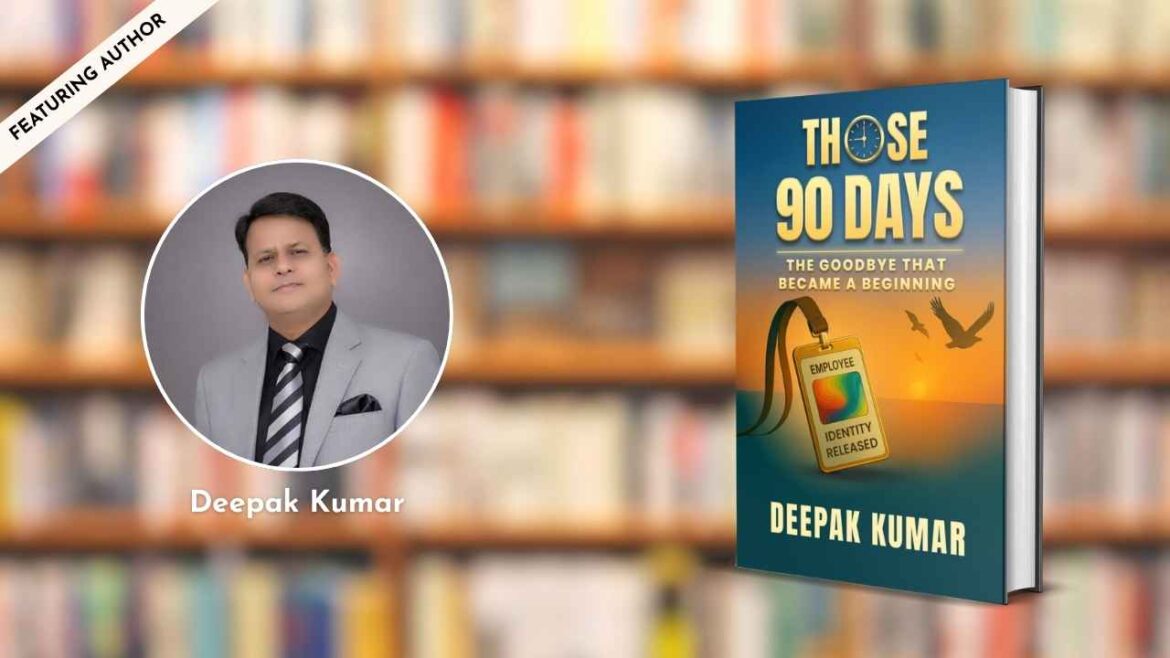
The Literature Times: Author, welcome to The Literature Times. Congratulations on the publication of your book! What feedback do you get from your readers? Please share your thoughts on this book.
Author: Thank you, Team. It’s an honour to be featured here. ‘Those 90 Days’ marks my debut as an author, and it explores a side of corporate life that is rarely spoken about—the final stretch of a notice period.
For decades, we’ve all read books like Michael D. Watkins’ The First 90 Days, which beautifully explain how to enter an organization with clarity, impact, and a 30-60-90-day charter for success. But very few talk about the opposite end of this journey—the last 90 days. The phase when you’re made to feel dispensable. When you’re quietly removed from the very initiatives you once built. When routines that shaped your identity suddenly feel unfamiliar or distant. When your soul begins to detach from what once defined your day.
The early feedback has been deeply humbling. Here are the three themes that stand out:
- Relatability: Almost every reader felt the story mirrors a lived experience. More than 95% of professionals have seen or felt shades of this journey—directly or through someone close.
- Emotional truth: Many early reviewers connected instantly with the turmoil of sudden, unfair, or forced exits—the uncertainty, the silence, and the internal battles that follow.
- A refreshing surprise: Nearly all readers expected a story of corporate revenge. Instead, they found a narrative of constructive revenge—a journey of using those 90 days to create your most meaningful body of work, to leave behind a legacy, and to walk out with more dignity than you walked in with.
For me, ‘Those 90 Days’ is more than a memoir. It is a testimony that even in the hardest phases of a career, one can rise, rebuild, and redefine their story.
The Literature Times: What motivates you to become a writer?
Author: I come from a technology presales and consulting background, where storytelling isn’t a soft skill — it’s the backbone of impact. Presales is never about “selling” technology; it’s about helping customers arrive at the decision to buy. And the most powerful way to communicate complex ideas has always been through stories.
As a presales leader, I’ve spent years mastering the craft of translating complex technology concepts into simple, human, industry-specific narratives that resonate with people. Writing, in many ways, is just an extension of that craft.
But becoming a writer wasn’t planned — at least not now. It was an aspiration for a much later stage in life. And then life took its own turn. As the saying goes, “Man proposes, God disposes.”
A sudden and unexpected exit from my corporate role shook me to the core. It challenged my comfort zone, my sense of identity, and even my understanding of fairness. In that moment, I had two choices — to become hostile and bitter, or to choose the harder, quieter, more dignified path. I chose the latter: to continue creating value, to exit with grace, and to leave behind a legacy that would outlast my presence.
When I shared this experience with close friends and family, they were stunned by how universally relatable it was. Many said, “This is every second corporate employee’s story — but no one talks about it.” That pushed me to research further, and I discovered something surprising — while countless books explain how to join an organization with impact, almost nothing has been written about navigating the last 90 days of a career chapter.
That’s when I knew this story needed to be told.
And that’s how Those 90 Days was born.
The Literature Times: What are your favourite writing topics? Please tell us a little bit about your literary interests.
Author: I’m drawn to stories across genres as long as they carry purpose. If a narrative challenges a prevailing social belief in a constructive way, inspires introspection, or leaves readers with a tangible takeaway they can apply in their own lives, then it becomes my writing sweet spot.
I firmly believe that a story is worth telling only when it doesn’t just entertain, but also empowers. I gravitate toward writing that offers a framework, a lesson, or a perspective that can help someone navigate their own journey a little better.
As for my literary interests, narrative non-fiction is my absolute favourite category. I love real stories lived by real people — especially the ones where grit, resilience, and character change the course of someone’s life. The insights, frameworks, and guiding principles born out of someone’s lived experience are pure gold to me. Those are the stories that stay, teach, and transform.
The Literature Times: We were hoping you might tell us about some of the authors that have influenced you and who you read!
Author: My journey into writing wasn’t driven by a traditional literary path — it grew naturally out of my work in technology, storytelling, and human behaviour. Writing has always been a passion I turn to for reflection, clarity, and creating meaning. And while I read selectively, the authors I do follow have had a profound influence on how I think and how I write.
I gravitate toward storytellers and thinkers who transform real-life experiences into practical wisdom. Authors like Michael D. Watkins (The First 90 Days) and James Clear (Atomic Habits) have inspired me through their ability to simplify complex ideas into powerful, actionable frameworks.
I’m also deeply moved by writers who explore resilience and emotional truth, such as Viktor Frankl (Man’s Search for Meaning) and Robin Sharma, whose work blends introspection with everyday leadership.
Some contemporary books that have stayed with me include
- Rejection Proof by Jia Jiang
- When by Daniel H. Pink
- The Courage to Be Disliked by Ichiro Kishimi & Fumitake Koga
Each of these offers a unique lens on human behaviour, courage, timing, and personal transformation — themes that resonate strongly with my own journey.
What inspires me most are authors who don’t just tell stories, but create meaning through them — the kind of writing that leaves readers with clarity, courage, and a framework to navigate their own lives. That’s the spirit I try to bring into Those 90 Days as well.
The Literature Times: The title is unique and appealing; how did you come up with them? Please tell us the story behind it.
Author: Thank you — titles, to me, are the emotional doorway into a book. They should be simple, honest, and rooted in the truth of the story. Those 90 Days felt like the only title that captured both the reality and the transformation within these pages.
Those three months were not just a notice period — they were a turning point. A phase that challenged me, reshaped me, and ultimately set the foundation for everything that followed. What started as a corporate goodbye quietly evolved into a powerful new beginning, which is why the book carries the essence of “the goodbye that became a beginning.”
I wanted a title that spoke directly yet carried depth.
One that corporate professionals could instantly relate to, and one that readers could feel.
And in the end, life itself offered the perfect name: Those 90 Days.
The Literature Times: What are your achievements so far? Tell us something about your writing career.
Author: ‘Those 90 Days’ is my debut book, but storytelling has been a core part of my professional identity for over two decades. In my career as a technology presales and consulting leader, I’ve built a reputation for simplifying complex ideas, crafting compelling narratives, and helping organizations make clear, confident decisions. In many ways, my writing career didn’t begin with a pen — it began in boardrooms, client presentations, and strategy sessions long before I ever thought of publishing a book.
As for achievements, the response to ‘Those 90 Days’ has been incredibly humbling. The manuscript has already been appreciated by industry leaders, technology professionals, and early reviewers who resonated deeply with its honesty and relatability. Many have called it “a first-of-its-kind exploration of the last 90 days,” and that acknowledgment means a lot to me as a debut author.
My biggest achievement, however, is turning a difficult personal chapter into a narrative that can support, guide, and uplift others going through similar transitions. If the book helps even a handful of people navigate their toughest corporate moments with dignity and clarity, I would consider that the most meaningful milestone of my writing journey.
In that sense, my writing career is just beginning — but it’s rooted in years of lived experiences, human observations, and the desire to create work that leaves a lasting impact.
The Literature Times: What is your current goal in writing a career? How do you see your future in writing?
Author: Writing, for me, is a passion — not a profession that I’m trying to convert into a full-time career. I don’t chase goals when it comes to passion; I let stories find me. Whenever I come across an idea that feels deeply human, meaningful, or waiting to be told, the instinct to write flows naturally.
That said, I do want to nurture this side of me with sincerity. I’ve made a personal promise to write at least one book a year for the next few years — across genres, themes, and geographies. If a story carries purpose, emotional truth, or the power to impact someone’s journey, I want to give it a voice.
So, while I may never call myself a “career writer,” I do see a future where writing continues to be a quiet but constant part of my life — something that grows with me, surprises me, and hopefully touches people along the way.
The Literature Times: Do you have any other novels in the works? Please keep us updated on your future endeavours.
Author: I’m fully immersed in the journey of ‘Those 90 Days’ right now, but yes — a new story has quietly begun taking shape. It’s an emotionally powerful narrative inspired by real-life resilience, transformation, and the kind of human courage that stays with you long after the last page.
It’s still in an early conceptual stage, but I can say this much:
it explores what happens when someone rebuilds themselves from a place of deep pain and turns their healing into purpose.
Once it matures into a manuscript, I’ll be happy to share more details. For now, I’m letting the story breathe and reveal itself at its own pace. And yes — I’ll definitely keep The Literature Times updated on my future writing endeavours.
The Literature Times: How do you view Indian writing in the twenty-first century? What changes do you see in today’s writing style? Do you feel it has been changed by the time?
Author: Indian writing in the twenty-first century has become far more inclusive, bold, and honest. Today’s readers look for authenticity over ornamentation, and writers are responding with narratives that are sharper, more personal, and rooted in lived experiences.
The biggest change I see is the shift from grand, idealized storytelling to real, human, everyday truths. Whether it’s fiction or non-fiction, modern writing is more conversational, more accessible, and more reflective of contemporary life.
Yes, it has changed with time — and for the better. Indian writing today reflects the diversity, complexity, and ambition of a new generation that values clarity, emotional intelligence, and purpose-driven narratives.
The Literature Times: How simple/difficult was it for you to publish your book? What message do you want to send to aspiring authors?
Author: Publishing a book is always a partnership. A publisher becomes the conduit through which an author’s story reaches the world. Early collaboration, logistical clarity, and constructive feedback are the real ingredients behind a smooth publishing journey.
In my case, things became simpler the moment I chose to step away from traditional publishing and embrace a self-sponsored model. And that’s when Astitva Prakashan entered the picture. They are a team of genuinely passionate professionals who handhold the author from day one and stay involved even after the launch. Their guidance made the entire process structured, supportive, and far less intimidating.
Not every author finds an instant entry into traditional publishing — and that’s perfectly okay. Self-sponsored publishing is a powerful route that ensures your story doesn’t wait for external validation to be told.
My message to aspiring authors is simple:
Use technology, including AI, as a companion in your creative journey — but don’t let it dictate your voice.
Your story must come from your lived truth. Everything else is just a tool.