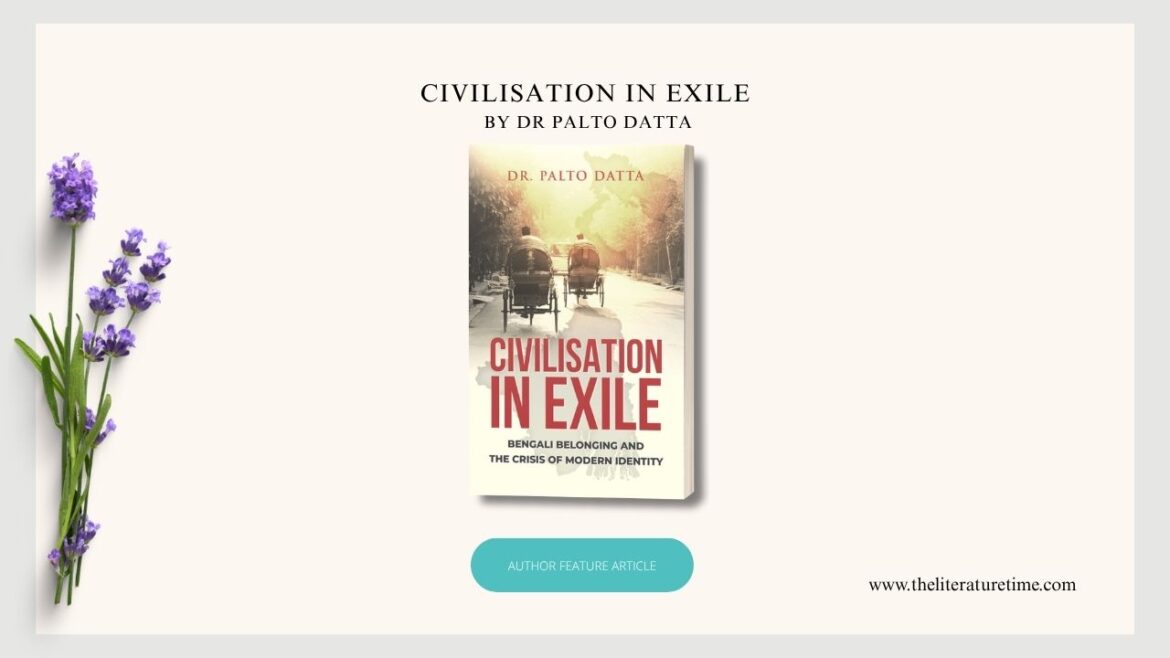
In a time when identities are constantly being reshaped by global forces, migration, and the relentless pace of modern life, the question of belonging has become more complex than ever before. Dr Palto Datta, an accomplished academic, author, and thinker, enters this nuanced conversation with his compelling work Civilisation In Exile: Bengali Belonging And The Crisis of Modern Identity. Through this deeply reflective and intellectually engaging book, he examines not only the lived experiences of the Bengali diaspora but also the broader philosophical tensions that define modern identity in an interconnected yet fragmented world.
Dr Datta’s academic journey is as expansive as the themes he explores in his writing. With nearly three decades of teaching experience in the United Kingdom’s further and higher education sectors, he brings a rare combination of scholarly depth and practical insight to his work. Holding a PhD in Marketing from the University of Hertfordshire, an MSc from the University of Glamorgan, and a BSc in Plasma Physics from the Peoples’ Friendship University of Russia, his interdisciplinary background allows him to approach cultural and social questions with analytical precision and intellectual versatility. His academic pursuits have been further enriched through executive education at globally recognized institutions such as the University of Edinburgh, the University of Pennsylvania, and Samford University. As a Fellow of the Royal Society of Arts, Advance HE, and the Chartered Institute of Marketing, Dr Datta stands at the intersection of academia, research, and thought leadership.
Yet, beyond his academic credentials lies a writer deeply attuned to the emotional and cultural undercurrents of modern life. Civilisation In Exile is not merely an academic text; it is a layered exploration of identity, memory, and belonging, shaped by lived experience, historical awareness, and philosophical inquiry. At its core, the book seeks to answer a deceptively simple question: what does it mean to belong in a world where physical location no longer guarantees cultural rootedness? For Bengalis living outside their homeland, particularly in places like Britain, this question takes on profound significance. While migration often brings opportunities, mobility, and material success, it also introduces a sense of dislocation that is not easily resolved.
Drawing from personal observations, historical narratives, and philosophical reflections, Dr Datta paints a vivid picture of the Bengali diaspora’s evolving consciousness. The streets of East London, with their vibrant cultural mix, become a symbolic backdrop for this exploration. Here, tradition and modernity coexist, sometimes harmoniously and at other times in tension. The legacy of iconic literary figures such as Rabindranath Tagore and Michael Madhusudan Dutt is invoked not merely as a historical reference but as a reminder of a rich intellectual and cultural heritage that continues to shape Bengali identity. Through these references, the book bridges past and present, highlighting how cultural memory plays a crucial role in sustaining a sense of self in unfamiliar environments.
One of the most compelling arguments presented in Civilisation In Exile is the idea that exile in the modern world extends beyond geography. Dr Datta suggests that exile has become increasingly psychological and civilisational, manifesting as a subtle yet persistent disconnect between one’s cultural roots and present reality. This form of exile is not always visible, nor is it easily articulated. It resides in the quiet moments of reflection, in the struggle to reconcile inherited values with contemporary demands, and in the gradual erosion of cultural practices under the pressures of globalisation. By framing exile in this way, Dr Datta shifts the conversation from external displacement to internal conflict, offering readers a more nuanced understanding of identity in the modern age.
The book also delves into the impact of the global marketplace on cultural identity. In an era dominated by consumerism and rapid technological change, traditional values often find themselves overshadowed by the demands of efficiency and profitability. Dr Datta critically examines how this shift influences not only individual choices but also collective cultural expressions. The tension between preserving heritage and adapting to new realities becomes a recurring theme, one that resonates with readers across different cultural backgrounds. While the focus remains on the Bengali experience, the insights offered are universally relevant, making the book accessible to a broader audience.
What sets Dr Datta apart as a writer is his ability to blend intellectual rigor with emotional depth. His narrative style is reflective yet grounded, allowing complex ideas to unfold organically without losing clarity. The inclusion of personal accounts adds a human dimension to the discourse, transforming abstract concepts into relatable experiences. This balance between theory and lived reality ensures that the book remains engaging while maintaining its scholarly integrity.
Beyond his work as an author, Dr Datta continues to contribute actively to academia and public discourse. As a Senior Lecturer and Scholarship Lead at Regent College London, he plays a pivotal role in shaping the academic journeys of his students. His involvement in international conferences and his extensive travels to over 75 countries have further broadened his perspective, enabling him to approach global issues with a nuanced understanding. This global outlook is evident throughout his writing, where local experiences are situated within a wider international context.
Civilisation In Exile stands as a testament to Dr Datta’s commitment to exploring the deeper questions of human existence. It challenges readers to look beyond surface-level definitions of identity and to engage with the complexities that lie beneath. In doing so, it opens up a space for introspection and dialogue, encouraging individuals to reconsider their relationship with culture, memory, and belonging.
In a world that often prioritizes speed over reflection, Dr Datta’s work serves as a reminder of the importance of pausing to examine who we are and where we come from. His exploration of exile, not as a condition imposed from outside but as an experience shaped from within, offers a fresh perspective on modern identity. Through Civilisation In Exile, he not only documents the journey of the Bengali diaspora but also invites readers from all walks of life to reflect on their own sense of belonging in an ever-changing world.