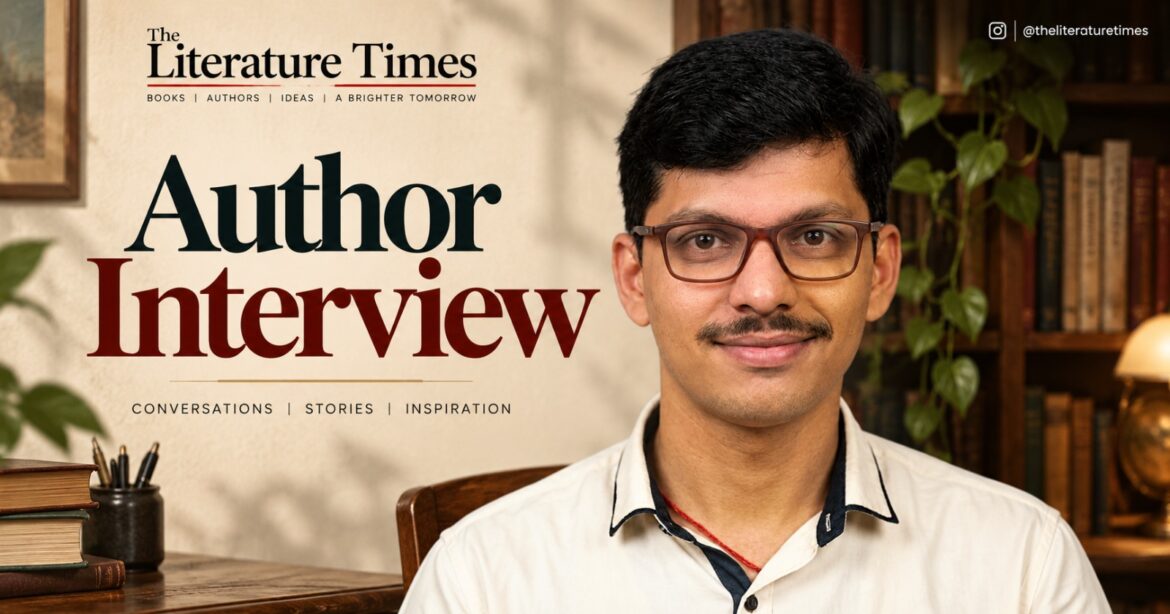
Amittej is an aspiring author and creator whose interests include education, careers, technology, publishing and the many ways people contribute to society. His writing explores ideas intended to encourage readers to learn, question and reconsider familiar subjects from new perspectives. In Who Is Perfect? No One Is Perfect., he turns to the world of professions, particularly the questions that arise for students and young people as they begin thinking about their futures. His approach focuses on the skills, responsibilities, challenges and rewards associated with different kinds of work, without placing one profession above another. At the centre of his perspective is the belief that everyone has strengths and limitations, and that meaningful contribution does not require perfection.
The Literature Times: What first inspired you to create an A–Z guide to professions, and was there a particular experience that made you feel young readers needed a resource of this kind?
Amittej: Actually, this is not my first novel. It’s my second published novel. My first book was for small kids and its genre was about superhero. And coming to your question, this idea was in my mind from long time ago but I couldn’t decide what to write. But very honestly, I am saying, I follow ‘Dhruv Rathee’. He promotes his courses in his video you see. So in one of his video he had mentioned something like’100 career guide’ and I lifted it and chose to write the book on A-Z career guide.
The Literature Times: The question “What do you want to become when you grow up?” can sometimes feel like pressure to decide early. What would you like students to understand about uncertainty and the process of choosing a career?
Amittej: Haha. I am interested in writing, sometimes I feel like to be a businessman or entrepreneur and now I want to be an engineer even if that is not my background. My background is in BA that’s why I chose to be a writer. Yah, I go through some tough times and can’t write much books which I wish but yeah, will try.
And stress and pressure you have in your life whatever you choose to do. It happens to me also.
That is upto them. I can’t tell them anything but yeah, don’t just look at the money. Look at the challenges that career has.
The Literature Times: You have chosen to examine professions through several perspectives, including a day in the life, skills, education, challenges and rewards. How did you decide on this structure, and what did you want readers to gain from it?
Amittej: I wanted people to show their life. I mean other people’s life. No one is perfect. Even if I feel I should have become a doctor. It was the only dream I had since childhood but I couldn’t. So I decided to become a writer as I used to write short scripts when I was 13 or 14 in Hindi. Then I started searching how to write TV or film scripts propertly in format on YouTube and I had taken admission in IGNOU in Camp, Pune for Diploma in Creative writing in English (DCE) but unfortunately we got a lockdown in 2020 and I lost my focus in that. In that period of time, I understood that writers take same efforts as others.
The Literature Times: The book deliberately avoids presenting one profession as superior to another. How can parents, teachers and students move beyond assumptions about prestige and salary when discussing career choices?
Amittej: I think every father/mother and son/daughter have different choices but in India, parents force children to take the same field they had taken. I think parents should support their children with their dreams such as barber, chef, painter,etc. a cheap labour. Because without them we can do nothing. So we should change our mindset and look at each profession with same sight/glance whether it gives low income or high amount of salary but it should give you happiness. For example, doctor can’t sleep when someone is at emergency. They have a lot of money but are they really happy? We should think
on this.
The Literature Times: The title states that no one is perfect. How does this idea connect with the realities of professional life, and why was it important for you to include the human side of every profession?
Amittej: How does this idea connect with the realities of professional life? We see that every person makes mistake in their work, in their lives at least once. No person in this world can do work without
doing mistake.
An actor needs to take multiple ‘takes’ for a single scene or shot. A director has to take a perfect angle while directing. A one wrong angle can ruin an entire movie. A wrong action or dialogue by an actor can ruin a film. Lakhs and millions of rupees can be wasted.
I want to show people that no one is perfect in this world of profession, again.
The Literature Times: While preparing the book, how did you approach the challenge of presenting a wide range of professions in a way that would be informative and accessible to young readers?
Amittej: I used research tools like Google and AI chatbot like ChatGPT. I first searched it on google but satisfactory results were difficult to find so I used ChatGPT.
The Literature Times: Is there a particular lesson or quality that you hope readers will carry with them after exploring the professions from A to Z? How might that lesson influence the way they view their own abilities and future?
Amittej: Of course. The readers who are interested in it will do so. Introduction to the profession shows that what is this profession about. The Day in Their Life tells you how and what that person does in his/her life related to their profession. The main thing I personally like this point. Without presenting skills and education, you cannot imagine a successful professional in any field and in any background. You need to have some kind of knowledge and skills and education in that field. Challenges also show you that every profession has its own challenges and not readymade success. Rewards. Every profession has its rewards just like challenges. Similarities with Other profession, by reading this point, you can be excited to read whether your profession fits in this similarity or not. This also attracts people. The uniqueness of the profession. For your question, the answer is simple. Read the “Skills and Education”, “ Challenges “ and “Similarities with Other Profession”. These points will show you your destination.
The Literature Times: Having explored professions and the people behind them in this book, what subjects or projects would you like to take up next, and how do you see your writing evolving?
Amittej: After this, I am thinking of writing a next part. Part 2 with the same title but in much interesting way for children, for kids.