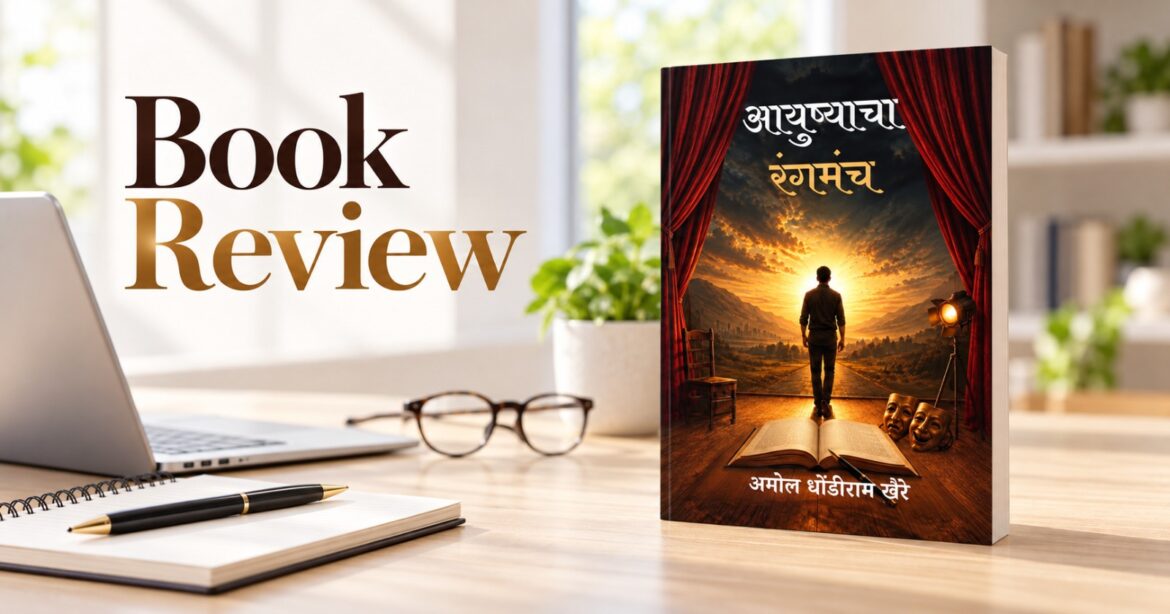
Ayushyacha Rangmanch by Amol Dhondiram Khaire: Vichar, Naati, Maanuski Aani Swatachya Shodhacha Pravaas
Ayushyacha Rangmanch is built on a quiet but enduring conviction: life ends, but the experiences that shape a person do not disappear. Memories remain after people leave; feelings and thoughts continue beyond the moment in which they are spoken. Amol Dhondiram Khaire develops this conviction into a collection of reflections on relationships, emotions, mistakes, loss, self-understanding, and the small incidents through which life steadily reveals its meaning. The book does not promise a perfect life or a simplified remedy for difficult feelings. Its strength lies in its invitation to pause, look inward, and recognise that even an ordinary experience can contain a direction for living.
The title, which evokes the stage of life, is fitting for a work concerned with the many roles, encounters, and changes that people pass through. Khaire considers life not as a single, fixed story but as a continuing sequence of scenes shaped by joy, pain, uncertainty, memory, and realisation. That perspective gives the book a humane openness. A relationship may be sustaining or difficult; a mistake may wound but also teach; a lonely moment may carry a question that deserves attention. Rather than turning such experiences into abstract lessons, the book presents them as part of the shared emotional fabric of human life.
At the centre of Ayushyacha Rangmanch is a concern for relationships. In busy routines, relationships can become habitual, neglected, or misunderstood. Khaire’s reflections return readers to the importance of valuing the people around them, listening with care, and recognising the effect of unspoken expectations, ego, and hurt. The book’s approach is not accusatory. It understands that people are imperfect and that relationships often require patience, forgiveness, and a willingness to see another person with greater sensitivity. This makes the work relevant to readers at different stages of life, because its concerns are not confined to one age group or one social setting.
The book is equally attentive to the relationship a person has with oneself. Modern life often rewards speed, visibility, and constant movement, while leaving little room for reflection. Khaire gently resists that pressure. His writing encourages readers not to lose themselves in the crowd of life, but to notice their own emotions and learn from their responses. Accepting mistakes, forgiving oneself, and developing an honest understanding of one’s choices are presented as necessary forms of growth. This is an important distinction: the book does not treat self-improvement as performance. It treats it as a patient process of becoming more aware, compassionate, and responsible.
Khaire’s background as a Marathi writer, poet, and theatre artist gives this subject a distinctive creative context. Theatre requires attention to character, mood, gesture, conflict, and what remains unsaid. Poetry demands a similar sensitivity to emotional nuance and symbolic expression. Those qualities are reflected in the book’s stated interest in human complexity and lived experience. The writing is designed to bring simple ideas into meaningful focus, allowing readers to connect the themes on the page with memories and dilemmas from their own lives. Nature and symbolic imagery, which are central to Khaire’s broader literary sensibility, add another way of approaching feelings that are often difficult to explain directly.
The relevance of these reflections is particularly strong in a time marked by social change and emotional overload. Questions of family values, loneliness, ageing, women’s freedom, misunderstanding, changing expectations, and the search for inner peace are not distant concerns; they are present in everyday conversations and silences. Ayushyacha Rangmanch does not claim to solve them through easy certainty. Instead, it creates space for readers to consider how these issues shape their own relationships and choices. That restraint helps the book feel credible. Its purpose is not to instruct from above, but to accompany readers as they reflect on the lives they are already living.
Another strength is the book’s faith in the possibility of goodness. The idea of becoming a small ray of light in someone else’s life may sound modest, but it carries moral weight. Khaire locates change not only in large decisions, but in everyday gestures of understanding, forgiveness, care, and presence. Such gestures may not remove pain, yet they can transform the way people meet it. This ethical thread gives the book a generous tone. It asks readers to acknowledge the reality of struggle while remaining open to empathy and to the possibility that a more sensitive response can alter the texture of a difficult moment.
For readers, the value of Ayushyacha Rangmanch lies in its accessibility as much as in its emotional depth. It is likely to appeal to those who appreciate reflective prose, personal observation, and writing rooted in human experience. Young adults navigating identity and relationships may find its questions familiar; mature readers may recognise the accumulated insight of memory, change, and reconciliation. It will also speak to readers of Marathi literature who value writing that engages social life without losing sight of the individual heart. The book’s themes make it suitable for anyone seeking a thoughtful, unhurried encounter with life’s emotional and ethical dimensions.
Ultimately, Ayushyacha Rangmanch offers a reminder that life becomes meaningful not because every scene is ideal, but because every experience can enlarge understanding. Amol Dhondiram Khaire writes from a sensibility attentive to the many shades of human life: the tender, the painful, the confusing, and the hopeful. His reflections encourage readers to slow down, understand themselves and others more deeply, and carry forward the lessons that experience leaves behind. In doing so, the book offers a credible and compassionate meditation on how to live with greater awareness, humanity, and inner balance.
Rating: 4.5/5