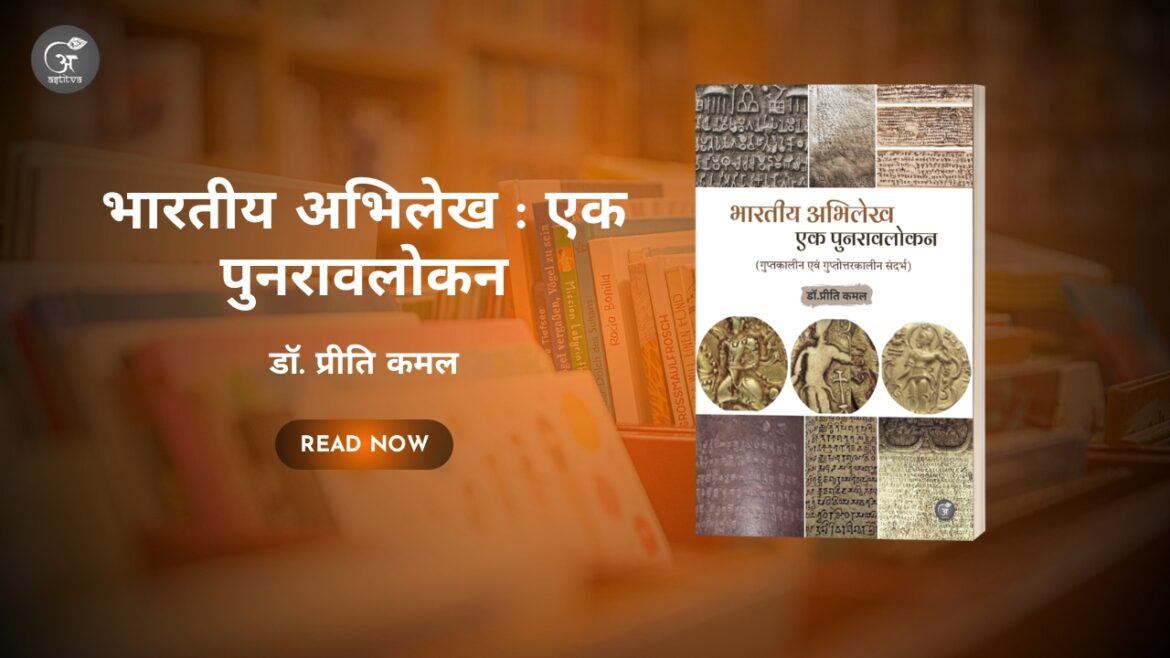
Dr. Preeti Kamal’s newly released book, Bhartiya Abhilekh: Ek Punaravalokan (Guptkalin evam Guptottarkalin Sandarbh), offers a compelling re-examination of ancient Indian inscriptions, particularly those from the Gupta and post-Gupta periods. Rooted in the belief that history must be an unbiased dialogue with time, the book insists that only by engaging directly with primary sources—literary and archaeological—can we arrive at a truthful narrative of the past. Through a meticulous study of inscriptional records, Kamal traces the socio-political and religious landscape of early medieval India, illuminating the intricate shifts that shaped the era.
Focusing primarily on North India, this work highlights how the decline of the Kushan Empire gave way to the powerful Gupta dynasty, whose governance was marked by a growing tradition of land grants to religious institutions. These charters, carefully analyzed and translated in the book, reveal not only the administrative and economic mechanisms of the time but also how state authority gradually gave way to autonomous religious beneficiaries. From land, pastures, and water bodies to judicial rights, these grants marked a significant shift in societal organization and resource ownership.
Dr. Kamal, an esteemed Assistant Professor of Sanskrit at Vinoba Bhave University, brings to this book her vast academic expertise and deep understanding of Sanskrit texts. Holding a doctorate from Allahabad University, she has long been a voice for integrating ancient wisdom with contemporary social discourse. Known for her scholarly work on gender issues and socio-legal structures in ancient Indian literature, Kamal continues to bridge traditional knowledge systems with present-day challenges.
In Bhartiya Abhilekh, she not only presents a detailed analysis of historical transitions but also provides translations and references that make primary sources accessible to scholars and history enthusiasts alike. This book stands as a valuable contribution to Indian historiography, offering nuanced insights into a transformative era and reaffirming the critical role of inscriptions in reconstructing the past.