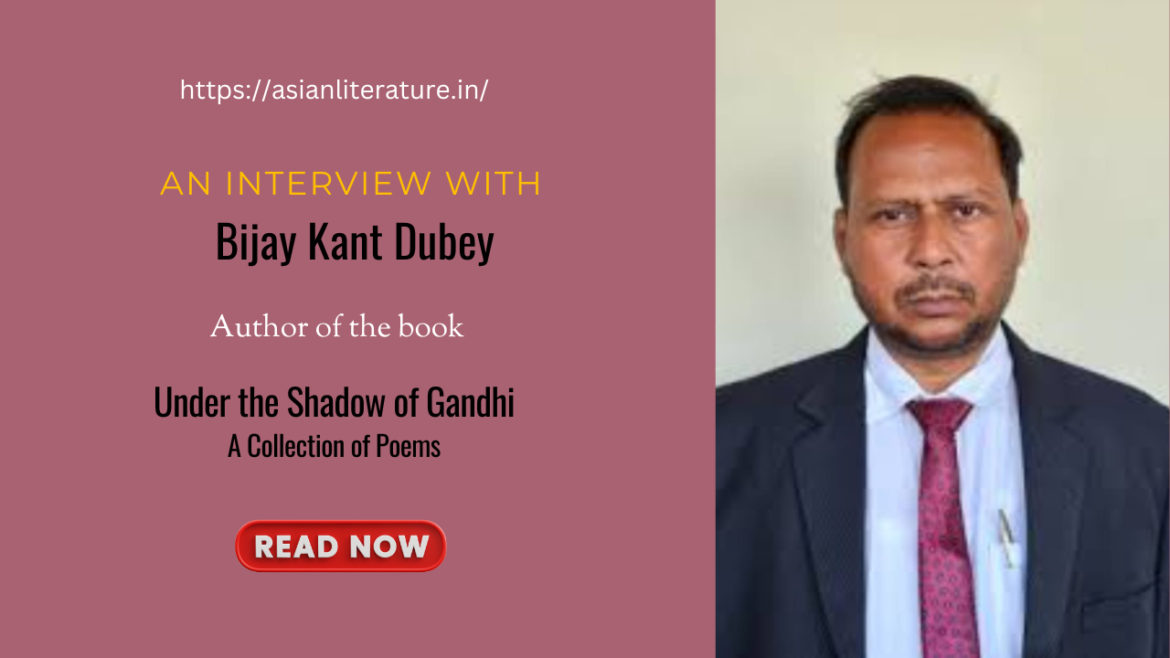
Title: Under the Shadow of Gandhi-A Collection of Poems
Author: Bijay Kant Dubey
ISBN: 978-93-7900-495-6
Publisher: Inksight Publishers
About The Author
Bijay Kant Dubey (11.10.1965) has been publishing poetry since 1988 when he brought it out The Ferryman (Songs of Soul). Most of the works he has authored remain unpublished and unattended to as these could not the light of day in time. Apart from, his poems have appeared digitally through the online mode and have been appreciated world-wide.
About The Book
Under The Shadow of Gandhi (A Collection of Poems) is one of the best collections commemorating Gandhi and Gandhian principles, the man he was, the saint, the leader and the idealist. It is an offering of flower petals in his homage, a tribute to the great soul in the form of song offerings. An apostle, a votary of Satya, ahimsa, shanthi, he was indefatigable in striving to get it materialized through this prism of vision. Gandhi is now an image, a photograph, a symbol and a motif; Gandhi in Gandhian studies and Gandhism. Gandhi is in khaddardharis and also not. And Gandhi is a man, what sort of was he, a brahmachari or not? We know it not. Was there no leader him? If was a saint, can a man be? How his qualities, these the things of post-truth evaluation! But leaving it aside, question you it not. Gandhi is Gandhi, Mohandas Karamchand Gandhi and I walking past under the cover, the lurking shadow and image of Gandhi on the eve of Gandhi Jayanti and the old man smiling peculiarly, sending joys to me as I have not it naturally.
Bapu, Bapu we call him with joys as we cannot without, he is in our mind and heart, he is our guiding spirit. Where is he not? His presence is everywhere. He is there in our currency notes. I meet him at the town square whenever trying to walk it past hurriedly, casting a cursory glance upon and he seemingly bidding bye and the life-statue so lively appearing that it reminding us of his ever-felt presence heard through, Gandhiji ki jay, Gandhiji ki jay, amar rahe, amar rahe, doing the rounds and the sounds keep striking for till it fades into in the din and bustle and strides of busy life scheduled with daily routines.
Neel Preet: What inspired you to write Under the Shadow of Gandhi, and what does Gandhi personally represent to you?
Bijay Kant Dubey: Actually, I had an intention of doing a long poem on Gandhi, but got deviated and digressed from the topic as for glossy delving, fickle visionary glance, could not remain glued to. But I used to hear about Gandhi in my household. The replica representative of the three monkeys used to attract and repel us. If I relate to my love for Gandhism, it will not end. It will be a never-ending story, Gandhi, why do I love? Gandhi, why do I dislike, love him not? Gandhi on my mind and heart and I walking past the statue, I want to hold parleys with to put up as my dialogues with him, but he standing non-responsive. Gandhi is Gandhi, I I, I cannot be Gandhi, but the spark is the same which you realise it not, realise I not, the same streak of genius in you, in me too. Say with love, Gandhiji ki jay!
Neel Preet: Your poems repeatedly return to Gandhi’s presence in everyday Indian life—from statues and currency notes to schools and public squares. Why was this imagery important for your poetic vision?
Bijay Kant Dubey: I have already said it to you, why do I like Gandhi? Why do I dislike him? I like him Gandhi as a naked fakir, an apostle Satya, ahimsa and shanthi and I dislike him too as for being a man, a lover and a father. Wherever I go, I keep following him. His shadow leaves me not and I too leave him not. His statues at town squares, in campuses and buildings often hold talks with and standing vis-a-vis, face-to-face or having a tete-a-tete, we carry out the discussions. Gandhi is my friend, lost friend. a friend of good days and bad days. Gandhi is my counsellor. My friend, philosopher and guide, where has he gone away leaving me here? Can you say? Can you locate it?Gandhi is an image, an idea, a motif, a symbol, a dream, a reflection, a vision. Gandhi, I meet him while walking past the crossroads in a huff. Sometimes at midnight I see him at the crossroads the township suburbs leading to villages and the lonely jackals sitting below the raised statue. The imagery strikes me whenever I pass by chance and catch sight of the lonely jackal, a life-size statue of Gandhi and the floodlight, but none in his company. How much alone? But the night, how can we negate it the nocturnal mystery of it? Gandhi, I see him on currency notes.
Neel Preet: In poems like “Have We Gandhi-ized History?”, you question society’s repeated invocation of Gandhi. Were you trying to provoke reflection on how Gandhi is remembered today?
Bijay Kant Dubey: Yes, by, we have Gandhi-ized history, means, have we turned him into an icon? Was he not a man? Had he not faults? Can there be no man like him? Was there not anyone before him? Will there be not after? Idolatry is good, but can we not see holding an iconoclast standpoint? Gandhi, when he was, when he is not, how the difference! Who made Gandhi? What is in Gandhi? Can you be Gandhi? A man becomes as he thinketh and so can you, what he has turned into. Mark it, there are many who do want name and fame. Where from come gold and diamond? I make and un-make the statues. The other thing is this Gandhi too was a politician. He knew it better how to do politics, but was a great soul, we shall have to accept it side by side. But say you it not please, there will not be any other Gandhi as because Arnold’s The Scholar Gypsy, Gray’s Elegy and Auden’s The Unknown Citizen opine us otherwise. Can nameless people be not great? Can wild flowers be not ravishingly beautiful?
Neel Preet: The book balances admiration with critical questioning. How did you maintain this balance while writing about such an iconic historical figure?
Bijay Kant Dubey: The poems are a tribute, a homage to him, to Father of the Nation. These question him as a no man and express adoration for too. A post-truth evaluation, it constructs and de-constructs too, seen from colonial and post-colonial angles of delving. What the secret of his power, goat milk? Are we able to get goat milk now when pure cow milk is but a myth? The plus and the minus need to be balanced and so have I in dealing with Gandhi.
Neel Preet: Many poems in the collection connect Gandhi with loneliness, silence, and memory. Why do these emotions appear so strongly in your work?
Bijay Kant Dubey: Gandhi seen as a votary, a worshipper of satya, ahimsa, shanthi, I have seen through this prism of delving as if one locked in silence before a statue of Mahavira and Buddha. A singer of Rama, he singing the songs as well as running the spinning wheel to weave yarn; Gandhi in Khadi-gramodyoga selling handloom clothes, how do you the images? A minute’s silence before his statue may reinvigorate us. We do not want war, but peace.
Neel Preet: You also explore Gandhi’s influence on global figures like Martin Luther King Jr. and Nelson Mandela. What does Gandhi’s global legacy mean to you?
Bijay Kant Dubey: Actually, my references to them refer to Gandhi and Gandhism and Gandhian Studies. How the Gandhists and Gandhian people world-wide? How the visitors of the Raj Ghat?
Neel Preet: Poems about Gandhi’s three monkeys, the charkha, and Gandhian symbols evoke childhood nostalgia. How much of the book is rooted in your own memories and experiences?
Bijay Kant Dubey: Yes, the book is rooted in my nostalgia for Gandhi and Gandhism. When I was a boy, how did I grow in Gandhi, Gandhism and Gandhian Studies? How did the charkha impact my imagery? How could not forget, Bapuji ke tin bandar, bura mat dekho, bura mat kaho aur bura mat shuno! Even now when move I ahead, calls he from behind to hear him. What I learnt in my childhood I could not.
Neel Preet: Your poetry often mixes philosophy, politics, spirituality, and ordinary observation. How do you see poetry functioning in understanding history and national identity?
Bijay Kant Dubey: While writing on Gandhi, something of his biography, criticism, art, painting and celebration I called and derived it from. Azadi ka Amrit mahotsav, how to celebrate it? How to remember Gandhi? How it the relevance of Gandhi? Does the world need him still? I see him as per national history, as per alternative history. Though is a history figure, a national-international personality, instead of I have tried to see him through poetry, a series of tagged poems to concoct his images. Gandhi as I see him, Gandhi as I remember, is the thing.
Neel Preet: In today’s fast-changing and conflict-filled world, do you believe Gandhian values like truth, non-violence, and simplicity still hold relevance?
Bijay Kant Dubey: Let the world fight, warring tribes pitched battles, but I in the gait of mine, asking the gypsy girl to give me the black idol of Mahavira, the brown clay headpiece of Buddha and the idol of the toothless old man smiling simply. From her footpath tents, she takes to the statues to clutch along to sell into the streets and I looking them with awe and splendour. My Mahavira, my Buddha, my Gandhi, where are you going to sell? You give me, I want them now.
Neel Preet: If readers take away one message from Under the Shadow of Gandhi, what would you most want them to reflect upon?
Bijay Kant Dubey: Live and let live. There is no religion greater than service to mankind. Non-violence is the greatest religion. Shanthi, let peace prevail upon us. Let us be into the shelter of Buddha. Let Mahavira be our guide.