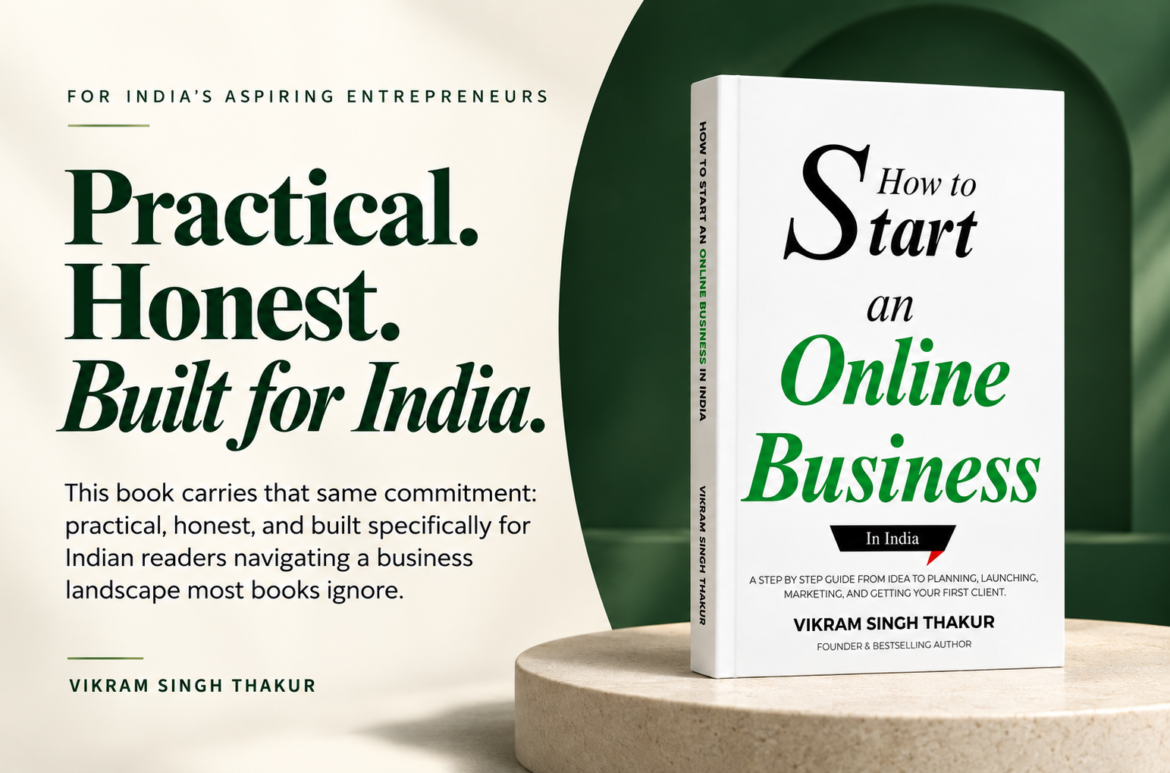
In an India where smartphones have become storefronts, UPI has transformed the way money moves, WhatsApp has become a powerful business communication tool, and social media can turn a small idea into a national brand, starting an online business has never appeared more accessible. Yet accessibility does not automatically translate into success. Thousands of aspiring entrepreneurs have an idea, create an Instagram page, design a logo, perhaps register a domain, and then find themselves wondering what to do next. This gap between having an idea and building a functioning business is exactly where Vikram Singh Thakur’s How to Start an Online Business in India: A Step by Step Guide from Idea to Planning, Launching, Marketing, and Getting Your First Client finds its relevance. Rather than presenting entrepreneurship as an inspirational fantasy, the book approaches online business as a practical process that can be understood, planned, executed, measured, and improved.
Buy Your Copy: https://www.amazon.in/dp/9376866622
One of the strongest aspects of How to Start an Online Business in India is its deliberate focus on the Indian entrepreneurial environment. Much of the business content available online is influenced by markets, consumer behaviour, payment systems, regulatory structures, and business models that do not necessarily correspond to the everyday realities of Indian entrepreneurs. Thakur takes a different approach by placing the reader inside the UPI and WhatsApp driven economy that has become increasingly important for small businesses, freelancers, service providers, home based entrepreneurs, and emerging brands. References to platforms such as WhatsApp, Instagram, Meesho, Amazon, LinkedIn, and cold email make the book particularly accessible to someone who is trying to understand where customers actually come from in the Indian market. The discussion of Udyam registration, GST, current accounts, pricing, customer acquisition, and business systems further strengthens its practical orientation.
The book’s central message is simple but important: starting a business is not the same as preparing to start a business. Many aspiring entrepreneurs spend months researching business ideas, watching motivational videos, designing websites, comparing competitors, or waiting for the perfect product before making their first attempt to sell. How to Start an Online Business in India challenges this pattern by placing action at the centre of the entrepreneurial journey. The book encourages readers to move from an idea to validation, from validation to an offer, from an offer to outreach, and from outreach to the first paying customer. This sequence gives the book its identity as a practical business guide rather than another general motivational book about entrepreneurship. The emphasis on doing something at every stage makes it especially useful for readers who tend to consume large amounts of business information but struggle to convert knowledge into action.
Another valuable feature of the book is its treatment of business ideas. The author does not present entrepreneurship as something reserved for people who discover an extraordinary billion-dollar concept. Instead, the book encourages readers to examine their own skills, experiences, problems, networks, interests, and everyday observations for potential business opportunities. This is particularly relevant for freelancers, students, homemakers, professionals considering a career change, and individuals who want to build a side income. A useful business idea does not necessarily need to be revolutionary. It needs to solve a meaningful problem for a sufficiently specific group of customers. By shifting the reader’s attention from finding a “genius idea” to identifying a problem that people are willing to pay to solve, the book makes entrepreneurship feel considerably more approachable.
The sections dealing with planning and business setup are equally important because the excitement of launching an online business can often make entrepreneurs overlook basic operational requirements. The book brings attention to areas such as Udyam registration, GST considerations, banking arrangements, pricing, documentation, and business structure. These subjects may not have the excitement of launching a social media campaign, but they form the foundation of a business that intends to operate beyond its first few customers. For new entrepreneurs in India, understanding which registrations and financial practices may apply to their business can prevent avoidable confusion later. Readers should, of course, verify current regulatory requirements with official government sources or qualified professionals because taxation, registration thresholds, and compliance rules can change. Within the broader structure of the book, however, their inclusion reinforces an important lesson: a business is not only a product or an Instagram page. It is also an operating system.
The discussion around branding and digital presence is particularly relevant to today’s online marketplace. For many small businesses, WhatsApp and Instagram are effectively the first storefront a potential customer encounters. Before speaking to the entrepreneur, a prospective customer may look at the profile, photographs, product information, testimonials, posts, pricing signals, and overall presentation to determine whether the business appears trustworthy. The book’s emphasis on creating a digital “shop window” therefore goes beyond simply telling readers to open a social media account. It focuses attention on the much more important question of whether that digital presence communicates credibility quickly. In a marketplace where customers frequently discover businesses through social media, search engines, recommendations, and messaging platforms, this ability to establish trust can have a direct impact on enquiries and conversions.
Pricing is another area where the book offers a practical perspective. New entrepreneurs frequently make the mistake of calculating prices based only on what competitors charge or what they personally feel comfortable asking. Such an approach can create a business that generates sales but does not generate sufficient profit. How to Start an Online Business in India brings the conversation back to costs, margins, positioning, and the relationship between price and value. This is particularly useful for freelancers and service providers, who may underestimate the time involved in delivering their work, customer communication, revisions, marketing, administration, and other invisible costs. Sustainable pricing requires more than multiplying a cost by an arbitrary percentage. It requires an understanding of the economics of the business and the value of the solution being offered.
Perhaps the most immediately useful portion of the book is its focus on acquiring the first customer. The first sale represents a psychological turning point for many entrepreneurs because it transforms a business idea from something theoretical into something validated by an actual transaction. Thakur explores practical customer acquisition routes including warm outreach, LinkedIn, cold email, WhatsApp, and other direct approaches. This is an important corrective to the common belief that a new business must first build a large social media following before it can make money. In reality, many small businesses begin with direct conversations, referrals, existing networks, personal connections, targeted outreach, and a clearly defined offer. The book’s focus on finding the first few customers therefore makes its advice particularly actionable for someone who has little audience and limited marketing budget.
The book also recognizes that getting the first customer is only the beginning. An entrepreneur who can make one sale but cannot consistently deliver the product or service, manage customers, maintain margins, collect payments, or generate repeat business has not yet built a sustainable operation. This is where the book moves into systems, delegation, hiring, marketing, and scaling. The transition from a one-person operation to a business with repeatable processes requires a significant change in mindset. Entrepreneurs have to stop treating every task as an individual improvisation and start documenting processes, tracking performance, managing customer relationships, and deciding which responsibilities can eventually be delegated. The book’s attention to these issues makes the entrepreneurial journey feel more complete because it does not end at the first successful transaction.
The scaling discussion, particularly the movement from ₹1 lakh to ₹10 lakh a month, adds another dimension to the book. Scaling a business is not simply a matter of doing ten times more of everything. As revenue increases, problems related to capacity, customer acquisition, quality control, team management, cash flow, systems, and operational efficiency become increasingly important. A business that works at a small scale may require substantial structural changes when it grows. By introducing readers to the idea that different stages of revenue require different business decisions, the book encourages them to think beyond the immediate excitement of their first sale and consider what a sustainable growth path might look like.
The inclusion of practical worksheets and a 90-day roadmap is another feature that separates the book from purely theoretical entrepreneurship content. A roadmap can help transform broad objectives into specific actions and deadlines. For someone who has been saying “I want to start an online business” for months or years, a structured ninety-day framework can provide a tangible starting point. The real value of such a roadmap, however, depends on whether the reader actually uses it. This is a book that is likely to be more useful when treated as a workbook rather than simply read from beginning to end. Readers who complete the exercises, test their ideas, contact potential customers, refine their offers, and track their results are likely to extract considerably more value from the material.
What also makes How to Start an Online Business in India relevant is the range of people it attempts to serve. A freelancer looking to escape inconsistent project income may use the book to refine an offer and develop a client acquisition process. A homemaker may find a framework for turning a product, skill, or home based capability into a commercial opportunity. A student may use the principles to experiment with a service business without waiting for a traditional career path to begin. A professional considering a career transition may use the book to test a business concept before making a larger commitment. These audiences have different circumstances, but they share a common challenge: moving from uncertainty to structured action.
The writing concept behind the book also addresses a widespread problem in modern entrepreneurship culture. There is no shortage of content promising quick success, passive income, overnight growth, or effortless online businesses. Against this background, the book’s emphasis on fundamentals is significant. Finding customers, making a profitable offer, communicating clearly, delivering consistently, managing costs, and building systems are not particularly glamorous activities, but they are central to running a business. The book therefore presents entrepreneurship as a process requiring experimentation, discipline, customer understanding, and continuous improvement rather than as a shortcut to easy money.
For readers searching online for practical guidance on how to start an online business in India, this book covers several of the questions that commonly arise during the early stages of entrepreneurship. What business should I start? How do I validate an idea? How should I price my product or service? Do I need GST registration? How can I sell through WhatsApp and Instagram? How can I find my first customer? How should I approach people on LinkedIn? When should I hire someone? How can a small business move from its first few sales toward predictable growth? Instead of treating these questions as isolated problems, Thakur places them within a sequence. That sequencing is arguably one of the book’s biggest strengths because entrepreneurs often struggle not because they lack information, but because they do not know which information matters first.
At the same time, readers should approach the book as a practical framework rather than a guarantee of business success. No business guide can remove the uncertainty associated with entrepreneurship. Markets change, customer preferences vary, competition evolves, regulations are updated, and different business models have different economics. The strategies that work for a freelancer may not work identically for an ecommerce seller, while a home based product business may face very different challenges from a consulting practice. The most productive way to use the book is therefore to adapt its principles to the reader’s specific market, customer, product, service, and financial circumstances.
Overall, How to Start an Online Business in India by Vikram Singh Thakur is positioned as a practical starting point for anyone who wants to move from entrepreneurial intention to execution. Its focus on Indian platforms, customer acquisition, business registration, pricing, digital presence, marketing, systems, and a structured 90-day action plan gives it a distinctly practical character. Rather than telling readers simply to believe in themselves, the book repeatedly brings the discussion back to the actions that turn an idea into a functioning business. For aspiring freelancers, students, homemakers, first-time entrepreneurs, professionals exploring a side business, and anyone searching for a practical guide to starting an online business in India, the book offers a structured framework for thinking about the journey from idea to first customer and beyond.
The most important idea running through the book is perhaps the simplest one: an online business does not begin when everything is perfect. It begins when an entrepreneur identifies a problem, creates a useful solution, presents it to the right people, and makes the first genuine attempt to sell it. From there, feedback creates refinement, customers create validation, and systems create the possibility of sustainable growth. How to Start an Online Business in Indiaencourages readers to make that first move while giving them a framework for understanding what comes next. For anyone who has spent too long researching entrepreneurship without actually starting, this book can serve as a practical roadmap from planning to launching, marketing, acquiring the first customer, and gradually building a real online business in India.
Buy Your Copy: https://www.amazon.in/dp/9376866622