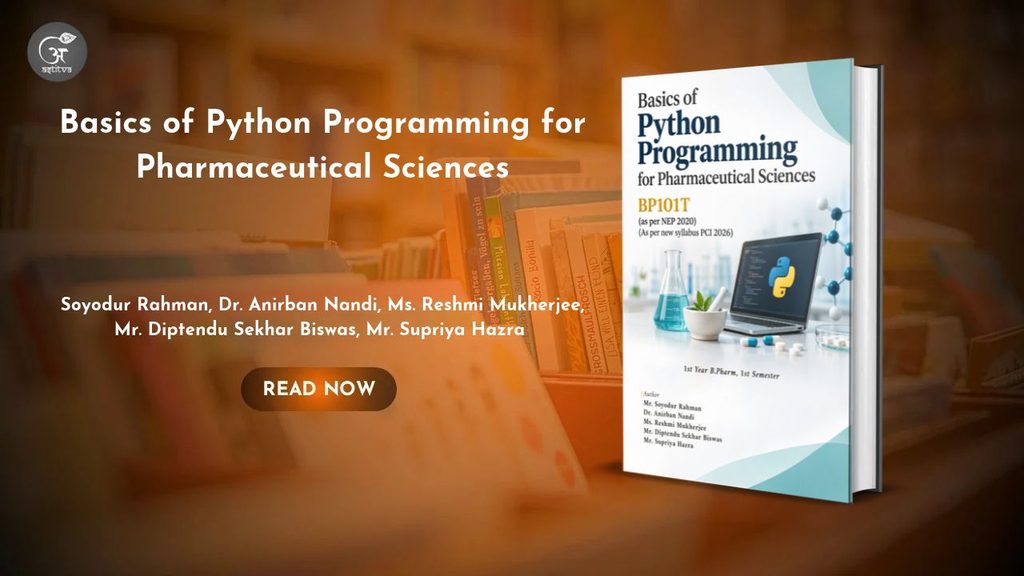
The field of pharmaceutical sciences is increasingly embracing technology, computational tools, and data-driven approaches to enhance scientific learning and research. Recognising the importance of programming in modern pharmaceutical education, the book Basics of Python Programming for Pharmaceutical Sciences (BP101T), authored by Soyodur Rahman, Dr. Anirban Nandi, Ms. Reshmi Mukherjee, Mr. Diptendu Sekhar Biswas, and Mr. Supriya Hazra, has been introduced as a comprehensive and student-friendly learning resource for pharmacy students.
Designed primarily for first-year Bachelor of Pharmacy (B.Pharm) students, this book aims to simplify the fundamentals of Python programming and demonstrate their practical applications in pharmaceutical education, scientific calculations, laboratory data analysis, and research. It also serves as a supplementary reference for pharmacy educators, researchers, and students interested in developing foundational computational skills.
The book follows a systematic approach, beginning with the installation of Python and an introduction to popular Integrated Development Environments (IDEs), including Jupyter Notebook, PyCharm, and Visual Studio Code. It gradually familiarises readers with essential programming concepts such as variables, data types, type casting, operators, input and output operations, string manipulation, and the use of standard and third-party libraries.
Moving beyond the basics, the book explains conditional statements, nested conditions, loops, functions, and fundamental programming structures that form the foundation of computational problem-solving. It also introduces data structures, data handling, and the analysis of pharmaceutical datasets, helping students understand how programming can be applied to practical scientific challenges.
A significant highlight of the book is its emphasis on pharmaceutical applications of Python. It introduces important libraries such as NumPy for numerical computation, Pandas for tabular data processing, and Matplotlib for graphical representation. Through pharmaceutical examples, readers explore how Python can assist in performing scientific calculations, organising experimental observations, analysing concentration–time profiles, comparing drug dissolution patterns, visualising laboratory measurements, and examining adverse drug reaction reporting data.
To make learning more effective and accessible, the book incorporates illustrative examples, Python code, sample outputs, tables, flowcharts, multiple-choice questions (MCQs), and descriptive questions with answers. These learning resources are designed to strengthen conceptual understanding, develop programming confidence, and support examination preparation. By connecting programming fundamentals with pharmaceutical applications, the book encourages students to move beyond theoretical knowledge and develop practical computational problem-solving abilities.
The strength of this publication also lies in the combined academic expertise and research experience of its contributors. Soyodur Rahman, an Assistant Professor in the Department of Pharmaceutical Chemistry and Quality Assurance at Saraswati Institute of Pharmaceutical Science, Gandhinagar, Gujarat, brings expertise in pharmaceutical chemistry, medicinal chemistry, pharmaceutical analysis, and drug discovery research. His academic qualifications from Jamia Hamdard University and research interests in anticancer and antidiabetic drug discovery reflect his commitment to pharmaceutical education and scientific innovation.
Dr. Anirban Nandi brings more than two decades of experience in the pharmaceutical industry, teaching, research, and academic administration. Currently associated with Krishna College of Pharmacy as Principal, his professional journey encompasses pharmaceutical production, academic leadership, pharmaceutics, formulation development, and research. His doctoral research focuses on the efficacy and safety of paediatric anti-tubercular immediate-release formulations.
Ms. Reshmi Mukherjee, an Assistant Professor at Vidyasagar Pharmaceutical College of Education, Simurali, Nadia, West Bengal, contributes her academic and research expertise in pharmaceutical chemistry, medicinal chemistry, herbal drug technology, phytochemistry, and molecular docking. She has been actively involved in research publications, patent applications, undergraduate research supervision, and scientific activities, with a particular interest in pharmaceutical and biomedical innovation.
Mr. Diptendu Sekhar Biswas, an Assistant Professor at Vidyasagar Pharmaceutical College of Education, brings experience in pharmacy education and research, with particular interests in pharmaceutical formulation development, drug delivery systems, pharmaceutical technology, and pharmacological evaluation. His contributions to research publications, review articles, patent publications, and academic writing further strengthen the multidisciplinary foundation of this publication.
Mr. Supriya Hazra, an Assistant Professor at Vidyasagar College of Pharmaceutical Education, West Bengal, adds expertise in pharmaceutical chemistry, analytical method development, herbal drug research, and pharmaceutical formulation. His research experience includes HPTLC method development and validation, herbal formulations, and the study of biologically active compounds. His practical knowledge of analytical instruments and computational research tools supports the book’s focus on connecting scientific concepts with modern technological applications.
The publication also benefits from the editorial contribution of Trishagni Baidya, an Assistant Professor in the Department of Pharmacology at Gupta College of Technological Sciences, Asansol, West Bengal. With an academic background in pharmacology and research interests spanning drug discovery, antimicrobial research, and nanotechnology-based biomedical applications, she brings valuable academic insight to the editorial process.
Jnandeepi Pradhan, an Assistant Professor at Pandaveswar School of Pharmacy, West Bengal, has also contributed his academic and professional expertise in pharmaceutics, pharmaceutical nanotechnology, drug delivery systems, and formulation development. His industrial experience with Macleods Pharmaceuticals Ltd. and research interests in computational tools, data analysis, artificial intelligence, and emerging technologies complement the book’s broader vision of integrating technology with pharmaceutical sciences.
As pharmaceutical education continues to evolve, programming knowledge is becoming an increasingly valuable skill for students entering the fields of pharmaceutical research, drug development, laboratory analysis, and healthcare innovation. Understanding computational methods can help future pharmacy professionals organise complex information, perform calculations efficiently, analyse scientific observations, and make informed decisions based on data.
Basics of Python Programming for Pharmaceutical Sciences (BP101T) seeks to make this learning journey easier by presenting programming concepts in a structured, accessible, and application-oriented manner. By bringing together the fundamentals of Python programming and relevant pharmaceutical examples, the book provides students with an opportunity to develop both technical understanding and scientific thinking.
This publication is a valuable academic resource for B.Pharm students and an encouraging step towards integrating computational learning into pharmaceutical education. It aims to equip aspiring pharmacy professionals with foundational programming skills that can support their academic development, research capabilities, and future contributions to the rapidly advancing field of pharmaceutical sciences.




Your perspective matters
Share your thoughts respectfully. Comments are moderated.