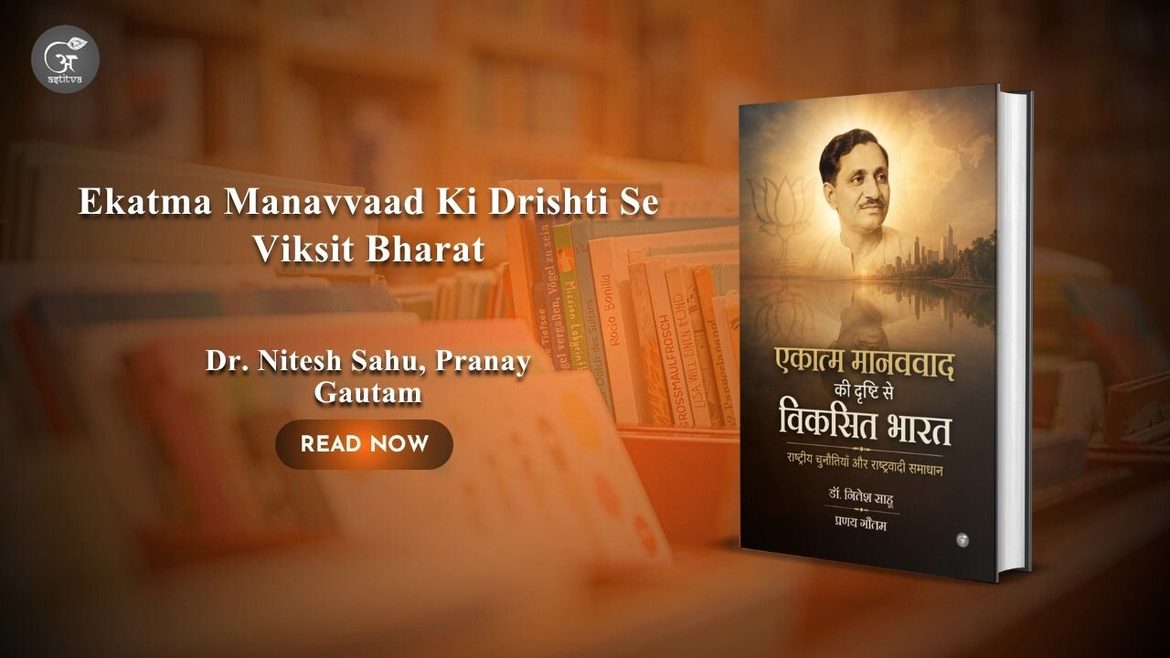
As India moves towards the centenary of its independence in 2047, the vision of a developed nation has become an important subject of national discussion. Ekatma Manavvaad Ki Drishti Se Viksit Bharat: Rashtriya Chunautiyan Aur Rashtravadi Samadhan by Dr. Nitesh Sahu and Pranay Gautam explores this vision through the philosophical framework of Integral Humanism, offering readers an opportunity to examine India’s contemporary challenges and reflect on possible approaches to nation-building.
The book goes beyond a general discussion of economic growth and development. It seeks to understand the social, economic, cultural, ideological, and political dimensions of the challenges facing the country. By placing these issues within the broader vision of Viksit Bharat 2047, the authors encourage readers to consider how national progress can be pursued alongside social harmony, cultural confidence, economic self-reliance, environmental responsibility, and the welfare of citizens.
A central foundation of the book is Ekatma Manav Darshan, or Integral Humanism, which emphasises the interconnectedness of the individual, society, the nation, and nature. The principle of Antyodaya, focused on the upliftment of the last person, further reinforces the idea that development must reach the most marginalised sections of society. Through these perspectives, the book presents nation-building as a comprehensive endeavour that requires not only material advancement but also ethical responsibility, social participation, and a commitment to collective welfare.
The authors address a wide range of subjects relevant to India’s national journey, including national security, internal and external challenges, demographic concerns, illegal infiltration, religious conversion, information and ideological challenges, economic self-reliance, cultural consciousness, environmental protection, social evils, and women’s empowerment. By bringing these subjects into a common discussion, the book seeks to encourage a broader understanding of the issues shaping India’s present and future.
Dr. Nitesh Sahu brings experience in public service, youth leadership, social development, and political research to this work. Originally from Phulwari F village in Chhattisgarh’s Mungeli district, he has been actively involved in initiatives relating to cleanliness, water conservation, de-addiction, and community development. He received the National Youth Award for 2016–17 from the Government of India in 2019 in recognition of his social contributions. His experience as a National Youth Volunteer with Nehru Yuva Kendra Sangathan, along with his involvement in youth empowerment and organisational activities, has shaped his interest in participatory development and public policy. He holds a doctorate in Political Science from Hemchand Yadav University, Durg, and his areas of interest include governance, rural development, politics, and social service.
Co-author Pranay Gautam contributes a research-oriented perspective informed by his interests in diplomacy, policymaking, mass communication, and social development. A native of Bemetara district in Chhattisgarh, he secured first place nationally in the 14th National Youth Parliament organised by the Government of India. His academic background includes undergraduate studies in English Literature and postgraduate studies in Journalism and Mass Communication at Guru Ghasidas Central University, Bilaspur. A Ph.D. research scholar in Indian diplomacy, he has published research papers and book chapters and has explored subjects including international relations, foreign policy, democratic institutions, and social change.
Together, the authors bring perspectives from political science, public service, youth leadership, communication, and policy research to the discussion of India’s future. Their work invites readers to examine national challenges critically while considering solutions grounded in the principles of Integral Humanism and Antyodaya.
Ekatma Manavvaad Ki Drishti Se Viksit Bharat: Rashtriya Chunautiyan Aur Rashtravadi Samadhan is intended for students, researchers, social and political activists, and readers interested in India’s development and public life. By connecting philosophical ideas with contemporary national concerns, the book contributes to the ongoing conversation about the meaning of progress and the responsibilities of citizens in shaping the country’s future. As India approaches 2047, it encourages reflection on how development, social responsibility, cultural awareness, and inclusive welfare can work together in the pursuit of a stronger and more prosperous nation.