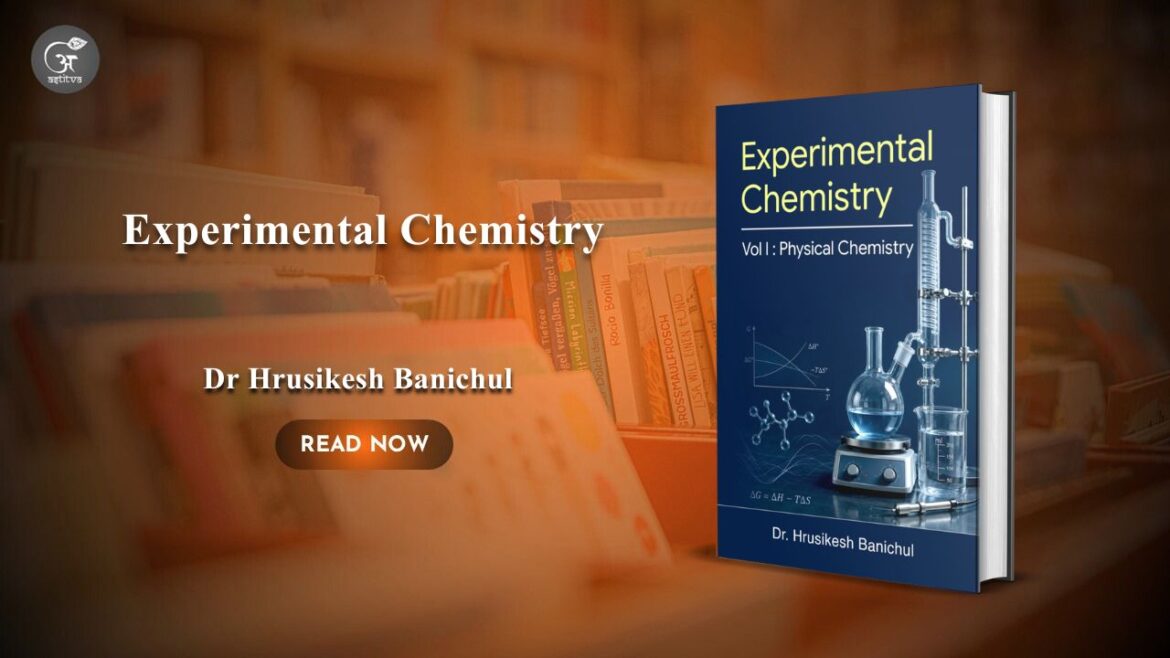
The release of Experimental Chemistry: Vol I – Physical Chemistry by marks an important contribution to chemistry education and laboratory learning. Designed as a comprehensive laboratory manual, the book offers students a practical understanding of physical chemistry by connecting theoretical concepts with experimental applications.
In today’s scientific education, practical exposure plays a crucial role in helping students understand the real-world relevance of chemistry. While classroom learning introduces formulas, principles, and laws, laboratory experimentation transforms those concepts into observable and measurable phenomena. This book has been carefully developed to support that transition from theory to practice.
Experimental Chemistry Vol I focuses on the quantitative and measurable aspects of chemical systems. The book introduces students to essential laboratory techniques and precision instruments commonly used in physical chemistry experiments. From measuring surface tension and viscosity to understanding electrochemical behavior through pH-metry, potentiometry, and conductometry, the volume provides a systematic and student-friendly approach to experimental science.
One of the strongest aspects of the book is its emphasis on technical skill development. Students are guided through practical procedures involving pH meters, potentiometers, and conductometers with clarity and precision. The experiments are structured to encourage analytical thinking, careful observation, and scientific accuracy—skills that are essential for academic success as well as industrial and research careers.
The volume also explores important concepts such as chemical kinetics, distribution coefficients, thermochemical changes, and energy exchange. These topics are fundamental to understanding modern physical chemistry and its industrial applications. By presenting these concepts through experiments and laboratory exercises, the book helps learners develop confidence in handling scientific investigations independently.
Another significant feature of the book is its relevance to modern scientific and industrial practices. Physical chemistry forms the foundation of many advanced fields including materials science, environmental chemistry, catalysis, energy research, and pharmaceutical development. This laboratory manual prepares students not only for examinations but also for future scientific endeavors and professional applications.
The language of the book has been kept simple, clear, and academically precise, making it suitable for undergraduate and postgraduate students alike. Teachers, laboratory instructors, and institutions will also find it valuable as a practical teaching resource.
The release of Experimental Chemistry Vol I reflects the growing importance of experiential learning in science education. It encourages students to think critically, perform carefully, and understand chemistry beyond textbooks. By combining scientific rigor with practical accessibility, the book serves as an essential companion for aspiring chemists and researchers.
This publication stands as a meaningful step toward strengthening laboratory-based chemistry education and inspiring students to engage deeply with the fascinating world of physical chemistry.