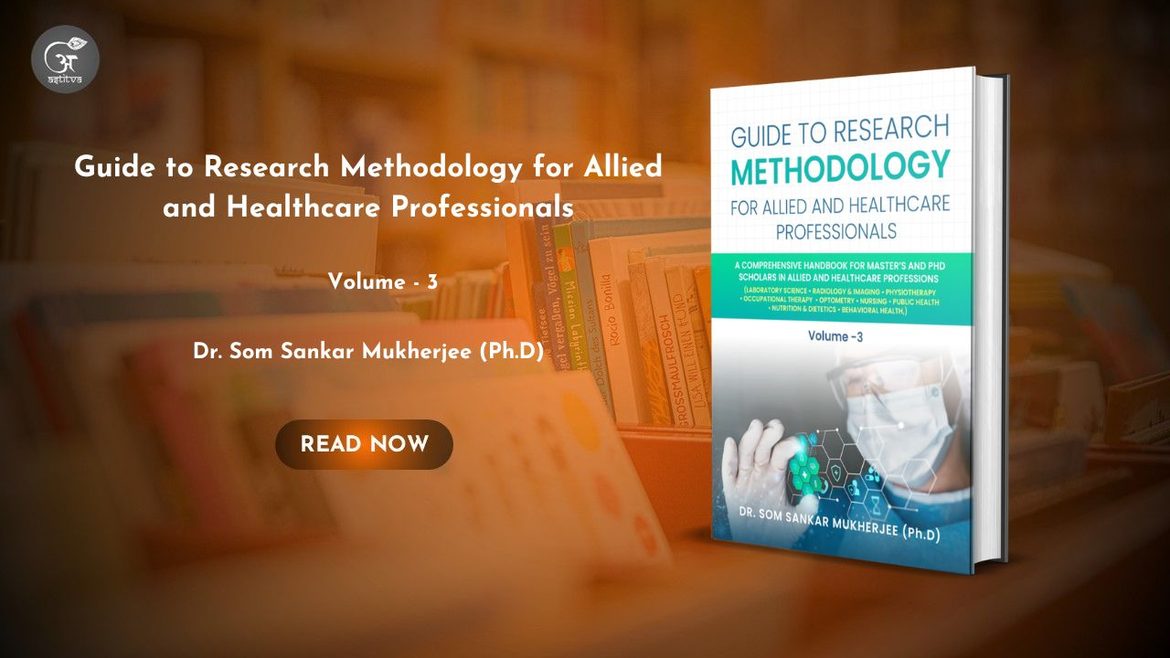
Research plays a vital role in strengthening healthcare systems, improving professional practice, and supporting informed clinical decision-making. With the growing emphasis on evidence-based healthcare, professionals and students in allied and healthcare sciences need a clear understanding of how scientific research is planned, conducted, analysed, and applied in real-world settings. Guide to Research Methodology for Allied and Healthcare Professionals – Volume 3 by Dr. Som Sankar Mukherjee (Ph.D) is designed to address this need by providing a structured and practical foundation in healthcare research methodology.
Continuing the comprehensive exploration of research concepts, this volume covers Chapters 14–18 and guides readers through essential aspects of conducting meaningful and responsible research in allied health and healthcare professions. The book begins by examining the role of research in evidence-based practice and its evolution within modern healthcare systems. It highlights how scientific inquiry contributes to improving patient care, strengthening professional knowledge, evaluating interventions, and developing healthcare practices based on reliable evidence.
A major strength of the book is its systematic presentation of the research process. Readers are introduced to important stages such as identifying a research problem, formulating clear objectives and hypotheses, developing conceptual frameworks, and conducting an effective literature review. These elements are explained in a manner that helps learners understand not only their theoretical importance but also how they contribute to the development of a strong and scientifically sound research study.
The book also provides valuable insights into research design and the practical planning of a research project. It discusses different approaches to research design, sampling techniques, variables, measurement tools, and methods of data collection. By presenting these concepts in a clear and organized manner, the book enables learners to understand how appropriate methodological choices can influence the quality, reliability, and validity of research findings.
Ethical considerations form another important component of the book. Healthcare research involves individuals, patient information, clinical settings, and sensitive data, making ethical responsibility essential at every stage of scientific inquiry. The book emphasizes fundamental principles such as informed consent, confidentiality, patient privacy, research integrity, and responsible conduct of research. These discussions encourage readers to approach research not only as a scientific activity but also as a professional responsibility requiring transparency, accountability, and respect for participants.
An introduction to biostatistics further strengthens the practical value of the volume. Healthcare professionals frequently encounter numerical data, research findings, clinical measurements, and statistical outcomes. Developing an understanding of basic biostatistical concepts enables students and practitioners to interpret healthcare data more effectively and critically evaluate published research. The book therefore helps bridge the gap between research methodology and the analytical skills required for evidence-based healthcare practice.
Written in a clear, structured, and learner-friendly manner, Guide to Research Methodology for Allied and Healthcare Professionals – Volume 3 is intended to develop critical thinking, analytical ability, research competence, and scientific reasoning. Rather than presenting research methodology as a purely theoretical subject, the book connects fundamental concepts with their practical relevance in healthcare and academic environments. This approach can help learners develop greater confidence in designing research studies, evaluating scientific literature, interpreting findings, and applying evidence to professional practice.
The volume is particularly relevant for students and professionals in allied health sciences, rehabilitation, physiotherapy, healthcare education, and related disciplines. It can serve as a useful academic resource for learners beginning their research journey as well as for educators and practitioners seeking to strengthen their understanding of research principles and evidence-based decision-making.
The author, Dr. Somsankar Mukherjee, PhD (Physiotherapy), M.Phil (Physiotherapy), and MPT (Sports Physiotherapy), is a distinguished academician, researcher, and healthcare professional with more than 18 years of experience across national and international universities in the fields of health sciences, rehabilitation, and sports medicine. His extensive academic career has involved teaching, curriculum development, research supervision, and the advancement of physiotherapy education.
Over the years, Dr. Mukherjee has successfully guided numerous postgraduate and doctoral scholars, encouraging them to develop strong foundations in evidence-based practice and scientific research methodology. His experience in academic mentoring and research makes him well positioned to present complex methodological concepts in a structured and accessible manner.
Currently, Dr. Mukherjee serves as the Chairperson of the Arunachal Pradesh Allied and Healthcare Council, where he contributes to strengthening healthcare education standards, professional regulation, and academic development. His leadership and professional experience further reflect his commitment to advancing the quality of allied and healthcare education.
Dr. Mukherjee is also an accomplished academic author. His published textbooks include Textbook of Sociology for Physiotherapists, Textbook of Psychology for Physiotherapists, Foundation of Ethics and Professionalism in Physiotherapy, Pedagogy in Physiotherapy, and Management and Administration in Physiotherapy Practices. In addition to his books, he has contributed more than 30 research publications in reputed journals, demonstrating his sustained involvement in scientific research and academic advancement.
With its emphasis on research planning, evidence-based practice, ethical conduct, data collection, research design, and introductory biostatistics, Guide to Research Methodology for Allied and Healthcare Professionals – Volume 3 offers a valuable foundation for developing competent and responsible healthcare researchers. Chapters 14–18 provide learners with the knowledge and methodological perspective required to move from identifying a research question to understanding how scientific evidence can ultimately contribute to better healthcare practice.
For students, educators, researchers, and healthcare professionals, this volume serves as a practical academic companion for understanding the principles of healthcare research and developing the confidence to engage with scientific inquiry. By combining methodological clarity with practical relevance, Dr. Som Sankar Mukherjee presents a resource that supports both academic learning and the broader goal of promoting evidence-based clinical and professional decision-making in allied and healthcare sciences.