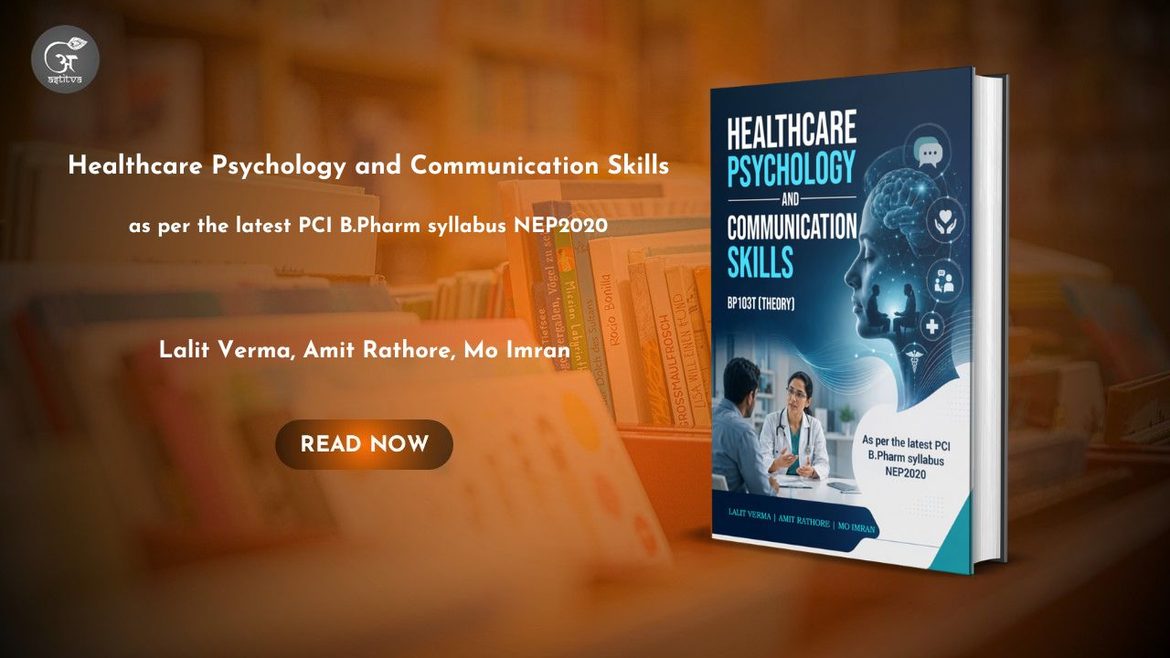
Healthcare Psychology and Communication Skills (BP-103T), edited by Lalit Verma, Amit Rathore, and Mo Imran, is a comprehensive textbook developed in accordance with the Pharmacy Council of India (PCI) syllabus under the New Education Policy (NEP) 2020 for students of the First-Year Bachelor of Pharmacy (B.Pharm) programme. The book is designed to provide pharmacy students with a strong foundation in psychological, behavioural, and communication principles that are essential for effective and patient-centred healthcare practice.
The textbook presents the subject in a systematic, clear, and learner-friendly manner, covering a wide range of important topics, including psychology in healthcare, personality, learning, memory, motivation, stress management, communication skills, empathy, patient counselling, health literacy, professional ethics, digital communication, behaviour change theories, and the psychosocial aspects of illness. Each chapter has been structured to promote conceptual understanding while connecting theoretical knowledge with practical applications in healthcare settings.
A key strength of Healthcare Psychology and Communication Skills is its emphasis on competency-based learning, clinical relevance, patient-centred care, and professional communication. The content has been presented in simple and precise language to support undergraduate learners while also serving as a useful reference for teachers and healthcare professionals. The book reflects the evolving expectations of modern pharmacy education and aims to help students develop not only academic knowledge but also the interpersonal and professional skills required in healthcare practice.
The book is the result of the collaborative efforts of academicians, researchers, and pharmacy educators committed to developing quality educational resources. Care has been taken to ensure that the material is authentic, updated, academically relevant, and aligned with the prescribed curriculum. By integrating psychological understanding with effective communication and patient-care principles, the textbook seeks to prepare future pharmacy professionals to interact confidently, ethically, and compassionately with patients and healthcare teams.
Lalit Verma, one of the editors, is an Assistant Professor at Bhagwant Institute of Pharmacy, Muzaffarnagar, Uttar Pradesh. With experience in pharmacy education, academic coordination, scholarly writing, and curriculum development, he has actively participated in workshops, faculty development programmes, seminars, conferences, and research activities. His academic interests include pharmaceutical sciences, pharmacy education, research methodology, and student-centric learning. He has contributed to research publications, academic collaborations, and book projects, with a strong commitment to developing high-quality educational resources for pharmacy students and young researchers.
Amit Rathore is an M.Pharm Research Scholar in the Department of Pharmaceutical Sciences at Gurukula Kangri (Deemed to be University), Haridwar, Uttarakhand. He has previously served as a Lecturer at Shri Ram College of Pharmacy, Muzaffarnagar. His academic interests include pharmacology, pharmaceutical research, scientific writing, and healthcare education. He has participated in numerous workshops, conferences, seminars, and research activities and has contributed research papers, review articles, and book chapters. His continued involvement in research, academic publishing, and textbook development reflects his dedication to evidence-based pharmaceutical education.
Mo Imran, an Assistant Professor at Bhagwant Institute of Pharmacy, Muzaffarnagar, Uttar Pradesh, India, is actively involved in pharmaceutical education, academic mentoring, research, and curriculum development. He has experience in teaching undergraduate pharmacy students and promoting student-centred learning. His academic interests encompass pharmaceutical sciences, clinical pharmacy, pharmacology, healthcare education, and research methodology. He has participated in national and international workshops, seminars, conferences, faculty development programmes, and continuing education initiatives. His contributions to research publications, review articles, and academic book chapters demonstrate his commitment to scientific writing and evidence-based education.
Through their combined academic experience and scholarly contributions, the editors have created a textbook that bridges theoretical knowledge with the practical demands of healthcare communication and patient care. Healthcare Psychology and Communication Skills (BP-103T) is therefore expected to be a valuable academic resource for B.Pharm students, educators, and healthcare professionals seeking to strengthen their understanding of psychology, communication, ethics, and patient-centred practice.
The book ultimately aims to empower future pharmacy professionals with the knowledge, communication abilities, ethical values, and confidence necessary to contribute meaningfully to modern healthcare. By encouraging empathy, effective interaction, critical thinking, and professional responsibility, Healthcare Psychology and Communication Skills serves as a relevant and practical addition to contemporary pharmacy education.