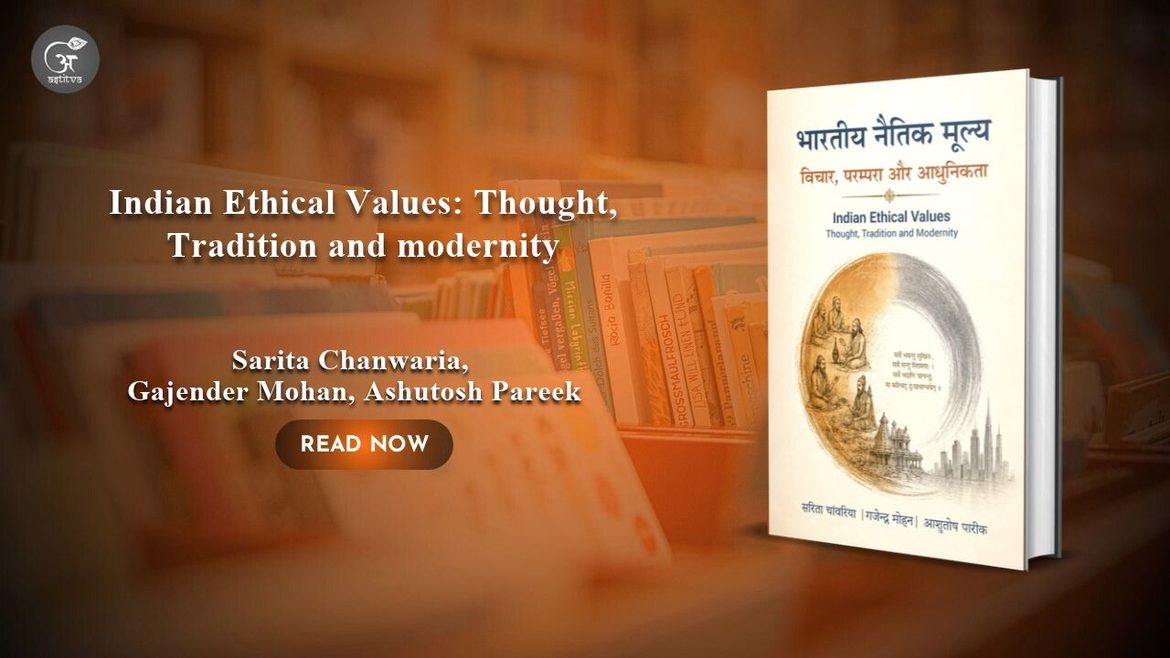
The book Indian Ethical Values: Thought, Tradition and Modernity, authored by Dr. Sarita Chanwaria, Dr. Gajender Mohan, and Dr. Ashutosh Pareek, offers a comprehensive exploration of India’s rich ethical heritage and its continuing relevance in the contemporary world. Bringing together ancient philosophical wisdom and modern intellectual perspectives, the book examines how ethical values have shaped Indian civilization and how they can guide individuals and societies through the complexities of modern life.
At a time when rapid technological advancement, globalization, and changing social relationships are transforming human experiences, the question of ethical responsibility has become increasingly significant. This book seeks to reconnect readers with the foundational principles of Indian ethical thought, including dharma, truth, compassion, non-violence, and moral responsibility. It highlights the enduring importance of these values while examining their application in personal conduct, professional life, and social engagement.
A central objective of the book is to bridge the gap between tradition and modernity. Rather than presenting Indian ethical values merely as historical concepts, the authors explore their potential to address contemporary challenges. The book encourages readers to reflect on how traditional wisdom can contribute to responsible decision-making, harmonious relationships, environmental awareness, and the development of a more compassionate society.
Drawing upon classical Indian sources such as the Vedas, Upanishads, and great epics, the work examines the philosophical foundations that have influenced Indian moral and intellectual traditions over centuries. These sources provide insights into the relationship between individual duties, collective welfare, justice, and spiritual development. The discussion also considers how ethical principles have evolved, been preserved, and been reinterpreted in response to changing historical and social circumstances.
The book’s engagement with modern philosophical debates further strengthens its relevance. By placing traditional ideas in conversation with contemporary concerns, it invites readers to consider the practical significance of ethical values in a world increasingly shaped by competition, material aspirations, social change, and interconnected global communities. Its interdisciplinary perspective makes it relevant to students, teachers, researchers, philosophy enthusiasts, and readers interested in Indian Knowledge Systems and cultural heritage.
One of the work’s key contributions is its emphasis on the practical dimensions of ethics. Ethical values become meaningful not only through intellectual understanding but also through their application in everyday decisions. The principles of truthfulness, compassion, fairness, and non-violence can influence professional integrity, interpersonal relationships, public conduct, and civic responsibility. By exploring these connections, the book encourages readers to approach ethics as a living tradition rather than a collection of abstract doctrines.
The three authors bring complementary academic expertise and research experience to this intellectual undertaking.
Dr. Sarita Chanwaria is a Professor of English with 27 years of distinguished service in higher education. Her research interests include Indian English literature, children’s literature, Indian Knowledge Systems, ecocriticism, and contemporary literary studies. With 35 research papers and articles published in reputed journals, participation in more than 50 national and international seminars and conferences, and four edited books to her credit, she has consistently contributed to literary scholarship and cultural understanding. Her academic interests reflect a sustained commitment to the humanistic dimensions of literature and the continuing significance of India’s intellectual traditions.
Dr. Gajender Mohan is a Professor in the Department of Hindi at Samrat Prithviraj Chauhan Government College, Ajmer, Rajasthan. With 29 years of academic experience, he has edited textbooks for various universities in Rajasthan. His literary and scholarly contributions include articles, poems, stories, memoirs, and research papers published in national and international journals and research magazines. He has also authored and translated several books from English into Hindi. His areas of specialization include medieval Hindi poetry and literary criticism, bringing valuable perspectives on India’s literary and cultural traditions.
Dr. Ashutosh Pareek is a Professor of Sanskrit at the Commissionerate of College Education, Jaipur, Rajasthan. An accomplished author, educator, researcher, and promoter of Sanskrit, he has nearly 18 years of academic and research experience. He has authored and edited 13 books, published more than 85 research papers, and presented his work at over 130 national and international conferences and seminars. He has also contributed to various academic projects and serves as Visiting Faculty at the Hindu University of America in Orlando, Florida, USA. His expertise in Sanskrit provides an important foundation for understanding India’s classical philosophical and ethical heritage.
Together, the authors offer a scholarly perspective that connects literature, language, philosophy, and cultural studies. Their combined expertise strengthens the book’s exploration of the historical roots and contemporary significance of Indian ethical thought.
Indian Ethical Values: Thought, Tradition and Modernity serves as an invitation to rediscover the moral foundations of Indian civilization and reflect on their relevance to present-day society. By connecting classical wisdom with contemporary realities, the book contributes to ongoing discussions about character, responsibility, social harmony, and ethical leadership.
Ultimately, the book emphasizes that a meaningful engagement with tradition does not require rejecting modernity. Instead, it encourages a thoughtful dialogue between inherited wisdom and present-day needs. In doing so, it offers readers an opportunity to understand India’s ethical legacy more deeply and consider how its enduring principles can help build a more responsible, inclusive, and humane future.