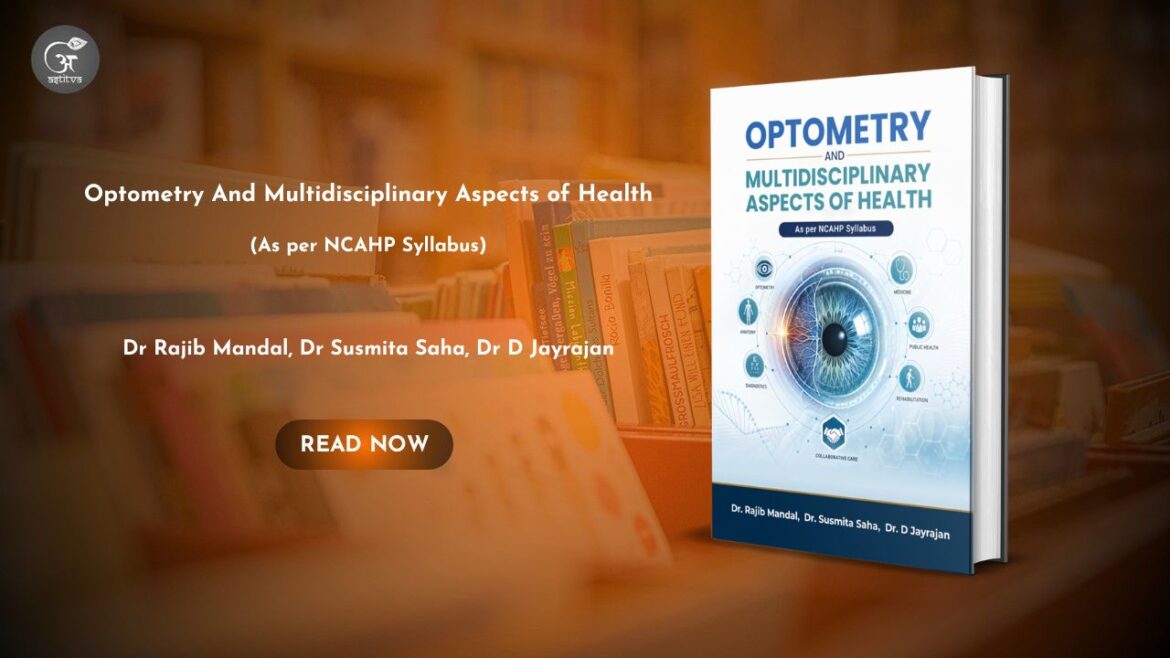
The field of healthcare is undergoing a remarkable transformation, moving steadily toward a collaborative, patient-centered approach where professionals from diverse disciplines work together to deliver comprehensive and effective care. In this evolving healthcare ecosystem, optometry has emerged as a crucial discipline that extends far beyond the traditional boundaries of vision correction. Recognizing this significant shift, the book Optometry And Multidisciplinary Aspects of Health by Dr. Rajib Mandal, Dr. Susmita Saha, and Dr. D. Jayarajan has been released as a comprehensive academic resource designed to prepare students and professionals for the expanding role of optometry in modern healthcare.
Developed in accordance with the National Commission for Allied and Healthcare Professions (NCAHP) syllabus, the book serves as a bridge between theoretical knowledge and practical healthcare applications. It introduces readers to the multidisciplinary nature of contemporary healthcare systems and emphasizes the important role optometrists play in preventive care, rehabilitation services, systemic disease management, public health initiatives, and interdisciplinary clinical practice.
The book provides an extensive exploration of healthcare models, rehabilitation services, eye care delivery systems, and integrated healthcare approaches. It covers both international and Indian healthcare frameworks while addressing critical topics such as visual rehabilitation, low vision care, management of neurological and systemic disorders, primary to tertiary eye care services, tele-optometry, community eye health, and collaborative patient management. Through these discussions, readers gain a broader understanding of how optometry contributes to holistic healthcare outcomes.
One of the distinguishing features of this publication is its student-focused design. Complex concepts have been presented in a simplified yet academically rigorous manner, ensuring accessibility without compromising clinical relevance. The inclusion of tables, flowcharts, diagrams, clinical examples, and a comprehensive model question bank enhances the learning experience and supports examination preparation. The question bank includes multiple-choice questions, short notes, long-answer questions, and application-based problems developed according to Bloom’s taxonomy, encouraging deeper understanding and critical thinking.
Beyond examination success, the authors have placed significant emphasis on developing analytical skills, clinical reasoning abilities, and a patient-centered perspective among learners. The book aims to equip future optometrists with the knowledge and confidence required to function effectively within multidisciplinary healthcare teams and contribute meaningfully to integrated patient care.
The authors bring extensive expertise and experience to this important work. Dr. Rajib Mandal, associated with the Programme of Optometry at the Faculty of Allied and Healthcare Sciences, Assam down town University, Guwahati, has over eight years of academic and clinical experience. He has authored more than 30 textbooks and published over 25 Scopus-indexed research papers. His research interests span binocular vision, low vision rehabilitation, visual ergonomics, clinical optometry, and artificial intelligence applications in vision science.
Dr. Susmita Saha serves as Associate Dean (Academic) and Assistant Professor at the Faculty of Allied and Healthcare Sciences, Assam down town University. With substantial experience in teaching, research, and academic leadership, her work focuses on systemic diseases and ocular health, chronic disorders, rehabilitation, and emerging healthcare technologies. Her dedication to evidence-based healthcare education and student mentorship has contributed significantly to academic excellence within the institution.
Dr. D. Jayarajan, Professor at the Faculty of Allied and Healthcare Sciences, Assam down town University, brings more than two decades of teaching experience and seventeen years of research expertise. His extensive contributions include numerous research publications, book chapters, patents, and academic innovations in biomedical and life sciences. He has been recognized with several prestigious awards for excellence in teaching and research and continues to play a vital role in interdisciplinary innovation and curriculum development.
Optometry And Multidisciplinary Aspects of Health stands as a valuable resource for undergraduate and postgraduate students, educators, researchers, and healthcare professionals interested in understanding the growing significance of optometry within integrated healthcare systems. By combining academic depth with practical clinical perspectives, the book offers readers a comprehensive guide to the multidisciplinary dimensions of eye care and healthcare delivery.
As healthcare continues to evolve toward greater collaboration and patient-centered care, this publication arrives at a crucial time, providing learners and practitioners with the knowledge, skills, and perspectives necessary to meet the challenges of modern healthcare. The release of this book marks an important contribution to optometric education and reflects the commitment of its authors to advancing healthcare knowledge, professional development, and excellence in patient care.