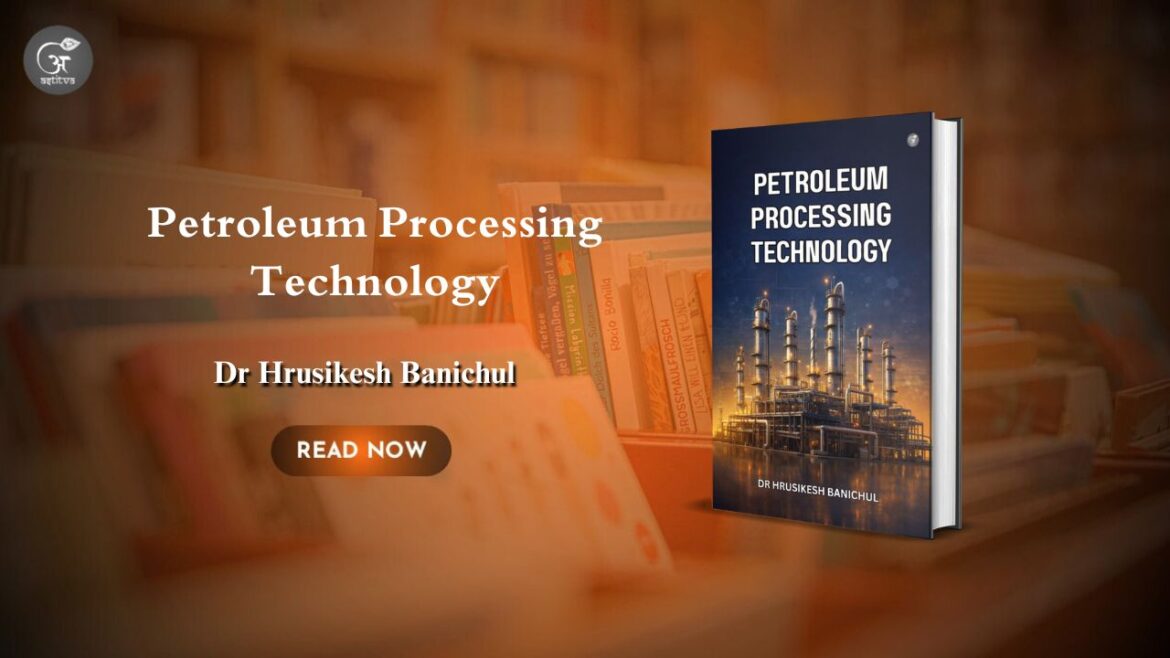
The field of petroleum science plays a crucial role in modern industrial development and global energy supply. Adding to the academic and technical resources in this domain, Dr. Hrusikesh Banichul presents his new book titled “Petroleum Processing Technology.” This comprehensive work offers a systematic introduction to the science and technology involved in the exploration, processing, refining, and utilization of petroleum and its products. Designed for both academic and professional audiences, the book serves as an essential guide for undergraduate and postgraduate students of chemistry, chemical engineering, petroleum engineering, and related disciplines, as well as professionals working in the petroleum and petrochemical industries.
Petroleum remains one of the most important energy resources in the world, and understanding its processing technologies is essential for efficient utilization and sustainable industrial growth. In this book, Dr. Banichul explains the complex processes involved in petroleum refining in a clear and structured manner, enabling readers to build a strong foundation in both theoretical and practical aspects of the subject.
The book begins by introducing the fundamentals of petroleum, including the nature, origin, and composition of crude oil. It then progresses into the exploration of major petroleum products such as gasoline, aviation fuels, naphtha, kerosene, and diesel. The author highlights their chemical properties and quality evaluation methods, providing readers with a clear understanding of how these fuels are analyzed and utilized in different industrial and commercial applications.
A major portion of the book is dedicated to crude oil refining processes. Detailed explanations are provided on key refining operations such as desalting, atmospheric distillation, vacuum distillation, cracking processes, reforming, isomerization, alkylation, polymerization, and hydroconversion. Important techniques like thermal cracking, catalytic cracking, fluid catalytic cracking, and hydrocracking are discussed to illustrate how heavy crude fractions are converted into valuable fuels and chemicals. The book also explains blending techniques and refinery treatment processes that ensure fuel quality and performance.
Another important section focuses on lube chemistry, an essential component of petroleum processing. The author provides in-depth information about lubricating oils, additives, and base oil classification. Topics such as transformer oil, grease, bitumen, paraffin jelly, and liquid paraffin are also covered. The book explains several lube oil processing methods including solvent extraction, dewaxing, and acid-clay treatment, along with the chemistry and industrial applications of greases and bituminous materials.
The book also introduces readers to the field of petrochemicals, which plays a vital role in the modern chemical industry. This section discusses the conversion of hydrocarbons into valuable chemicals through industrial processes involving methane, ethylene, propylene, acetylene, benzene, toluene, synthesis gas, and alcohols. Reaction pathways, process technologies, and their industrial significance are clearly described, helping readers understand the transformation of raw hydrocarbons into essential chemical products.
Recognizing the environmental impact of petroleum industries, the final chapter addresses environmental challenges associated with crude oil processing. It discusses issues such as oil spillage, refinery-related pollution, and modern techniques for environmental protection. The concept of bioremediation, which involves using microorganisms to clean soil and water contaminated with petroleum hydrocarbons, is also explored, emphasizing the importance of sustainable practices in the petroleum sector.
The author, Dr. Hrusikesh Banichul, is an accomplished chemist and researcher with more than fifteen years of experience in academic teaching and industrial research. He earned his Ph.D. from IIT (ISM) Dhanbad, where his research focused on environmentally sustainable catalysis using fly ash–derived materials. He also holds an M.Phil. and M.Sc. from Sambalpur University in organic synthesis.
Dr. Banichul has served in key scientific and leadership roles in both industry and academia. His expertise includes process development from laboratory to plant scale, petroleum and petrochemical analysis, pharmaceutical synthesis, environmental monitoring, and quality assurance under ISO standards. He has also contributed significantly to academic research as a teacher, mentor, and editorial board member of several international journals.
Through “Petroleum Processing Technology,” Dr. Banichul combines his extensive academic knowledge and industrial experience to create a valuable resource that connects scientific theory with real-world petroleum processing applications.