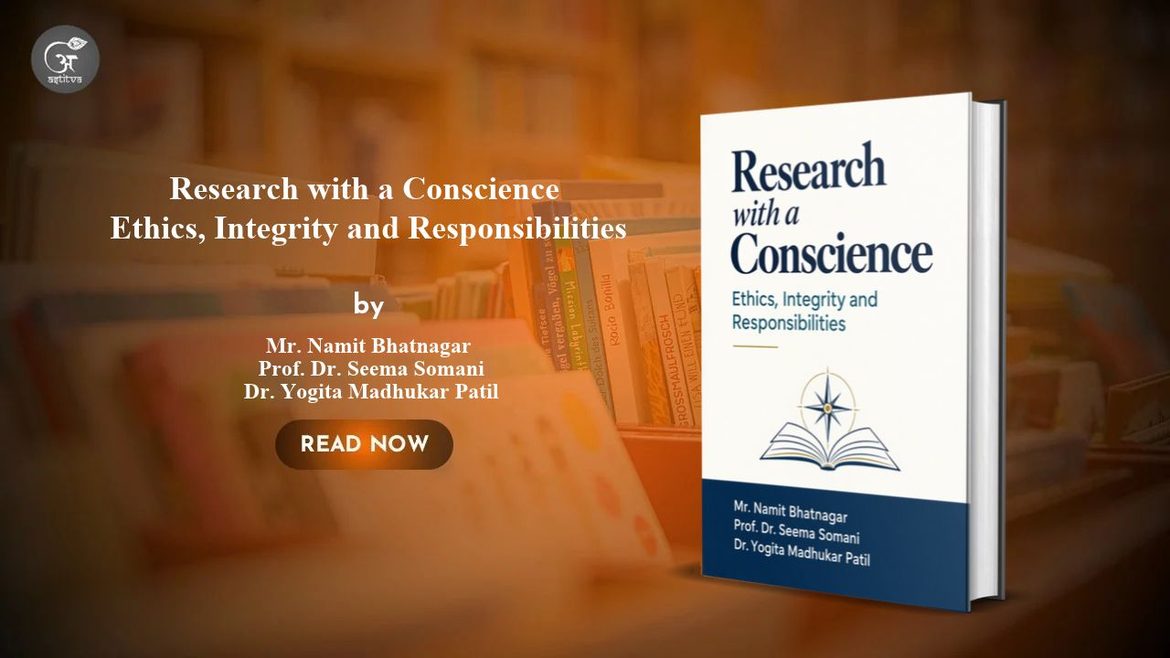
Book Release: Research with a Conscience: Ethics, Integrity and Responsibilities
A Comprehensive Guide to Responsible Research and Publication in Indian Higher Education
Authors: Mr. Namit Bhatnagar, Prof. Dr. Seema Somani and Dr. Yogita Madhukar Patil
In an era where research, innovation and academic publications play an increasingly important role in shaping knowledge and society, the need for ethical and responsible research practices has never been more significant. Addressing this need, “Research with a Conscience: Ethics, Integrity and Responsibilities”, authored by Mr. Namit Bhatnagar, Prof. Dr. Seema Somani and Dr. Yogita Madhukar Patil, presents a comprehensive and practical textbook on research and publication ethics, with a particular focus on the Indian higher-education and research ecosystem.
Designed for students, researchers and academic professionals, the book is intended for MBA, M.Com, MA, MSc, M.Tech and PhD programmes, including doctoral coursework in Research and Publication Ethics (RPE). It also serves as a valuable resource for faculty development programmes focused on research integrity and responsible academic practices.
The book is structured into fourteen chapters across six parts, taking readers from the philosophical foundations of knowledge and ethics to practical challenges encountered throughout the research journey.
Part I lays the philosophical foundation by exploring what constitutes knowledge, the relationship between evidence and methodology, and the role of ethical theories in addressing difficult research situations. Part II focuses on research ethics and responsible conduct, including ethical considerations surrounding human participants and the responsible handling of research data.
Part III examines research misconduct and plagiarism, helping readers understand the various forms of unethical research practices and their consequences. Part IV turns to publication ethics, covering important issues such as authorship, conflicts of interest, peer review and editorial decision-making.
The book also addresses some of the most relevant challenges facing researchers today. Part V explores responsible publishing in the contemporary academic environment, including open access, predatory and cloned journals, research metrics and the growing role of artificial intelligence in research and publishing. Part VI focuses on institutional responsibility and practical application, culminating in an ethical walkthrough of the complete research journey.
A major strength of the book is its emphasis on learning through practical engagement. Each chapter begins with learning objectives and a short scenario, followed by systematically numbered sections that develop the central arguments. The chapters also bring these discussions into the Indian context, while incorporating recent developments in the field.
To support deeper understanding and application, every chapter concludes with a summary, key terms, review and analytical questions, case study, discussion questions and an application exercise. Across the volume, readers will find 16 case studies, 34 tables, 16 figures and 11 practical tools, making the book more than a theoretical introduction to research ethics.
The volume is further complemented by a printable checklist, glossary, consolidated reference list in APA 7th edition style and subject index, providing readers with useful resources for both academic study and practical research work.
Importantly, the book does not require readers to have any prior background in philosophy. Instead, it assumes that readers are engaged in, or preparing to undertake, research. This makes it accessible to students beginning their research journey as well as scholars and faculty members seeking to strengthen their understanding of ethical research and publication practices.
“Research with a Conscience: Ethics, Integrity and Responsibilities” ultimately reinforces a fundamental principle of academic inquiry: research is not only about producing knowledge, but also about how that knowledge is pursued, validated, communicated and shared responsibly.
With its structured approach, Indian academic context and strong emphasis on practical learning, the book is poised to serve as a valuable academic resource for students, doctoral researchers, faculty members and institutions committed to building a culture of ethics, integrity and responsibility in research.