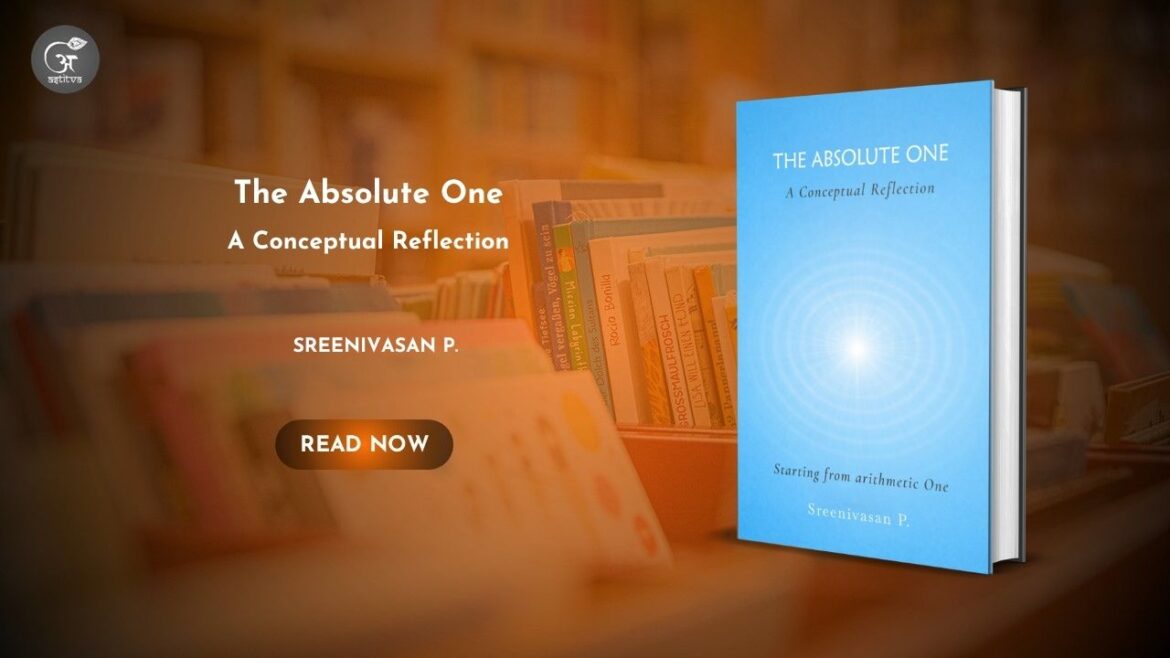
A thought-provoking new work, The Absolute One: A Conceptual Reflection by Sreenivasan P., invites readers into a deeply reflective journey that challenges conventional ways of understanding the universe, existence, and the nature of unity. Rooted in the simplest arithmetic idea of “1.”, the book unfolds into a profound philosophical exploration that bridges the gap between numbers and being, quantity and presence, logic and reality.
Rather than relying on complex equations or technical scientific frameworks, the author approaches fundamental questions through clear and disciplined reasoning. The book examines how multiplicity—everything we perceive as diverse and separate—can emerge from a single origin without requiring any external shift or division. In doing so, it gently questions long-held assumptions about how the universe generates and sustains itself, offering readers a fresh lens to reconsider the idea of “oneness” at the core of existence.
What makes this work especially compelling is its accessibility. Sreenivasan P. deliberately avoids dense academic language, instead choosing a path of clarity that welcomes readers from all backgrounds. Whether one is interested in philosophy, mathematics, or simply the deeper nature of reality, the narrative encourages contemplation without demanding specialized knowledge. The result is a book that feels both intellectually engaging and personally resonant.
At its heart, The Absolute One is not just an abstract inquiry—it is a meditation on how we understand existence itself. By distinguishing between quantitative operations and ontological presence, the book opens up a space for readers to reflect on what it truly means for something to “be,” beyond measurement or calculation.
Sreenivasan P., an independent thinker and a retired individual, brings a unique perspective shaped not by formal academic training, but by years of careful thought and lived experience. His interests span logic, mathematics, physics, and philosophy, yet his approach remains grounded in simplicity and first principles. Through analogy, logical consistency, and an unwavering commitment to clarity, he presents ideas that feel both original and deeply intuitive.
This book stands as a testament to the power of reflective thinking and the idea that meaningful insights into the universe are not limited to formal institutions or technical expertise. Instead, they can emerge from a sincere and persistent engagement with the most basic questions of existence.
The Absolute One: A Conceptual Reflection is more than just a book—it is an invitation to pause, think, and reconnect with the fundamental unity underlying all things.