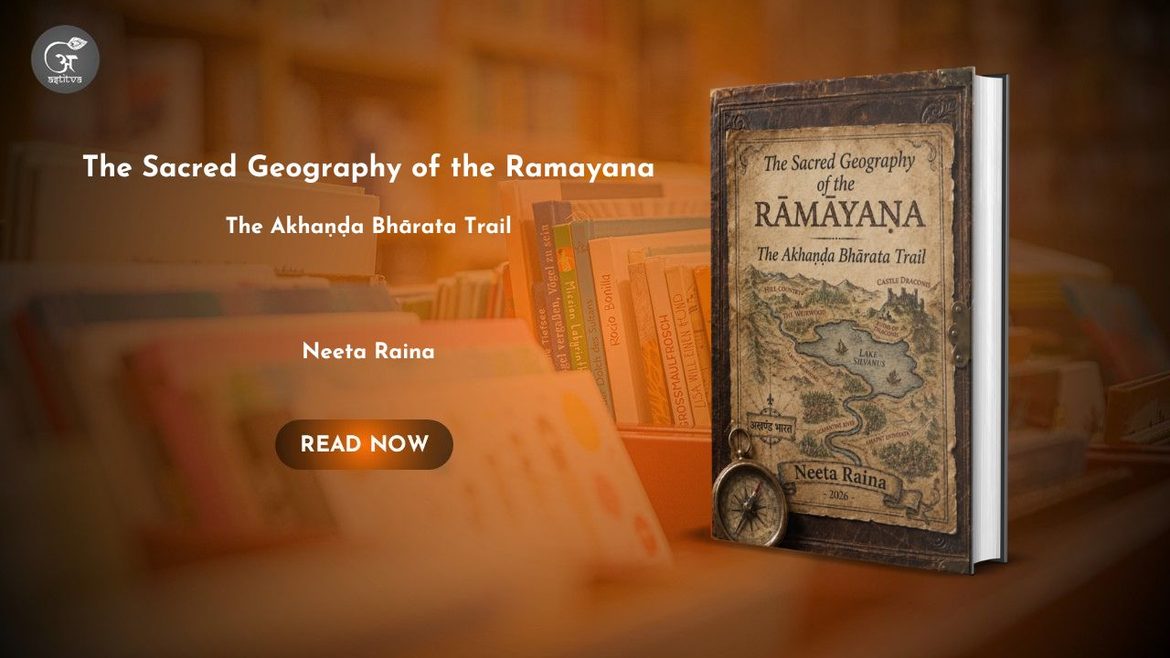
The Sacred Geography of the Ramayana: The Akhaṇḍa Bhārata Trail by Neeta Raina offers a bold and unconventional exploration of the Ramayana through the lens of geography, archaeology, linguistics, and civilizational history. Moving beyond conventional interpretations of the epic as solely a theological or literary text, the book examines the journeys of the vanaras and the landscapes described in the Ramayana as clues to an expansive geographic world connected by routes, terrains, rivers, mountains, and ancient settlements.
At the heart of the book is the idea of Akhaṇḍa Bhārata as more than a symbolic civilizational concept. Neeta Raina investigates it as a geographical reality whose traces may be explored through archaeological sites, ancient place names, physical landscapes, and cultural connections extending across regions and continents. By following the routes associated with the Ramayana, the author invites readers to reconsider the scale of the world known to, travelled through, or imagined by ancient Indian civilization.
One of the book’s distinctive contributions lies in its examination of ancient rivers and mountains whose names have survived across different parts of the world. Drawing upon Sanskrit sources and etymological analysis, Raina explores possible linguistic relationships and meanings behind these ancient geographical names. These connections form an important part of her larger attempt to reconstruct a civilizational map in which language, landscape, memory, and movement intersect.
The journey of the vanaras becomes a particularly fascinating framework for this exploration. Their search, movement, and descriptions of distant lands provide the foundation for tracing a network of landscapes that extends far beyond the familiar geographic boundaries associated with the Ramayana. Mountains, rivers, forests, coastlines, and settlements become markers in a larger trail—one that the author presents as evidence worthy of renewed investigation and discussion.
Rather than presenting a conventional retelling of the Ramayana, The Sacred Geography of the Ramayana: The Akhaṇḍa Bhārata Trail approaches the epic as a geographical narrative. It asks readers to look closely at descriptions that are often treated as poetic imagery and consider whether they may also preserve memories of actual terrains, routes, and locations. This approach creates a fascinating intersection between epic literature and the study of geography, archaeology, historical linguistics, and civilization.
Neeta Raina brings a distinctly interdisciplinary perspective to this ambitious work. She holds a Master’s Degree in Political Science and an M.Phil in Chinese and Japanese Studies from the University of Delhi, along with an MBA in Business Management from the University of Cleveland, Ohio, USA. Her academic background spans geopolitics, Asian civilizations, and strategic thought, providing a distinctive foundation for her study of civilizational geography. Her extensive experience in media management further strengthens her ability to examine how narratives are constructed, communicated, remembered, and received.
With its detailed research, unconventional connections, and wide-ranging geographical inquiry, the book encourages readers to approach the Ramayana from a fresh perspective. It does not simply ask where the epic took place; it asks how its routes, landscapes, names, and geographical descriptions might help us understand the ancient world and the movement of ideas and peoples across it.
The Sacred Geography of the Ramayana: The Akhaṇḍa Bhārata Trail is therefore an invitation to undertake an intellectual journey—one that moves from the familiar landscapes of the Ramayana toward a much wider civilizational map. By bringing together mythology, geography, archaeology, Sanskrit etymology, geopolitics, and historical memory, Neeta Raina presents a thought-provoking work that challenges established boundaries and encourages readers to look at one of India’s greatest epics through an entirely new geographical lens.
For readers interested in the Ramayana, ancient Indian civilization, historical geography, archaeology, Sanskrit studies, and the enduring question of how civilizations remember their past, this book offers a compelling and thought-provoking trail to explore.