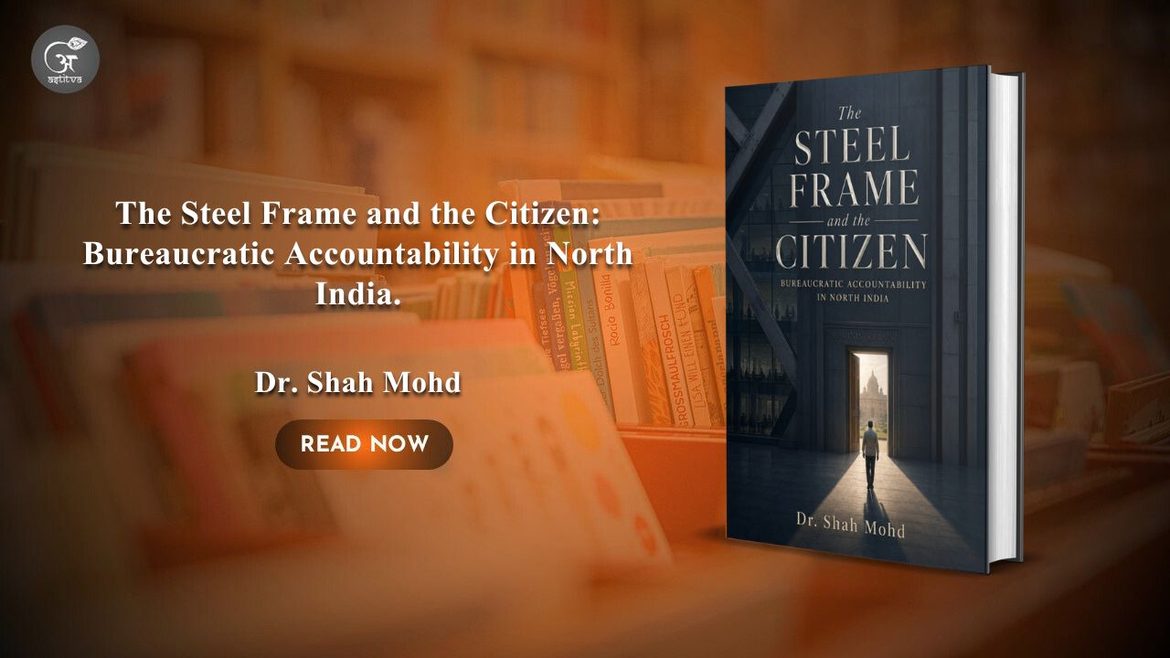
Dr. Shah Mohd’s The Steel Frame and the Citizen: Bureaucratic Accountability in North India offers a timely and insightful examination of the relationship between India’s administrative machinery and the citizens it is ultimately designed to serve.
A new academic work, The Steel Frame and the Citizen: Bureaucratic Accountability in North India, authored by Dr. Shah Mohd, provides a comprehensive study of the institutional structures, administrative practices, and democratic responsibilities of the Indian Civil Services at the sub-national level.
The phrase “steel frame” has long been associated with India’s civil services, reflecting their central role in maintaining administrative continuity and implementing public policy. However, in a rapidly changing democratic environment, the administrative system faces increasingly complex demands for transparency, responsiveness, social equity, efficiency, and citizen participation. Dr. Shah Mohd’s book explores this evolving landscape and critically examines what bureaucratic accountability means in practice.
Focusing particularly on the socio-political and economic realities of North India, the book moves beyond conventional theoretical discussions to investigate the functioning of public administration at the grassroots level. It examines the challenges that arise between policy formulation at the state level and its actual implementation in local communities. Issues such as systemic bottlenecks, political interference, discretionary administrative authority, institutional limitations, and weaknesses in public service delivery receive careful attention.
One of the central concerns of the book is the gap that can emerge between the state apparatus and the everyday experiences of citizens. While government policies may be carefully designed, their effectiveness ultimately depends on how they are interpreted, implemented, and monitored at the local level. The book therefore places citizen experience at the heart of its analysis and asks important questions about responsibility, responsiveness, and institutional performance.
Dr. Shah Mohd also highlights the role of civil society and formal accountability mechanisms in challenging bureaucratic inertia. Democratic governance, the book argues, cannot depend solely on administrative structures; it also requires effective oversight, public participation, institutional transparency, and mechanisms through which citizens can question and evaluate government performance.
The publication is particularly relevant at a time when debates surrounding good governance, administrative reform, decentralisation, transparency, and citizen-centric public services are gaining increasing importance. By connecting foundational theories of public administration with contemporary institutional realities, the book offers readers a nuanced perspective on the strengths and limitations of India’s bureaucratic system.
The book is expected to be a valuable resource for scholars, researchers, policymakers, educators, administrators, and students of Public Administration, Political Science, Public Policy, South Asian Studies, and Democratic Governance. Its interdisciplinary approach makes it useful both as an academic reference and as a contribution to broader discussions on institutional reform and democratic accountability.
Dr. Shah Mohd is a researcher, educator, and author whose scholarly work focuses on Public Administration and Political Science. He holds a Ph.D. in Public Administration, with research centred on bureaucratic responsibility toward citizens and sustainable systems of good governance. His academic qualifications also include UGC NET, JKSET, CTET, and a Bachelor of Education (B.Ed.).
Through his textbooks and peer-reviewed research, Dr. Shah Mohd has contributed to academic discussions concerning local development, public-sector efficiency, and urban-rural linkages. His research brings together administrative theory and empirical perspectives on institutional reform, offering practical and pedagogical insights into contemporary challenges in public management.
With The Steel Frame and the Citizen, Dr. Shah Mohd adds an important voice to the continuing conversation about how India’s administrative institutions can become more accountable, responsive, and closely connected to the people they serve. The book ultimately invites readers to reconsider the meaning of the “steel frame” in a modern democracy—not simply as an enduring administrative structure, but as an institution whose legitimacy depends upon its responsibility to the citizen.