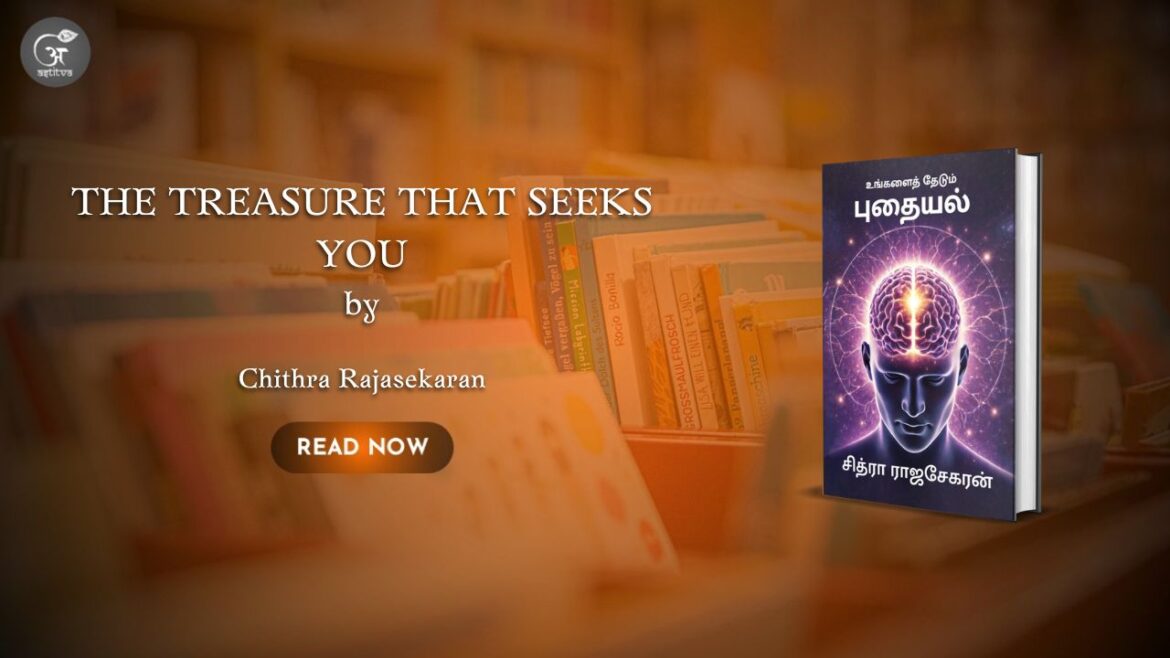
The literary world welcomes an insightful and thought-provoking addition with the release of The Treasure That Seeks You by Chithra Rajasekaran. In an age defined by speed, ambition, and relentless competition, this book pauses to ask the questions many silently carry but rarely articulate. Why do some people flourish while others struggle despite similar opportunities? Why do intelligence, morality, success, and happiness vary so dramatically from one individual to another? What truly governs the trajectory of a human life? Through years of disciplined inquiry and reflective study, Rajasekaran offers a compelling perspective that challenges conventional assumptions about success, intelligence, and human potential.
At its core, The Treasure That Seeks You explores a profound yet often overlooked idea: the gradual decline of what the author terms “natural intelligence.” According to Rajasekaran, most of life’s persistent challenges—whether personal, social, or professional—can be traced back to the weakening of this innate human capacity. Drawing upon sixteen years of research across literary works, spiritual scriptures, philosophical traditions, and medical research articles, she constructs a framework that connects ancient wisdom with contemporary scientific understanding. The result is neither purely philosophical nor strictly academic; rather, it is a carefully woven narrative that bridges intellect and lived experience.
The book begins with familiar observations. Human beings are born, educated, employed, and conditioned to participate in what is often described as the “race of life.” While many follow similar paths, their outcomes differ dramatically. Some accumulate wealth and influence; others struggle for stability. Some display moral clarity; others falter. Rajasekaran argues that these differences are not merely products of luck or circumstance but are deeply connected to the state and functioning of one’s internal intelligences. She expands the common belief that humans possess six senses and instead introduces the reader to a broader spectrum of intelligences—many of which remain dormant or underdeveloped in most individuals.
One of the book’s most striking contributions is its attempt to make readers self-reflective about their own cognitive and emotional architecture. Rajasekaran asks a deceptively simple question: “Do you have intelligence?” While the obvious answer is yes, the author invites readers to go further. How many forms of intelligence do you possess? How many are active? How effectively are they functioning? By reframing intelligence as a dynamic, multidimensional phenomenon rather than a static trait measured by academic success or IQ scores, the book opens new pathways for personal growth and accountability.
Importantly, The Treasure That Seeks You does not remain in the realm of abstract theory. The author supports her insights with research-based discussions, real-life examples, and accessible explanations that allow readers from diverse backgrounds to engage with the material. Her writing style is clear, structured, and purposeful, reflecting both her academic training and her years of classroom experience. The book does not preach or prescribe rigid doctrines; instead, it invites exploration. It suggests that understanding one’s own intellectual potential can reshape decisions, relationships, health, and ultimately, destiny.
Rajasekaran’s professional journey significantly enriches the credibility of her work. Holding a Master’s degree in Electronics and Communication Engineering, she has served as an Assistant Professor in multiple engineering institutions. It was within the classroom environment that she first began noticing deeper patterns. Despite access to education, many students struggled not merely with academics but with focus, clarity, emotional balance, and resilience. These observations prompted her to examine the interconnectedness of intelligence, mind, and health. Over time, her inquiry expanded beyond textbooks to include ancient literary traditions, philosophical writings, ancestral lifestyles, and natural medical research.
As the founder of the NI Initiative—an organization committed to preserving and enhancing natural intelligence—Rajasekaran has spent the past several years sharing her findings with hundreds of participants through structured sessions and classes. The practical engagement with learners allowed her to test, refine, and contextualize her insights. This lived interaction gives the book a grounded tone; it emerges not from detached speculation but from sustained observation and dialogue.
The release of The Treasure That Seeks You comes at a time when discussions about mental health, cognitive overload, digital distraction, and declining attention spans dominate public discourse. In this context, the book feels particularly relevant. It suggests that the solutions to many modern problems may lie not in external accumulation but in internal restoration. By reclaiming and strengthening natural intelligence, individuals may rediscover clarity of purpose, resilience in adversity, and alignment between thought and action.
Ultimately, the book positions itself as both a mirror and a map. It reflects the reader’s present condition while offering direction toward a more conscious and empowered life. The “treasure” in the title is not material wealth or external recognition; it is the awakening of one’s intrinsic capacity. Rajasekaran emphasizes that each person carries within them extraordinary potential, often veiled by ignorance, habit, and societal conditioning. When these veils are lifted, life begins to transform from a competitive race into a meaningful journey.
With its blend of research, introspection, and practical wisdom, The Treasure That Seeks You stands as an invitation—to question, to rediscover, and to realign. It encourages readers to move beyond passive existence and actively engage with the deeper dimensions of their own intelligence. In doing so, it promises not merely information but insight, not merely reading but realization.