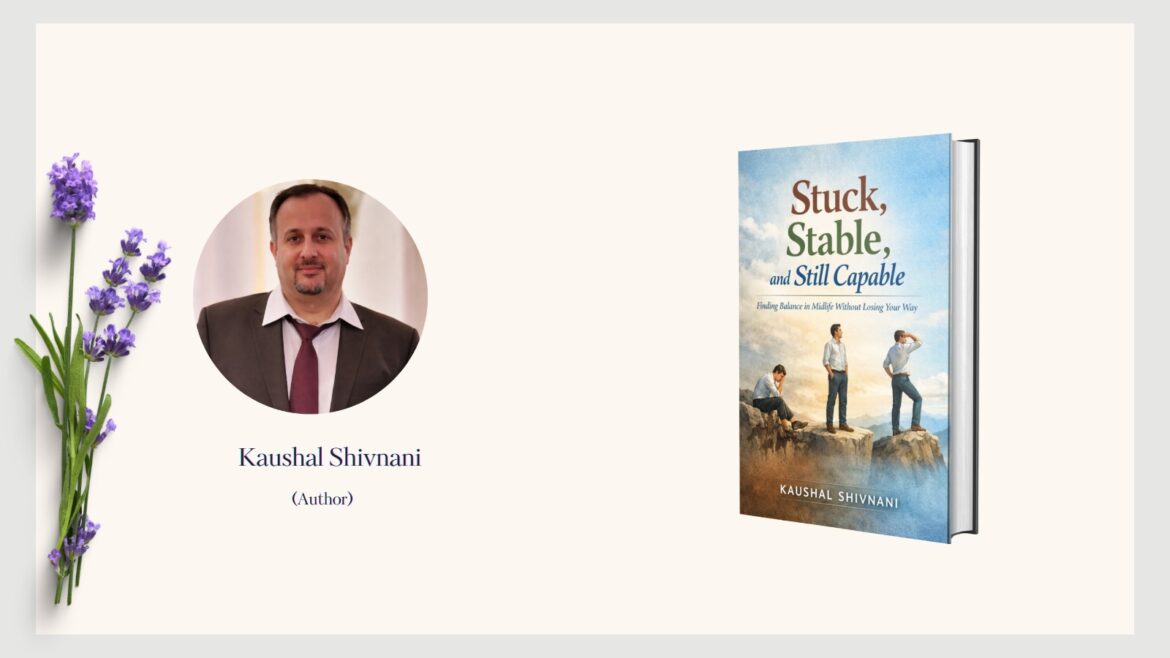
Stuck, Stable, and Still Capable
In a professional culture that celebrates speed, reinvention, and relentless upward movement, Kaushal Shivnani offers something both rare and necessary: calm clarity. His book, Stuck, Stable, and Still Capable, is not a manifesto for radical change or dramatic career pivots. Instead, it is a steady, thoughtful guide for mid-career professionals who find themselves at a crossroads — not because they lack ability, but because they have more to protect.
Kaushal Shivnani writes for those who have already built something meaningful. They have responsibilities, reputations, families, financial commitments, and a rhythm of life that works — mostly. Yet, somewhere along the way, questions begin to surface. Am I stuck? Should I be doing more? Is this stability a strength — or a silent compromise?
Rather than feeding anxiety with urgency, Shivnani reframes the conversation. After mid-career, he argues, the real skill is not speed. It is judgment under pressure.
What distinguishes Kaushal Shivnani as an author is his refusal to sensationalize career growth. In an era crowded with productivity hacks, overnight success formulas, and aggressive “10X” strategies, Stuck, Stable, and Still Capable stands apart for its restraint. The book avoids hype and tactics. It does not promise quick exits or exponential breakthroughs. Instead, it focuses on clear thinking — particularly around career choices, money, and side income.
Shivnani understands that mid-career decisions carry weight. A wrong move at 25 can be absorbed. A wrong move at 45 can ripple through a family’s stability, financial planning, and long-term security. His writing acknowledges this reality without fearmongering. He respects the reader’s intelligence and experience.
The professionals he speaks to are not inexperienced. They are capable, often highly competent individuals who may feel a quiet restlessness — but who also recognize that reckless change is not bravery. It is risk.
Redefining “Stuck”
One of the most powerful contributions of Stuck, Stable, and Still Capable is its reframing of what it means to feel “stuck.” Shivnani challenges the assumption that stability equals stagnation. He invites readers to examine whether their dissatisfaction stems from genuine misalignment — or from comparison.
Mid-career professionals often compare themselves to founders, influencers, or peers making bold moves. Social media amplifies stories of reinvention and rapid wealth creation. Against that backdrop, a stable career can feel underwhelming.
Shivnani counters this narrative with grounded logic. Stability is not mediocrity. It is often the result of years of disciplined decisions. A steady income, professional credibility, and predictable structure are not signs of failure. They are assets.
The book gently reminds readers: You are not late. You are not broken. You are still capable — just more selective.
A central theme of Shivnani’s work is the evolution of skill across a career. Early stages reward energy, adaptability, and speed. Mid-career demands something different — discernment. The ability to say no. The ability to evaluate risk calmly. The ability to protect what works.
He emphasizes that good judgment becomes the defining advantage after mid-career. This includes evaluating job changes not just by salary bumps, but by long-term sustainability. It includes assessing side income opportunities not by hype, but by effort-to-return ratio. It includes understanding when ambition becomes ego-driven rather than purpose-driven.
Shivnani does not discourage growth. Instead, he advocates deliberate growth — growth that does not damage a good life.
Clear Thinking About Money and Side Income
Financial decision-making is another cornerstone of Stuck, Stable, and Still Capable. Rather than encouraging dramatic exits from stable employment to pursue uncertain ventures, Shivnani guides readers through measured alternatives.
He explores how to think about side income without jeopardizing primary stability. He addresses the emotional pressure to “do more” financially and separates genuine opportunity from costly distraction. His approach is analytical yet empathetic, acknowledging the psychological weight of financial decisions at this stage of life.
Importantly, the book is not about maximizing income at all costs. It is about avoiding expensive mistakes. Shivnani’s philosophy is rooted in preservation — of capital, of time, of reputation, and of mental bandwidth.
Choosing Stability Without Guilt
Perhaps the most reassuring aspect of Shivnani’s message is his defense of stability. In modern professional discourse, stability is often framed as settling. Ambition is celebrated; contentment is suspect.
Shivnani dismantles this false dichotomy. Choosing stability can be strategic. It can reflect clarity about priorities. It can be an intelligent acknowledgment that peace, predictability, and manageable risk are valuable.
He encourages readers to release guilt around not wanting to chase every opportunity. Being selective is not weakness; it is maturity.
This perspective resonates deeply with professionals who feel pressured by cultural narratives of constant escalation. Shivnani gives them permission to pause, assess, and proceed thoughtfully.