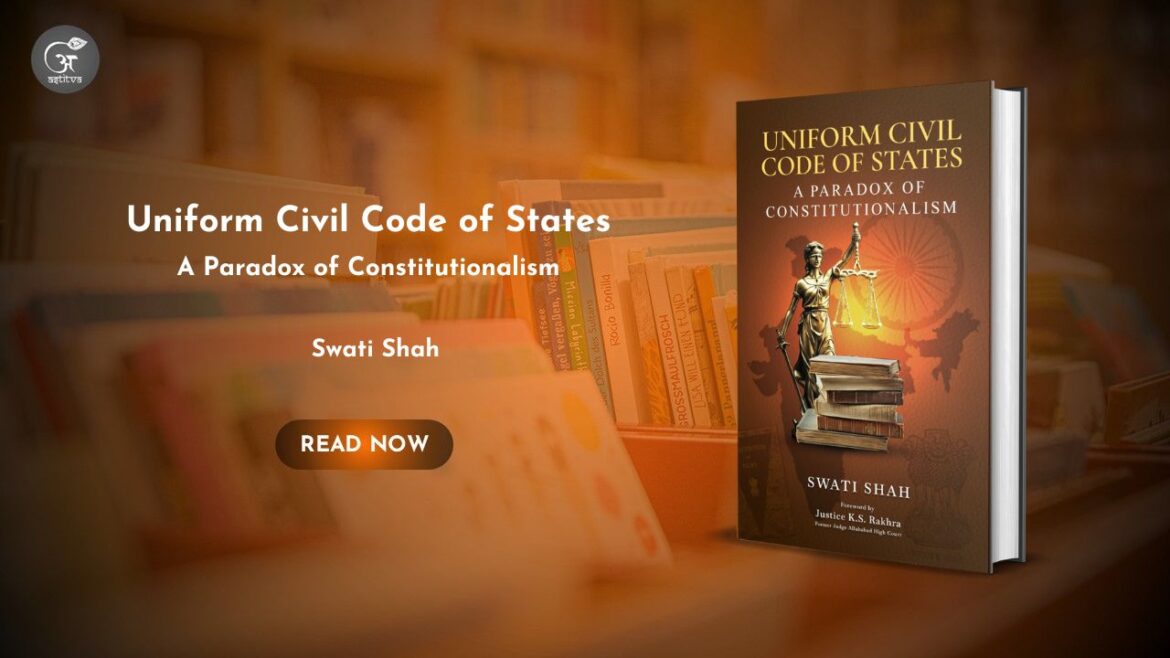
In an era where constitutional debates are increasingly shaping public discourse in India, Uniform Civil Code of States: A Paradox of Constitutionalism by Swati Shah emerges as a timely and thought-provoking contribution to the field of legal scholarship. The book delves into one of the most complex and debated subjects in Indian constitutional law—the Uniform Civil Code (UCC)—while situating it within the broader socio-political and legal framework of the country.
Designed as a comprehensive guide for students of Law, Political Science, research scholars, and aspirants preparing for competitive examinations such as PCS (J) and Higher Judicial Services, the book offers a structured and analytical approach to understanding constitutional law in the present context. Recognizing that constitutional law forms a substantial portion of competitive law examination syllabi, the author skillfully bridges the gap between academic theory and practical application, making the subject more accessible and relevant for readers.
The book explores critical constitutional concerns, particularly the socio-legal dimensions of personal laws in India and the ongoing debate surrounding the desirability and feasibility of implementing a Uniform Civil Code. By examining legal reforms in personal laws across different countries, it provides a comparative perspective that enriches the reader’s understanding of how similar issues are addressed globally. Additionally, the work sheds light on reforms related to the Directive Principles of State Policy, emphasizing their evolving role in shaping modern constitutional governance.
A key strength of the book lies in its reliance on significant judicial observations, including landmark judgments such as the Minerva Mills case. Through careful analysis of these decisions, the author highlights the delicate balance between fundamental rights and directive principles, offering readers a deeper insight into the constitutional philosophy of India. The discussion is presented in a clear, systematic manner, enabling readers to grasp complex legal concepts with ease while also preparing effectively for examination-oriented questions.
Swati Shah brings to this work a rich blend of academic excellence and practical legal experience. Having begun her professional journey by practicing at the State Commission in Lucknow, she has developed a strong foundation in legal practice. She completed her law graduation from Fergusson Law College, Pune, and pursued her LL.M from Gautam Buddha University, Noida. Her academic achievements are further underscored by her success in prestigious competitive examinations such as CLAT, UP PCS (J) Mains, and UGC-NET.
With experience in legal practice as well as work with law firms, the author has cultivated deep expertise in Constitutional Law and Family Law. Her scholarly contributions include several research papers published in UGC-listed journals, reflecting her commitment to advancing legal knowledge. Beyond her professional and academic pursuits, she has been actively engaged in teaching and mentoring students, guiding numerous aspirants preparing for PCS (J) and UGC-NET examinations.
This book is not merely an academic resource but also a reflection of the author’s dedication to legal education and her understanding of the challenges faced by students and aspirants. By combining conceptual clarity with practical insights, Uniform Civil Code of States: A Paradox of Constitutionalism stands out as an essential read for anyone seeking to navigate the complexities of constitutional law in India. It is a valuable addition to the library of students, educators, and legal professionals alike, offering both intellectual depth and practical relevance in today’s evolving legal landscape.