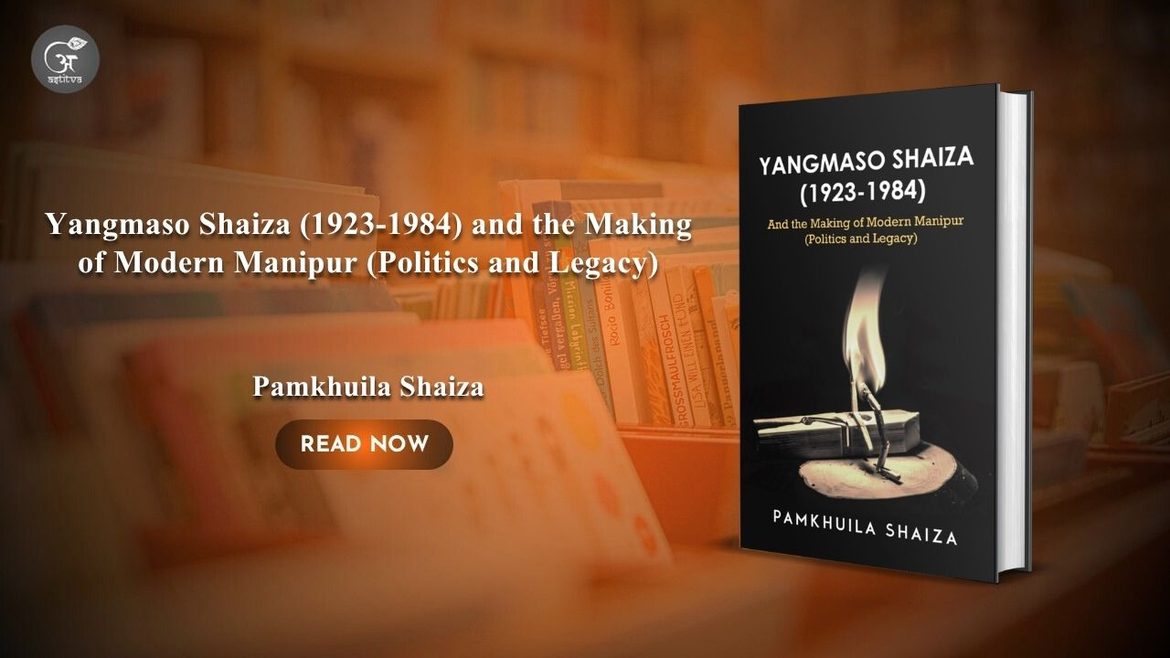
Yangmaso Shaiza (1923–1984) and the Making of Modern Manipur: Politics and Legacy by Pamkhuila Shaiza offers a significant historical study of one of the most influential political figures in modern Manipur. Going beyond a conventional biography, the book examines the life, political career, and legacy of Yangmaso Shaiza while placing his story within the wider historical developments that shaped Manipur and Northeast India during a crucial period of political transformation.
Yangmaso Shaiza holds a distinctive place in the political history of Manipur as the state’s first tribal Chief Minister. His political journey unfolded against the complex backdrop of postcolonial state formation, ethnic diversity, democratic transition, and competing political aspirations in Northeast India. Through his life and work, the book explores the opportunities and challenges faced by indigenous political leaders as newly independent India sought to establish institutions of governance across culturally and politically diverse regions.
Drawing on oral histories, family archives, political records, and indigenous perspectives, Pamkhuila Shaiza reconstructs the history of the Shaiza family and its important place in the political and social development of the region. The family becomes more than a biographical subject; it serves as a lens through which the evolution of tribal politics, education, civic development, leadership, and institution-building in Manipur can be understood.
The book also brings attention to the contributions of Shangyang Shaiza to education and civic development, alongside the political careers of Yangmaso Shaiza and Hangmila Shaiza. Their historical connections with prominent figures such as A.Z. Phizo and Rano Shaiza further illuminate the wider networks of Naga political thought and leadership during a period marked by profound political uncertainty.
Among the important historical developments examined in the book are the assassination of Yangmaso Shaiza, the 1975 Shillong Accord, Naga political movements, and the Sadar Hills controversy. These events are explored not simply as isolated moments in history, but as part of larger and continuing questions surrounding democracy, indigenous identity, political representation, state authority, and armed conflict.
A particularly important feature of the study is its engagement with indigenous historiography. By combining archival research with oral narratives and indigenous perspectives, the book seeks to recover historical voices and experiences that have often remained overlooked in mainstream accounts. This approach provides a richer understanding of the political history of Manipur while challenging readers to consider how history is recorded, interpreted, and remembered.
Pamkhuila Shaiza’s wider research focuses on the social and cultural history of the Naga tribes of North-East India, particularly the processes of change and continuity following the arrival of colonialism and Christianity. Situated within Indigenous Studies, the author’s work considers colonial encounters, cultural transformation, identity formation, marginalisation, and Indigenous resilience. This intellectual perspective informs the present volume and enables the history of the Shaiza family to be connected with broader questions of Indigenous modernity.
Yangmaso Shaiza (1923–1984) and the Making of Modern Manipur: Politics and Legacy is therefore both a historical study and an effort to preserve overlooked narratives of political and cultural transformation. By bringing together family history, political history, archival evidence, and indigenous perspectives, the book offers valuable insights into Manipur’s past and the continuing complexities of identity and governance in Northeast India. It will be of particular interest to scholars, students, researchers, and readers seeking a deeper understanding of Manipur, Naga history, Indigenous politics, and postcolonial South Asia.