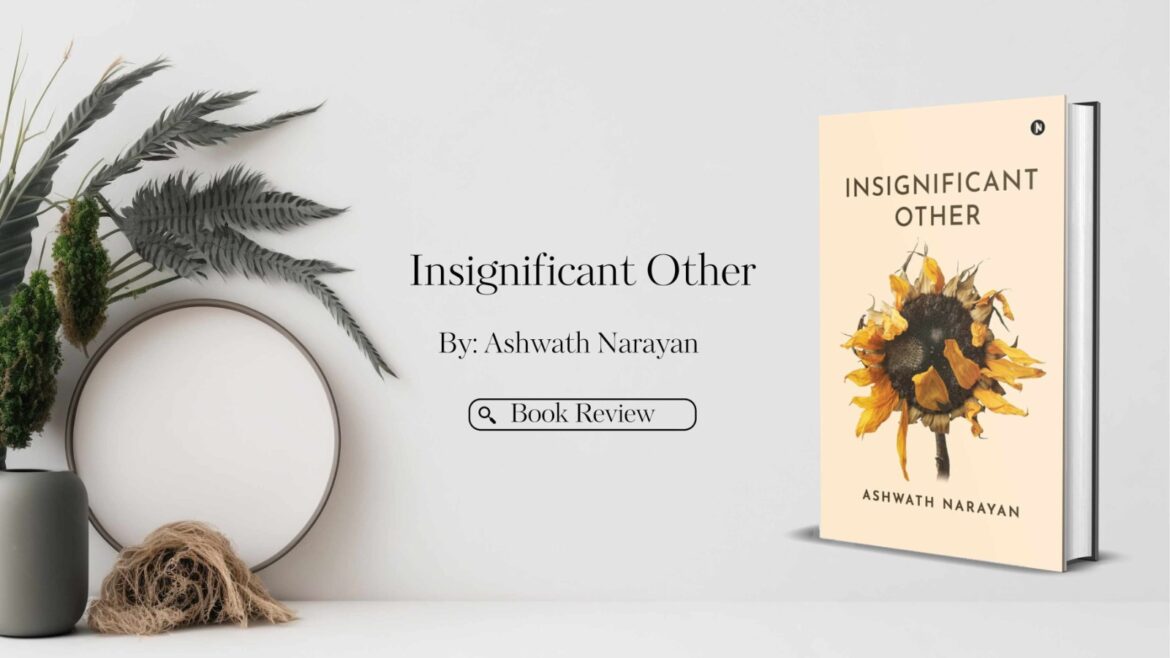
Some books seek to entertain, others to inspire, and a few dare to hold up an unflinching mirror to the most vulnerable corners of the human experience. Insignificant Other by Ashwath Narayan belongs firmly in the latter category. It is an emotionally charged and psychologically perceptive work that examines what it means to lose oneself in the pursuit of love, only to discover that the relationship one cherished never occupied the same emotional space in another person’s life. Rather than offering comforting answers or romantic ideals, the book invites readers into an intimate exploration of attachment, emotional dependency, grief, and ultimately, self-reclamation.
The title itself is one of the book’s greatest strengths. By transforming the familiar phrase “significant other” into “insignificant other,” Narayan immediately establishes the emotional terrain the narrative seeks to explore. It is a phrase that resonates long after the final page, encapsulating the painful realization that one can invest wholeheartedly in a relationship while remaining emotionally peripheral in another person’s world. This linguistic inversion is more than clever wordplay; it becomes the central metaphor around which the entire work revolves.
Narayan approaches the subject with remarkable honesty. There is little attempt to soften the discomfort that accompanies emotional neglect, manipulation, or the gradual erosion of identity within an unhealthy relationship. Instead, the writing embraces vulnerability as its greatest strength. The emotional landscape is presented with an authenticity that avoids melodrama, allowing the pain to emerge naturally through reflection rather than exaggeration. Readers are invited not merely to witness heartbreak but to understand the subtle psychological processes that transform affection into dependency and intimacy into isolation.
One of the book’s most compelling achievements is its exploration of narcissistic relationship dynamics. Rather than reducing complex emotional experiences to simplistic labels, Narayan presents these dynamics as evolving patterns that gradually reshape perception, self-worth, and emotional reality. The narrative carefully illustrates how idealization can transition into emotional manipulation and how affection, when unevenly distributed, can become a powerful instrument of control. The psychological insights woven throughout the text add considerable depth, encouraging readers to examine relationships beyond surface appearances and recognize the often invisible mechanisms that sustain emotional imbalance.
The queer relationship at the heart of the book is presented with honesty and nuance, without allowing identity to overshadow the universality of its emotional themes. While the experiences described emerge from a queer perspective, the emotions themselves—longing, rejection, hope, confusion, and grief—remain deeply human and widely relatable. This universality broadens the book’s appeal, making it accessible to readers regardless of their personal identities while simultaneously offering meaningful representation through its authentic perspective. Narayan succeeds in portraying queer love neither as exceptional nor symbolic but simply as love in all its beauty and complexity.
Perhaps the book’s greatest literary accomplishment lies in its refusal to present healing as linear or convenient. Emotional recovery unfolds gradually, marked by setbacks, moments of clarity, recurring doubts, and painful realizations. Rather than celebrating resilience through dramatic transformation, the narrative acknowledges that reclaiming one’s identity after emotional devastation is often an uneven process requiring patience and self-compassion. This measured portrayal lends credibility to the work and deepens its emotional impact.
Narayan’s background as both a physician and an artist appears to inform the narrative in subtle but meaningful ways. There is an analytical precision in the psychological observations that complements the emotional openness of the prose. Relationships are examined almost diagnostically at times, yet never lose their emotional resonance. This balance between intellect and feeling distinguishes Insignificant Other from many contemporary memoirs and relationship narratives that lean too heavily toward either emotional confession or theoretical analysis. Here, the emotional and psychological dimensions continually enrich one another.
The prose itself deserves recognition for its restraint. Rather than relying on ornate language or excessive sentimentality, Narayan writes with clarity and precision. The simplicity of the language allows the emotional weight to emerge organically, making moments of realization particularly striking. Silence, absence, and emotional distance often communicate more powerfully than overt declarations of pain. This understated style reflects confidence in both the subject matter and the reader’s ability to engage thoughtfully with complex emotional experiences.
Beyond its exploration of romantic relationships, the book ultimately becomes a meditation on identity. It asks unsettling but necessary questions: Who are we when another person’s validation defines our worth? What remains when the relationship that shaped our emotional world dissolves? How do we rebuild an identity that has become dependent upon external affirmation? These questions elevate the narrative beyond the confines of personal memoir, transforming it into a broader philosophical reflection on selfhood and emotional independence.
Readers familiar with trauma-informed psychology or attachment theory will appreciate the subtle ways in which these concepts inform the narrative without becoming academically burdensome. At the same time, those approaching the subject without prior psychological knowledge will find the book accessible and emotionally engaging. Narayan manages the difficult task of educating without lecturing, allowing emotional experience to illustrate psychological truths more effectively than theoretical explanation alone could achieve.
The emotional intensity of Insignificant Other may not make it an effortless read, nor does it aspire to be. Instead, it demands reflection and emotional engagement. There are passages likely to resonate deeply with anyone who has questioned their worth after the end of an unequal relationship or struggled to distinguish love from emotional dependency. Yet despite its exploration of pain, the book never descends into hopelessness. Embedded within its honesty is a quiet affirmation that healing begins when individuals reclaim the authority to define themselves independently of another person’s acceptance or rejection.
In an era where conversations surrounding mental health, emotional abuse, attachment, and identity continue to gain greater visibility, Insignificant Other arrives as a thoughtful and deeply relevant contribution. It neither sensationalizes suffering nor simplifies recovery. Instead, it offers readers something far more enduring: the reassurance that even after becoming insignificant in someone else’s story, one can still become profoundly significant in one’s own. Through emotional courage, psychological insight, and elegant restraint, Ashwath Narayan has created a work that lingers long after the final page, inviting readers to reconsider not only how they love others, but also how they choose to value themselves.