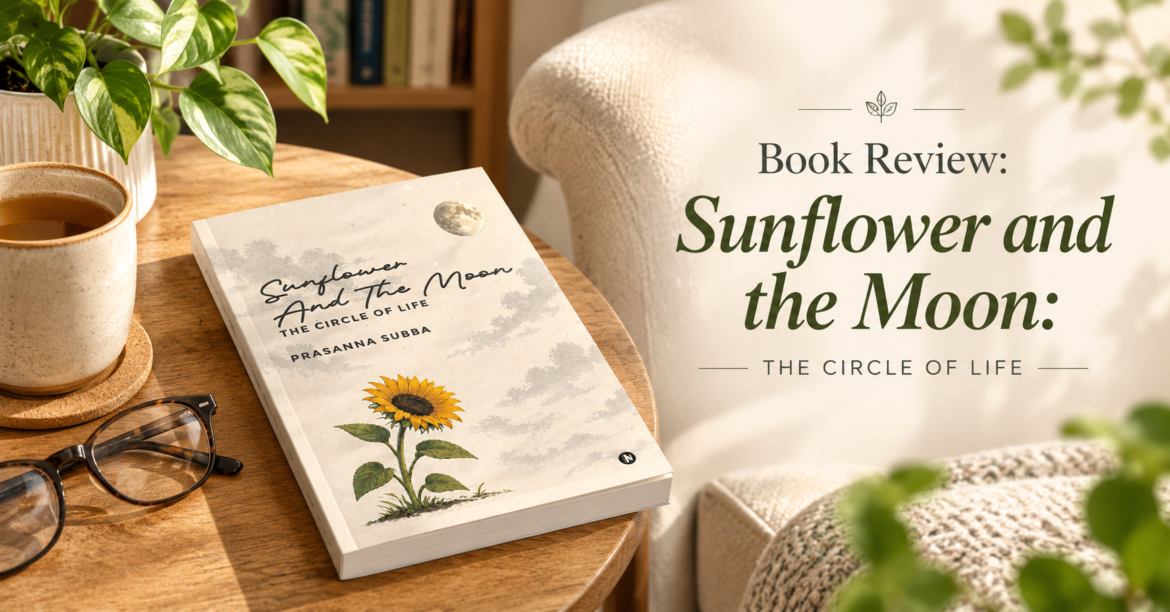
Some books tell a story, while others invite readers to pause and look more closely at the emotions, memories, and experiences that shape their lives. Sunflower and the Moon: The Circle of Life appears to belong to the latter category, presenting a title that naturally brings to mind the rhythms of nature, the passage of time, and the connections that make human life meaningful. The author’s description suggests a work that explores the many emotions of the human heart and the less familiar territories of the mind, touching upon feelings that often remain hidden beneath the surface of everyday life. It is this focus on the inner human experience that makes the book an interesting prospect for readers who enjoy reflective writing and stories that encourage them to think about themselves and the world around them.
The title itself offers an inviting starting point for reflection. A sunflower turns towards the light, while the moon moves through its phases, changing in appearance but remaining part of a larger natural cycle. Together, these images can evoke hope, longing, change, and the quiet acceptance that life rarely remains the same for long. Although the title alone cannot reveal the full direction of the book, it creates an atmosphere of contemplation and invites readers to consider how different people respond to the changing seasons of their lives. Like the sunflower seeking sunlight, people often search for happiness, understanding, and a sense of belonging. Like the moon, they also experience phases when they feel uncertain, distant, or emotionally overwhelmed. This contrast makes the title memorable and gives it a personal significance that readers may interpret in their own ways.
One of the most relatable aspects of writing centred on human emotions is its ability to bring attention to feelings that people experience but do not always express. Happiness, sadness, love, disappointment, fear, and hope are familiar parts of life, yet each person experiences them differently. Some emotions are easy to share, while others remain buried under responsibilities, social expectations, or the simple difficulty of finding the right words. The author’s stated interest in the unexplored territories of the mind suggests an attempt to look beyond outward appearances and acknowledge the complicated emotional lives people carry within themselves. Such a perspective can be meaningful because it reminds readers that what they see in others is not always the complete story.
The human mind is rarely as straightforward as it may appear. A person can feel grateful and dissatisfied at the same time, love someone while struggling to understand them, or look forward to a new beginning while quietly grieving what has been left behind. These contradictions do not necessarily make people weak or unreasonable. They are part of being human. Literature that recognises these complexities can help readers become more patient with themselves and more understanding towards others. Rather than presenting emotions as simple problems with easy solutions, reflective writing can give readers the space to sit with uncertainty and recognise that some questions take time to answer. This is where a book exploring the inner world of its readers can find its emotional relevance.
The idea of the circle of life adds another layer to the book’s appeal. Life is full of beginnings and endings, meetings and departures, achievements and setbacks. Some experiences change a person immediately, while others reveal their significance only after time has passed. A difficult period may eventually lead to a new understanding, while a happy memory may become more precious as circumstances change. The cycle of life does not mean that every painful experience has a hidden benefit or that every loss can be easily overcome. Instead, it can remind us that change is unavoidable and that our understanding of ourselves continues to develop through different stages of living. The image of a sunflower and the moon offers a gentle way to approach this idea without reducing life’s complexities to simple lessons.
Another reason readers may connect with a reflective book is the opportunity it provides for personal interpretation. Two people can read the same passage and take away entirely different meanings because their experiences are different. Someone dealing with a major life transition may find comfort in ideas about change, while another reader may be drawn to questions of identity, relationships, or emotional growth. A book that leaves room for this kind of personal connection can continue to occupy the reader’s thoughts after the reading session ends. Its value may lie not only in what is written on the page but also in the memories and questions that the writing brings to the surface.
At the same time, writing about the human heart and mind carries an important responsibility. Emotional themes become most convincing when they are expressed through genuine observations, believable experiences, and language that feels natural rather than overly dramatic. Readers are often more deeply affected by an honest moment of vulnerability than by grand statements about life. The strongest reflective writing allows emotions to emerge naturally and trusts readers to discover their own meaning. For Sunflower and the Moon: The Circle of Life, the promise of exploring emotions that remain within each of us creates an expectation of sincerity and thoughtful engagement with the experiences that connect people across different backgrounds and stages of life.
Ultimately, Sunflower and the Moon: The Circle of Life presents a title and central idea that invite readers to reflect on the relationship between nature, emotions, and the continuous process of becoming who we are. Its stated focus on the human heart and the unexplored corners of the mind gives it the potential to resonate with those who appreciate introspective literature and thoughtful explorations of everyday life. While the full depth of the book depends on how these themes are developed in its pages, its underlying concept raises questions that remain relevant to almost everyone: how well do we understand ourselves, how honestly do we acknowledge our emotions, and how do we continue moving forward when life changes unexpectedly? These questions have no universal answers, but they are worth exploring. Sometimes, the most meaningful reading experience is not one that tells us exactly what to think, but one that helps us recognise feelings we have carried quietly for years and reminds us that, in the changing circle of life, we are never entirely alone in trying to understand them.