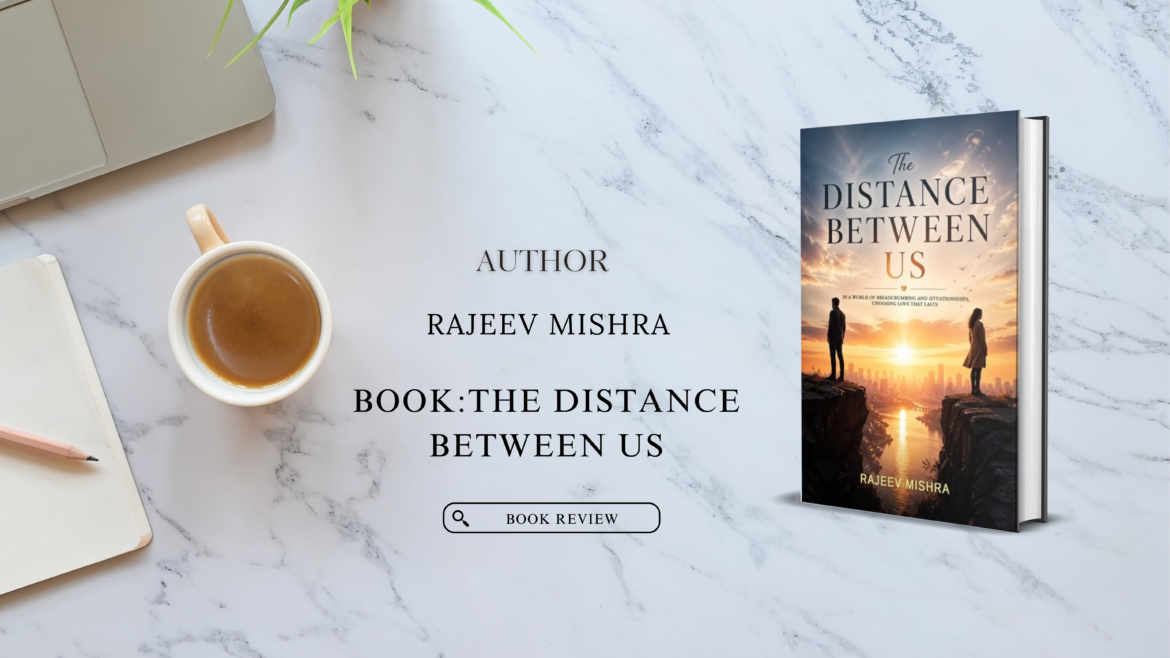
Love has always been one of literature’s most explored subjects, yet each generation experiences it differently. In an age dominated by instant messaging, social media, dating apps, and fast-paced lifestyles, relationships have become more connected on the surface while often growing emotionally distant underneath. Rajeev Mishra’s The Distance Between Us captures this paradox with remarkable sensitivity, presenting a thoughtful reflection on contemporary relationships rather than a conventional romance. It is a book that asks readers to pause, reflect, and reconsider what it truly means to love and to be loved in a world constantly competing for our attention.
At its heart, The Distance Between Us is not simply about two people navigating the complexities of a relationship. Instead, it explores the emotional spaces that silently develop between individuals over time. These distances rarely emerge through dramatic betrayals or catastrophic events. Rather, they are formed through everyday moments that often go unnoticed: conversations postponed until tomorrow, emotions hidden behind polite smiles, assumptions left unquestioned, and vulnerabilities that remain unspoken. Mishra demonstrates that relationships are shaped just as much by silence as by conversation, making the novel deeply relatable to modern readers.
One of the book’s greatest strengths is its emotional honesty. Rajeev Mishra avoids idealizing romance or presenting love as a perfect, effortless experience. Instead, he portrays relationships as living, evolving partnerships that require patience, empathy, communication, and continuous self-awareness. His characters are neither flawless nor extraordinary. They are ordinary people carrying insecurities, expectations, hopes, disappointments, and emotional baggage, making their experiences feel authentic and universally recognizable.
The narrative thoughtfully explores how modern society has transformed the way people experience intimacy. Technology has undoubtedly made communication easier, yet it has also introduced new forms of distraction and emotional absence. The novel subtly examines how people often become physically present but emotionally unavailable, constantly engaged with devices while gradually drifting away from meaningful conversations. Mishra neither condemns technology nor romanticizes the past. Instead, he realistically portrays the challenges contemporary relationships face in balancing digital connectivity with genuine human connection.
Another compelling aspect of the novel is its exploration of individuality within relationships. One of its recurring themes is that genuine love should never require the sacrifice of personal identity. Throughout the story, the author emphasizes that healthy relationships flourish when two complete individuals choose to grow together while continuing to nurture their own aspirations, values, and emotional independence. This balanced perspective offers readers a mature understanding of companionship that goes beyond traditional notions of romance.
The emotional depth of The Distance Between Us lies in its attention to the quiet moments that often define relationships more profoundly than dramatic declarations of love. Mishra beautifully illustrates how emotional intimacy is built through everyday acts of understanding, active listening, shared vulnerabilities, forgiveness, and mutual respect. At the same time, he shows how neglecting these seemingly small aspects can gradually create invisible barriers between partners. This nuanced portrayal makes the novel feel less like fiction and more like an honest reflection of real life.
Rajeev Mishra also deserves credit for addressing the complexity of emotional expectations. Many relationships struggle not because of a lack of love but because individuals silently expect their partners to understand feelings that are never expressed. The novel repeatedly reminds readers that assumptions often become the greatest obstacles to genuine connection. Through thoughtful observations rather than direct instruction, Mishra encourages emotional transparency and honest communication as the foundation of lasting relationships.
One of the book’s most admirable qualities is its refusal to offer simplistic solutions. Unlike many contemporary relationship books that promise guaranteed formulas for happiness, The Distance Between Us acknowledges that every relationship is unique. Human emotions cannot be reduced to universal rules or fixed strategies. Instead of prescribing answers, Mishra invites readers to reflect on their own experiences, encouraging introspection rather than certainty. This approach gives the narrative emotional credibility and intellectual depth.
The author’s writing style is elegant, calm, and deeply reflective. His prose avoids unnecessary melodrama, choosing instead to rely on subtle emotional observations that gradually accumulate into powerful insights. The pacing allows readers to absorb each reflection without feeling rushed, creating an immersive reading experience that feels almost conversational. His language remains accessible while maintaining literary sophistication, making the book appealing to a broad audience.
The novel also succeeds in portraying love as a journey of personal transformation. Relationships are presented not merely as partnerships but as mirrors through which individuals discover hidden aspects of themselves. Through moments of conflict, reconciliation, disappointment, and hope, the characters learn valuable lessons about trust, vulnerability, emotional resilience, and self-acceptance. Mishra suggests that while relationships may not always endure forever, they invariably leave lasting impressions that contribute to personal growth and emotional maturity.
Another significant strength is the book’s balanced emotional tone. While it addresses heartbreak, misunderstandings, loneliness, and disappointment, it never becomes overwhelmingly pessimistic. Instead, the narrative remains hopeful, emphasizing that emotional distance can often be bridged through self-awareness, compassion, and genuine effort. Even when relationships change or come to an end, the book encourages readers to view those experiences as opportunities for learning rather than failures.
The title itself, The Distance Between Us, operates on multiple levels. It represents not only physical separation but also emotional silence, psychological barriers, unspoken fears, unmet expectations, and the invisible walls people build around themselves. Mishra skillfully demonstrates that the greatest distances often exist between two people sitting side by side, unable to communicate what truly matters. This layered symbolism adds richness to the narrative and reinforces its central message.
What particularly distinguishes this book is its relevance to contemporary readers. Modern relationships face unique pressures, including demanding careers, digital distractions, changing social norms, and increasing emotional complexity. Mishra addresses these realities without becoming cynical. Instead, he offers thoughtful reflections on how meaningful relationships can still flourish when built upon honesty, empathy, patience, and mutual understanding.
The emotional intelligence reflected throughout the book makes it especially valuable for readers at different stages of life. Young adults entering relationships may gain insight into the importance of communication and self-awareness. Couples may find themselves reflecting on shared experiences and rediscovering forgotten conversations. Individuals recovering from heartbreak may find comfort in the book’s compassionate understanding that every relationship leaves behind wisdom worth carrying forward.
Beyond romance, The Distance Between Us ultimately becomes a meditation on human connection itself. It reminds readers that every meaningful relationship requires courage, not only the courage to love another person but also the courage to remain authentic, vulnerable, and emotionally present. Love, Mishra suggests, is less about perfection and more about choosing understanding over assumption, honesty over silence, and growth over comfort.
In conclusion, The Distance Between Us is a deeply reflective and emotionally intelligent exploration of modern relationships. Rajeev Mishra combines keen observations of human behavior with compassionate storytelling to create a work that resonates long after the final page. Rather than offering idealized romance or easy answers, the book encourages readers to embrace the complexities of love with greater awareness and authenticity. Insightful, mature, and profoundly relatable, it serves as both a mirror and a guide for anyone seeking to understand the delicate balance between intimacy, individuality, and emotional connection. It is a meaningful contribution to contemporary relationship literature and a rewarding read for those who believe that the strongest relationships are built not on perfection, but on understanding.