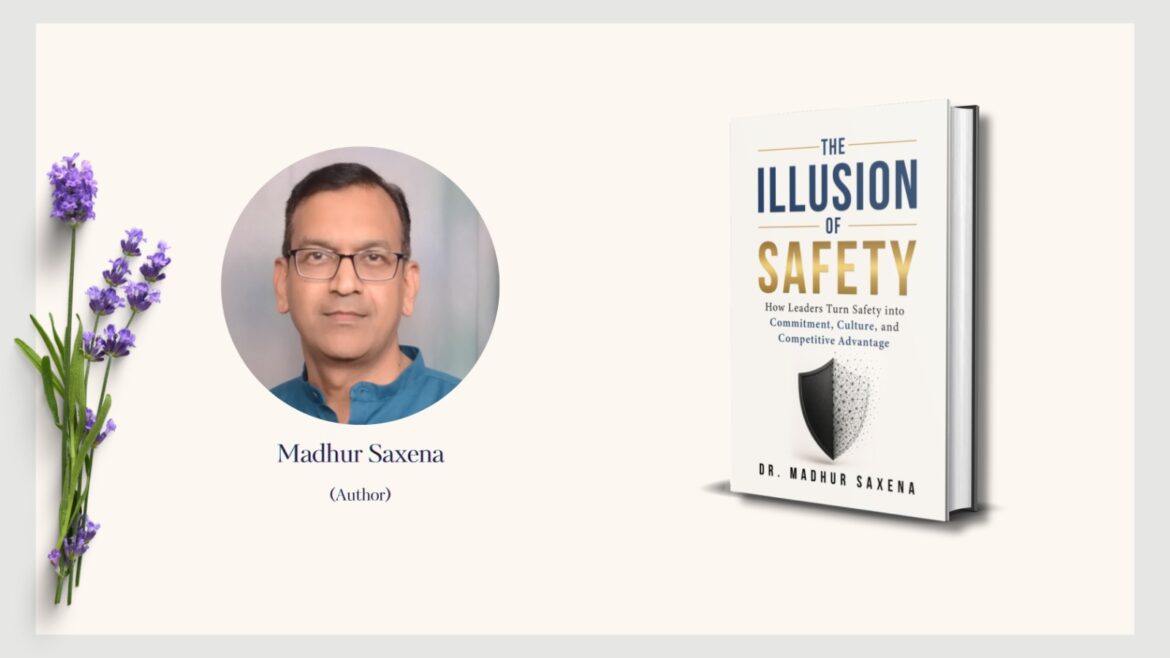
In every organization, safety is often spoken of as a top priority. It is discussed in boardrooms, reinforced in training sessions, documented in manuals, and measured through audits and compliance reports. Yet despite sophisticated systems, clearly defined procedures, and increasing awareness, incidents continue to happen across industries. These failures are not always the result of missing policies or inadequate standards. Often, they emerge from something far more subtle and far more human—a disconnect between compliance and commitment. In The Illusion of Safety, Dr. Madhur Saxena explores this critical gap with honesty, depth, and practical insight, presenting a compelling perspective on why safety often fails despite the appearance of preparedness.
What makes this book particularly impactful is its central argument: safety cannot be sustained through rules alone. Organizations may create detailed protocols, implement advanced risk controls, and invest heavily in safety infrastructure, but if the people within those systems do not genuinely believe in safety as a personal and collective responsibility, then the culture remains fragile. Dr. Saxena introduces the reader to a difficult but necessary truth—the illusion of safety is created when organizations mistake compliance for commitment.
The title itself is thought-provoking. The Illusion of Safety suggests that many organizations may feel secure simply because systems are in place. Checklists are completed, inspections are passed, and metrics appear favorable. But beneath that structured surface, human behavior, attitude, and ownership determine whether safety is truly embedded or merely performed. Dr. Saxena challenges the traditional understanding of safety management by asking a deeper question: Are people following rules because they must, or because they genuinely understand and believe in their purpose?
Drawing from years of close experience with high-risk industries where danger is immediate, real, and unforgiving, Dr. Saxena brings authenticity to his observations. His perspective is not theoretical or detached. It comes from witnessing environments where one poor decision can result in severe consequences. Through these experiences, he identifies a recurring pattern—organizations that rely solely on enforcement struggle to maintain safety consistency, while those that build trust, belief, and accountability create stronger and more sustainable safety cultures.
Rather than positioning the book as another technical manual on safety management systems, the author intentionally distances it from standard checklists, compliance guides, or procedural frameworks that often dominate organizational safety discussions. Instead, this work serves as a practical exploration into why incidents actually happen. Dr. Saxena explains that accidents are rarely isolated events; they often emerge from repeated behaviors, overlooked assumptions, and cultures where responsibility becomes external rather than internal.
One of the book’s strongest contributions lies in its examination of why safety culture initiatives frequently fail. Many organizations launch awareness campaigns, conduct workshops, and create slogans designed to reinforce safety values. Yet these efforts often remain superficial because they fail to address mindset transformation. Dr. Saxena emphasizes that culture cannot be built through communication alone. Posters, meetings, and regulations may reinforce expectations, but they cannot replace ownership.
This leads directly into the book’s most powerful concept—the C2C Framework: Compliance to Commitment. This framework forms the foundation of Dr. Saxena’s philosophy and offers a structured but practical pathway for cultural transformation. Through this approach, safety evolves in three critical dimensions: from rules to understanding, from enforcement to ownership, and from supervision to self-discipline.
The transition from rules to understanding is especially significant. Rules are necessary, but understanding creates purpose. When employees understand not only what to do but why it matters, behavior becomes more thoughtful and consistent. The shift from enforcement to ownership reflects another essential principle: people protect what they feel responsible for. Safety becomes stronger when individuals move beyond following orders and begin to see themselves as active contributors to organizational well-being.
Perhaps the most meaningful transformation described in the book is from supervision to self-discipline. In many workplaces, safety is often maintained only when oversight is visible. Dr. Saxena challenges this dependency by highlighting that true safety culture is reflected in choices made when no one is watching. Self-discipline, rather than external pressure, becomes the real marker of maturity within an organization.
The author’s writing is practical, direct, and highly accessible. He avoids unnecessary complexity and instead focuses on real-world reflections, leadership observations, and honest thinking. This makes the book valuable not only for safety professionals but also for executives, managers, supervisors, and decision-makers responsible for shaping organizational behavior. His ability to connect systems with psychology and leadership gives the work depth without losing clarity.
Another strength of The Illusion of Safety is its leadership-focused perspective. Dr. Saxena recognizes that sustainable safety culture begins at the top. Leaders who treat safety as a compliance requirement often unintentionally create transactional environments where employees do the minimum required. But leaders who model commitment, communicate belief, and consistently reinforce accountability create trust and long-term behavioral change. The book strongly suggests that safety is not a department’s responsibility alone—it is a leadership mindset.
The relevance of this work extends beyond industrial environments. While rooted in high-risk sectors, its principles apply across organizations of all kinds. Every workplace, regardless of industry, depends on human judgment, decision-making, and responsibility. Whether the risks are physical, operational, or systemic, the challenge remains the same: moving from reactive compliance to proactive commitment.
Dr. Madhur Saxena’s reflections are grounded in realism. He does not offer theoretical perfection or unrealistic guarantees. Instead, he presents safety as a living culture built through everyday decisions. His philosophy is simple yet powerful—systems create structure, but people create safety.
The Illusion of Safety is an important and timely contribution to organizational leadership, culture-building, and safety thinking. It encourages readers to rethink traditional approaches and recognize that sustainable safety is not defined by audits, forms, or visible systems alone. It is shaped by belief, discipline, and choices made consistently over time.
For leaders, professionals, and organizations seeking to go beyond surface-level initiatives, this book offers practical insight and meaningful transformation. Dr. Madhur Saxena successfully reminds us that real safety is not an illusion built on compliance. It is a conscious culture built on commitment, ownership, and the integrity of decisions made when no one is watching.