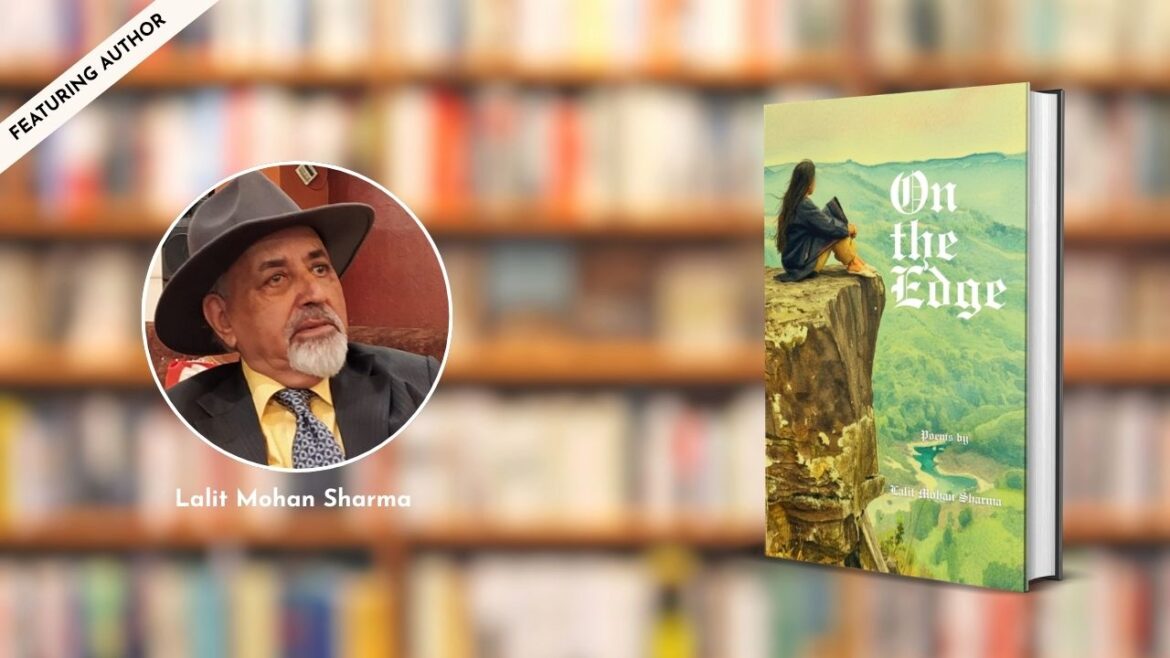
Lalit Mohan Sharma’s poetic journey is one that spans decades, geographies, languages, and emotional terrains. With On the Edge, his newest anthology, he once again proves that poetry is not merely a literary practice for him but the very lens through which he engages with the world. His work has always reflected a thoughtful negotiation between the inner self and the outer world, and this collection is no different—except that it stands even more distilled, more mature, and more attuned to the fragile balance of modern life.
Sharma belongs to a rare lineage of poets who remain unhurried in a time ruled by speed. His poems do not compete for attention; they invite, gently. They do not shout; they listen. They do not dramatize life; they illuminate it. On the Edge is divided into four books, each of which functions as a pause—a moment to breathe, observe, and feel the subtle, often unnoticed patterns of daily existence. These poems are not born out of sudden inspiration but out of a lifelong habit of noticing: the flicker of a moment, a shifting emotion, or the quiet heaviness tucked into ordinary routines. He writes like a man who has spent years watching the world from its edges, finding meaning where most people see none.
What makes this anthology compelling is the absence of theatrics. Sharma refuses sentimentality, yet his poems retain an intimate warmth. He avoids melodrama, yet his lines carry emotional weight. His diction remains precise, never ornamental, and he relies on thoughtful metaphor rather than embellished expression. It is this clarity—reflective without being confessional, personal without being self-centered—that gives his poetry its universal resonance. In a world flooded with noise, his work offers thoughtful silence.
Sharma’s life experiences have nurtured this depth. Born in 1952, he has lived various roles—teacher, translator, thinker, social worker—and each role has added a new dimension to his poetic voice. His career as a professor of English language and literature sharpened his relationship with words, but it was his engagement with life outside academia that carved the emotional vigor of his writing. The years he spent in Himachal Pradesh, teaching and later retiring as a principal, gave him a unique vantage point: one foot in the world of ideas, the other firmly planted in everyday realities.
His interests have never been confined to the classroom. The poet in him awakened early and remained consistent, producing fourteen collections of English poetry, a verse translation of Zahid’s Urdu poems, and later even expanding into Hindi with the release of Patal Sey Prangan Tak in 2023. This linguistic plurality reflects his sensitivity to the cultural and emotional rhythms of the country he loves deeply. His affection for India is not loud patriotism; it is a quiet devotion visible in the subtle ways he writes about landscapes, people, and memories.
The year 2025 marks an especially prolific phase for him with the publication of Voids of Silence, Accepting Absences, and Another Gandhi, a monograph dedicated to Pt. Durga Dass, a freedom fighter. These works mirror Sharma’s persistent engagement with themes of loss, memory, nationalism, and the shifting contours of moral and social identities. His writing is not only a poetic expression but a philosophical inquiry as well, exploring the dissolution of certainties and the emergence of new meanings in a world shaped by rapid transitions.
Living in Dharamshala, he remains closely connected to the State War Memorial and the Harmony Day Care Centre for Special Children—associations that reflect his deep-rooted belief in compassion and community. These spaces, filled with stories of sacrifice, resilience, and innocence, influence the quiet introspection visible in his poetry. His sensitivities are shaped as much by human interactions as by solitary contemplation.
Sharma’s work has been widely recognized and included in several notable anthologies and academic books, such as A Handbook of Contemporary Ethics (2024) and Cessation of History in Literary Thought in the Post-Truth Era. These inclusions underscore his relevance not only as a poet but as a cultural thinker whose ideas resonate beyond the boundaries of literature. The Galaxy International Foundation honored him as “A Connoisseur of Creative Arts,” and in October 2024, he received the International Academy Award in Literature at the World Poetry Conference in Pune—a recognition that acknowledges both his artistic mastery and his contribution to contemporary literature.
Yet, awards are not what define Lalit Mohan Sharma. His essence lies in the way he observes, reflects, and articulates the human condition with simplicity and depth. On the Edge is a testament to this lifelong commitment. Through its four sections, he guides readers into the shifting landscapes of human emotion, each poem standing as a moment of truth captured with delicate restraint. He does not merely write about life; he holds it in his hands, examines its contours, and returns it gently to the reader.
At a time when poetry often chases performance, Sharma continues to write for the quiet reader—for the one seeking clarity, understanding, and that rare connection between word and soul. His work reminds us that poetry, at its best, is not a spectacle but a mirror. And through On the Edge, Lalit Mohan Sharma once again offers readers a mirror polished with decades of thought, empathy, and unwavering creative courage.