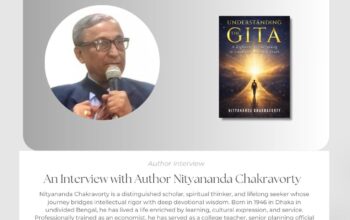
Nityananda Chakravorty stands as a rare synthesis of scholar, seeker, and practitioner—an author whose life journey mirrors the spiritual path he so gently unfolds in his writings. Born in 1946 in Dhaka in undivided Bengal, Chakravorty grew up in an environment steeped in cultural richness, music, literature, and philosophical inquiry. From an early age, he exhibited a contemplative temperament and an enduring curiosity about the nature of existence. These qualities later matured into a lifelong engagement with both worldly responsibility and inner exploration. Professionally trained as an economist, culturally shaped as a poet, lyricist, and singer, and emotionally anchored as a devoted follower of Sri Krishna, Chakravorty embodies a harmonious integration of intellect, creativity, and spirituality.
His professional career spans more than five decades and reflects a deep commitment to public service and academic excellence. Beginning as a college teacher between 1969 and 1976, he later served as an Economist and Joint Planning Chief at the Bangladesh Water Development Board until 2003, contributing to national planning and development initiatives. His expertise eventually carried him to international platforms, where he worked as a consultant economist for organizations such as the World Bank and the Asian Development Bank, among others, until 2021. Yet alongside this distinguished professional trajectory ran a quieter, more personal calling: an unwavering devotion to the study of Sanatan philosophy and the Shrimad Bhagavad Gita.
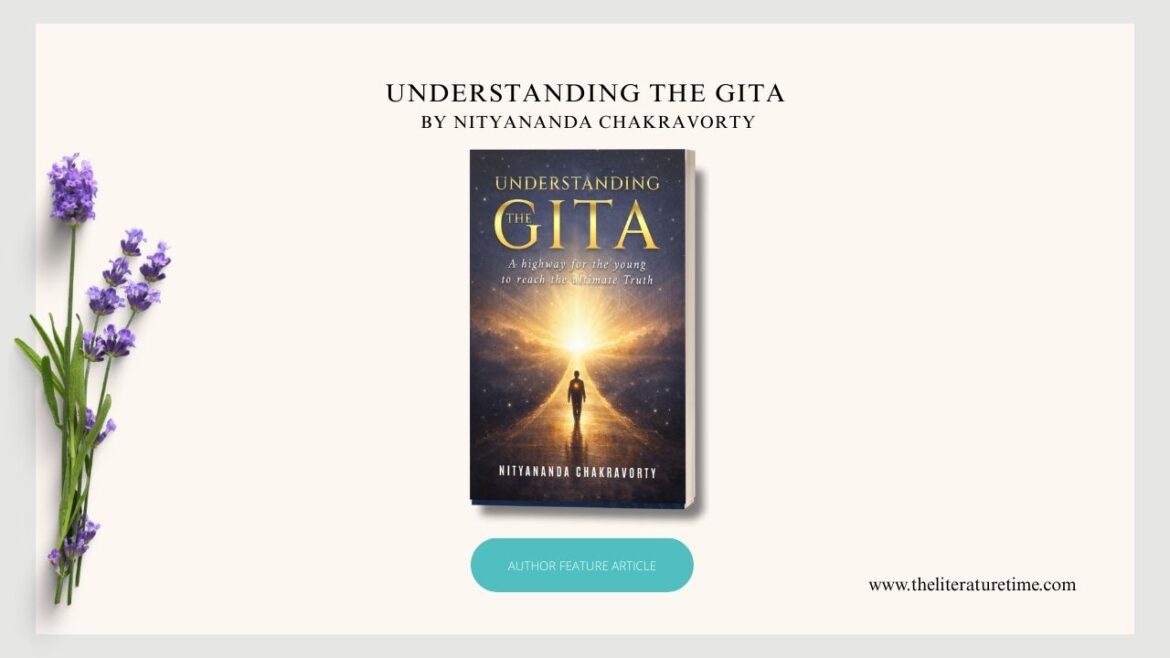
This calling culminated in the creation of Understanding the Gita: A Highway for the Young to Reach the Ultimate Truth, a book that reflects not only scholarly insight but lived wisdom. Chakravorty does not present the Gita as a text meant merely to be read or memorized; he approaches it as a living guide for transformation. The book’s central premise is clear and compelling: the purpose of the Gita is not simply to inform the mind, but to transform the entire human being—cognitive, emotional, and behavioral. In an age where information is abundant but inner clarity is scarce, this distinction becomes profoundly significant.
At the heart of the book lies the concept of shifting from the ego-“I” to the egoless-“I.” Chakravorty explains that most human suffering arises from identification with the ego-self, which is driven by desire, fear, comparison, and attachment. The egoless-“I,” by contrast, represents a state of awareness in which one recognizes their deeper, divine essence. According to the author, every individual is already divine; what obscures this truth are ignorance, indolence, and habitual patterns of thought and behavior. The role of spiritual practice, therefore, is not to create divinity but to remove the veils that hide it.
One of the most distinctive features of Understanding the Gita is its practical orientation. Rather than remaining confined to philosophical abstractions, Chakravorty introduces a two-stage module of self-purification designed especially for beginners. These stages consist of simple, self-explanatory, and objective exercises that guide readers toward greater self-discipline, awareness, and inner stability. The structure reflects a deep understanding of human psychology: transformation cannot be forced or rushed; it must unfold gradually through consistent effort. Each small step forward is portrayed as meaningful, reinforcing the idea that spiritual growth is a continuous and accessible process.
The modular exercises aim to liberate individuals from the lower derivatives of nature—states dominated by restlessness, ignorance, and inertia—and elevate them toward higher nature, characterized by clarity, balance, and resilience. As practitioners progress, they become better prepared for deeper disciplines such as dhyana, yoga, renunciation, and transcendental meditation. Chakravorty’s language remains reassuring throughout, emphasizing that setbacks are natural and perseverance is more important than perfection. In this way, the book functions as a compassionate companion rather than a rigid instruction manual.
Another powerful aspect of the book is its inclusivity. Chakravorty repeatedly asserts that belief, in the conventional sense, is not a prerequisite for benefiting from the Gita. The Gita, as he presents it, does not establish a particular creed, community, or doctrine. Instead, it identifies a universal destination—Truth—and offers guidance for aligning one’s behavior and consciousness toward that destination. This approach opens the book to readers across cultures, religions, and ideological backgrounds. Whether one considers themselves a believer, a skeptic, or simply curious, the book speaks to the shared human longing for meaning, peace, and freedom.
Chakravorty’s authority as an interpreter of the Gita is grounded in decades of dedicated study and lived experience. Since 2013, he has immersed himself in research on Sanatan mythology and has published several books offering modern and novel interpretations of sacred texts. His edited version of the Gita, recognized for its academic excellence and simplicity, was selected for printing and distribution among government-supported Gita schools throughout Bangladesh in 2020. This recognition underscores his ability to bridge scholarship and accessibility.
Beyond writing, Chakravorty is a dynamic spiritual practitioner and orator. He has conducted Gita Yajnas as chief priest for Sanatan communities in cities such as London, Melbourne, and Brisbane, carrying his message across continents. For over twenty-two years, he has served as the President of Sri Sri Gitasangha Bangladesh, guiding a nationwide organization dedicated to the study and dissemination of Gita wisdom. His speeches are known for their clarity, warmth, and practical relevance—qualities that also define his writing.
Ultimately, Understanding the Gita stands as both a spiritual guide and a mirror to the author’s own life journey. It reflects a man who has balanced worldly responsibility with inner devotion, and intellectual rigor with heartfelt surrender. For young readers especially, the book offers a steady highway toward self-discovery and inner freedom. It does not promise instant enlightenment, but it offers something far more valuable: a reliable path, gentle guidance, and the reassurance that the ultimate Truth is not distant or unattainable—it already resides within.