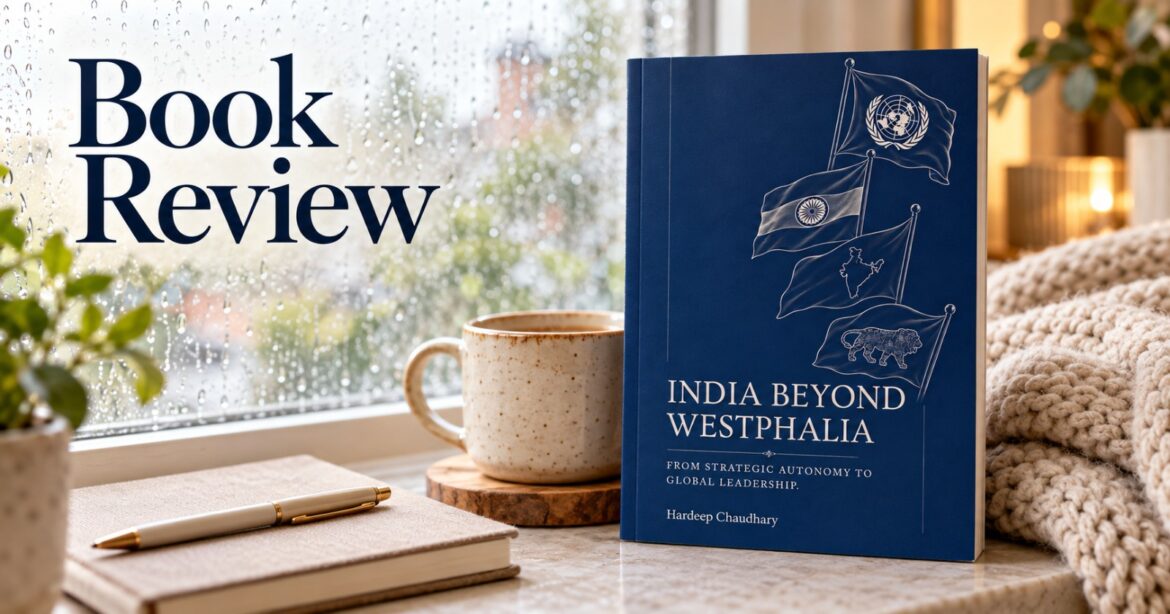
India Beyond Westphalia by Hardeep Chaudhary: From Strategic Autonomy to Global Leadership
India Beyond Westphalia arrives at a moment when India’s place in the world is being discussed with unusual intensity and, often, unnecessary simplification. Hardeep Chaudhary approaches that conversation with a clear proposition: the frameworks that once defined the modern nation-state are no longer sufficient to explain the scale of India’s responsibilities or the range of its choices. The book examines India’s movement beyond a narrowly Westphalian understanding of sovereignty toward a more expansive role in an emerging global order. It does not treat that movement as a rejection of national interest; rather, it frames national interest and international responsibility as increasingly connected in a multipolar century.
The title signals the book’s central intellectual concern. The Westphalian idea of international relations, centred on sovereign states, territorial authority, and formal equality among nations, remains important to diplomacy. Yet it cannot by itself account for contemporary pressures that cross borders: technological competition, climate disruption, supply-chain dependence, information flows, global health, and the search for more representative international institutions. Chaudhary uses this tension to ask how India can preserve strategic autonomy while participating more actively in shaping common rules, partnerships, and solutions. The result is a timely lens through which to consider not just what India seeks from the world, but what kind of international role it intends to build.
A notable strength of the book is its refusal to present global leadership as a matter of rhetoric alone. Its emphasis on responsible leadership gives the argument practical weight. In this account, India’s influence rests not merely on size, history, or aspiration, but on the ability to make credible choices across security, technology, climate action, development, and international cooperation. Strategic autonomy is therefore treated as more than distance from competing power blocs. It becomes a capacity for independent judgement, principled engagement, and sustained contribution in circumstances where dependence on a single geopolitical alignment may narrow a country’s options.
The discussion of the Global South is especially relevant to the book’s wider purpose. India is positioned as a country capable of carrying forward development concerns, institutional reform, and a more inclusive conversation about global governance. This is not a claim that India can speak for every country or experience within the Global South. Instead, the book’s framework invites readers to consider the responsibilities attached to mediation, coalition-building, and agenda-setting in a world where older centres of power no longer command unquestioned legitimacy. The question is not simply whether India can rise, but whether it can help create arrangements that are fairer, more stable, and more responsive to a diverse international community.
Chaudhary’s subject requires the joining of history, geopolitics, and strategic analysis, and the book’s stated design appears well suited to that task. Historical context is essential because India’s foreign-policy choices cannot be separated from the country’s experience of colonialism, non-alignment, development, and democratic nation-building. Geopolitical analysis is equally necessary because the contemporary environment is shaped by shifting power balances, regional competition, and the demands of an increasingly multipolar world. Strategic analysis gives these discussions their forward-looking direction, asking readers to weigh choices rather than merely observe events. This combination makes the book accessible to readers who want a concise framework without reducing difficult questions to slogans.
Technology and climate action emerge here as strategic concerns rather than subsidiary policy areas. That is one of the book’s most useful interventions. Technological innovation now affects economic resilience, national security, public infrastructure, and the distribution of global influence. Climate action, likewise, is no longer only an environmental obligation; it is entangled with energy security, development equity, finance, and international credibility. By including both within the same vision of diplomacy, India Beyond Westphalia reflects the changing vocabulary of power. Readers are encouraged to see foreign policy not as a distant domain reserved for summits and treaties, but as a field shaped by choices about knowledge, capability, sustainability, and public purpose.
The book also gains relevance from its focus on the path to 2047. That horizon gives the discussion a defined national milestone while keeping the argument directed toward the longer future. It invites a productive question for students and policymakers alike: what institutional habits, diplomatic capacities, and ethical commitments would enable India to become a trusted architect of international order rather than simply a consequential participant in it? The formulation is significant. Being a major power and being trusted are not identical achievements. Trust requires consistency, competence, and the ability to acknowledge that durable influence is built through relationships as much as through leverage.
As a work of public-facing strategic thought, India Beyond Westphalia appears particularly valuable for readers who want to move beyond binary debates. It recognises that India must protect its own interests, but it also suggests that those interests are increasingly served by helping address shared challenges. Such a position asks more of foreign policy than ceremonial visibility. It demands careful balance: autonomy without isolation, ambition without overreach, and international engagement that remains grounded in domestic capacity. The book’s argument is likely to resonate with readers who see India’s diplomatic future as a question of responsibility as well as opportunity.
The intended audience is broad but coherent. Students of international relations, political science, public policy, and contemporary history will find a compact entry point into a major debate. Scholars and researchers may appreciate its effort to bring philosophical and strategic questions into the same frame. Policymakers, diplomats, and practitioners can engage with its focus on the practical choices behind leadership in a contested world. It will also interest general readers who follow world affairs and want a more structured way to think about India’s expanding global role. The book does not need readers to arrive with a fixed view of India’s future; its value lies in giving them a set of serious questions with which to approach it.
Ultimately, India Beyond Westphalia is best read as an invitation to consider how India’s diplomatic evolution might be judged in the decades ahead. Hardeep Chaudhary argues for a foreign-policy imagination that is independent yet collaborative, realistic yet norm-conscious, and national in purpose without being narrowly inward-looking. At a time when the international order is under visible strain, that is a useful and credible direction for debate. The book’s concise, forward-looking framework makes it a worthwhile read for anyone interested in the principles and choices that may shape India’s role in the emerging world order.
Rating: 4.5/5