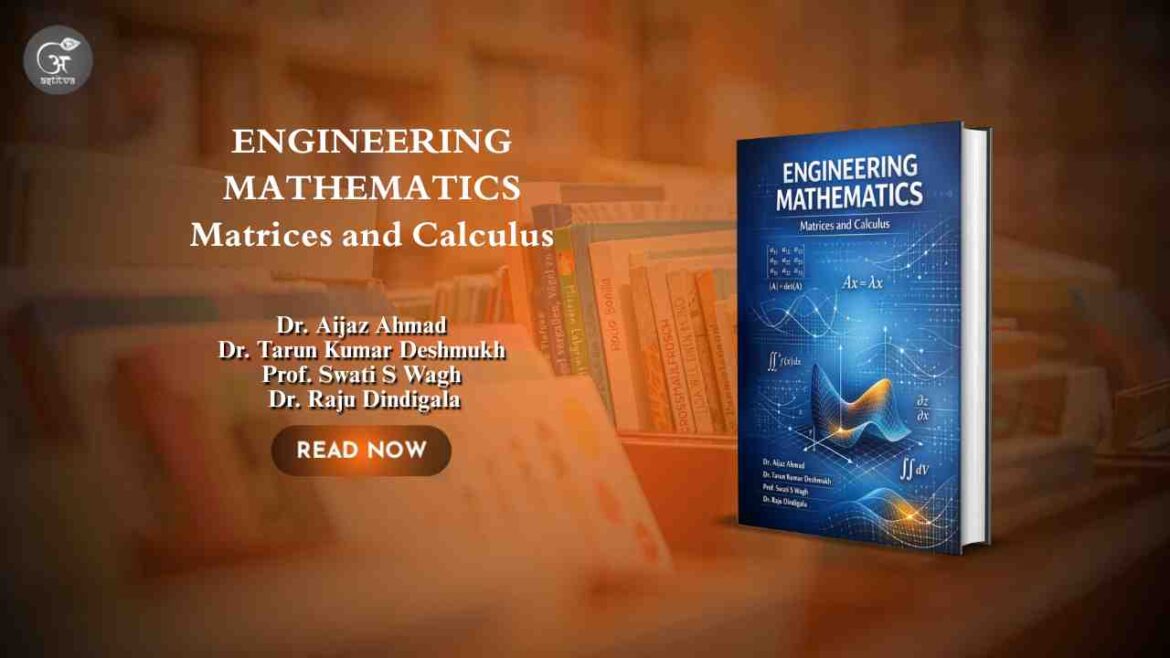
BILASPUR, CHHATTISGARH – Astitva Prakashan is proud to announce the publication of Engineering Mathematics: Matrices and Calculus, a comprehensive new resource designed to demystify some of the most fundamental yet challenging topics in modern mathematics. Authored by a distinguished team of educators and researchers—Dr. Aijaz Ahmad, Dr. Tarun Kumar Deshmukh, Prof. Swati S Wagh, and Dr. Raju Dindigala—this book serves as an essential guide for students, academics, and professionals alike.
The Core of Modern Engineering
Matrices and calculus are often viewed as distinct fields, yet they are deeply intertwined, forming the “backbone of modern mathematical analysis, engineering, and many branches of science”. Recognizing that students often struggle to connect these theoretical concepts with practical application, the authors have developed a text that bridges this gap through clear explanations, step-by-step methods, and numerous real-world examples.
Comprehensive and Structured Learning
The book is meticulously structured into five core units to build a solid foundation before advancing to complex topics:
- Unit I & II: Matrices and Eigen Values – Covers everything from basic operations and rank to advanced applications like the Cayley-Hamilton Theorem and Quadratic Forms.
- Unit III: Single Variable Calculus – Explores Mean Value Theorems, maxima and minima, and the introduction of Beta and Gamma functions.
- Unit IV & V: Multivariable Calculus – Delves into partial differentiation, Jacobians, and the evaluation of double and triple integrals in various coordinate systems.
Designed for the Modern Learner
With an emphasis on clarity and rigor, the book is intended for a broad audience, including undergraduate students beginning their journey, graduate students seeking deeper mastery, and professionals looking to refresh their knowledge.
“This book is more than a collection of mathematical principles,” the authors note in the preface. “It is a reflection of my passion for teaching and my belief in the power of mathematics to solve real-world problems”.