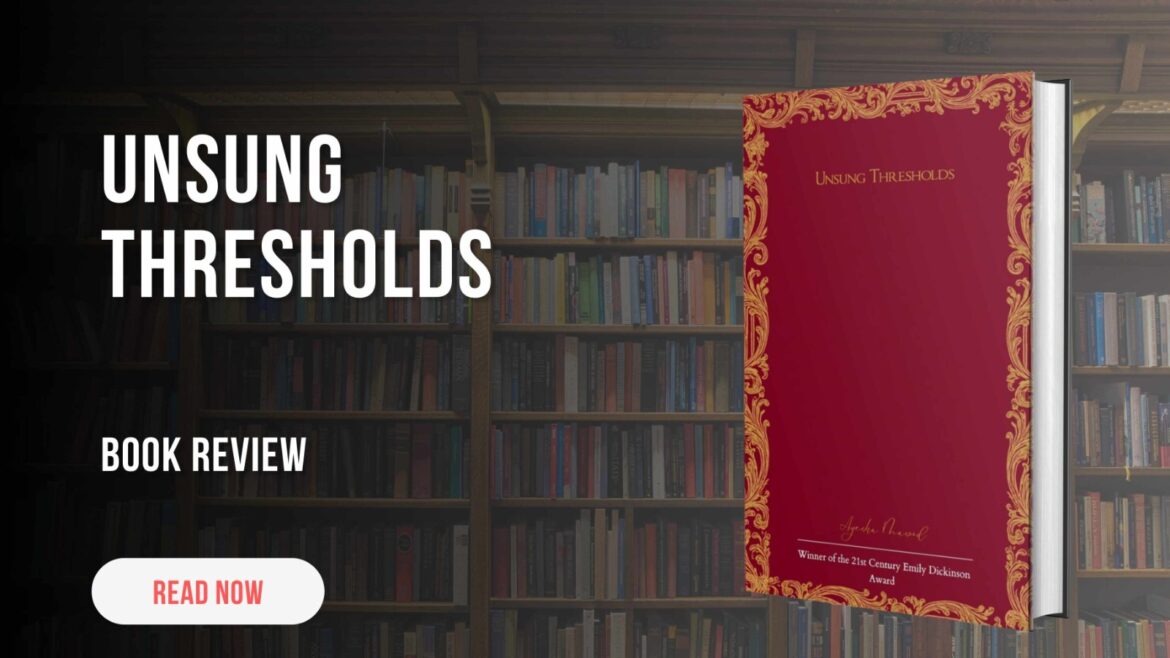
Unsung Thresholds by Ayesha Masood is a quietly resonant debut that resists spectacle in favor of something far more enduring: attention. Across its twenty-one poems, the collection traces the subtle, often unnoticed transitions that shape a life—the thresholds we cross not with ceremony, but with a kind of inward shift that only later reveals its weight. It is a book that does not demand to be read quickly; instead, it asks for stillness, rewarding those who are willing to sit with its silences as much as its words.
Masood’s poetic voice is marked by restraint, but it is never distant. There is an intimacy in her language that draws the reader close, not through confession or dramatic revelation, but through recognition. The poems seem to say: this, too, is part of living—the quiet labor, the small departures, the unnoticed endurance. Her work lingers in the in-between spaces: between staying and leaving, between memory and present, between what is spoken and what remains unsaid. These liminal zones become the true subject of the collection, and Masood navigates them with remarkable sensitivity.
One of the most striking aspects of the book is its attention to the ordinary. Everyday routines, domestic spaces, fleeting interactions, and inherited habits are rendered with a clarity that elevates them without romanticizing them. Masood understands that the ordinary is not inherently simple; it is layered with histories, expectations, and emotional residue. In her hands, a mundane act can carry the weight of generations, and a quiet moment can hold the tension of an unspoken goodbye. This ability to locate depth within the familiar is what gives the collection its quiet power.
Thematically, the poems move across a wide terrain—relationships, labor, cultural inheritance, and the natural world—but they are unified by a consistent emotional undercurrent. There is a deep awareness of how systems—familial, social, and cultural—shape individual lives, often in ways that go unquestioned. Yet Masood does not approach these themes with overt critique or didacticism. Instead, she allows them to emerge organically through image and gesture. A line about work, for instance, may carry within it an entire commentary on expectation and exhaustion, without ever naming it directly.
Relationships in the collection are portrayed with particular nuance. Love is not idealized; it is steady, sometimes quiet, sometimes strained, but always present as a shaping force. There are moments of tenderness that feel earned rather than declared, and departures that arrive not with drama, but with a kind of inevitability. The emotional clarity Masood brings to these experiences is one of her greatest strengths. She does not overstate or embellish; she trusts the reader to feel the weight of what is being suggested.
The presence of animals and cities in the poems adds another layer to the collection’s texture. These elements are not merely decorative; they function as extensions of the emotional landscape. A city may echo a sense of dislocation or continuity, while an animal may reflect vulnerability or instinct in ways that human language cannot fully capture. Masood uses these images sparingly but effectively, allowing them to deepen the reader’s engagement without overwhelming the central themes.
Stylistically, the poems are marked by clarity and precision. Masood avoids elaborate metaphors or dense abstraction, choosing instead a language that is direct yet evocative. This simplicity is deceptive; beneath it lies a careful crafting of rhythm and tone. The pauses in her lines—the spaces where meaning is allowed to settle—are as important as the words themselves. This measured approach creates a reading experience that feels almost meditative, encouraging reflection rather than immediate interpretation.
Silence plays a crucial role throughout the collection. It is present not only in what is left unsaid, but in the way the poems are structured. There is a respect for absence—for the idea that not everything needs to be articulated to be understood. This is particularly effective in poems that deal with memory and inheritance, where gaps and omissions become part of the narrative. Masood acknowledges that some experiences resist language, and she allows that resistance to remain intact.
As a debut, Unsung Thresholds is notably assured. There is a clear sense of purpose in the collection, and a consistency of voice that suggests a writer who is deeply attuned to her craft. At times, the restraint that defines the book may feel almost too controlled, leaving the reader wanting a moment of rupture or unpredictability. However, this is also part of its identity; the poems are committed to their quietness, and they do not break character for the sake of variety.
Ultimately, this is a collection that lingers. It does not announce itself loudly, nor does it seek to overwhelm. Instead, it settles into the reader’s awareness, returning in small, unexpected ways—much like the thresholds it describes. Masood invites us to reconsider the unnoticed passages of our own lives, to recognize the significance of what we often overlook. In doing so, she offers not just a set of poems, but a way of seeing.
Unsung Thresholds is a thoughtful and moving debut that finds meaning in the margins. It is a book for readers who value subtlety, who are willing to slow down, and who understand that the most profound changes often happen quietly.