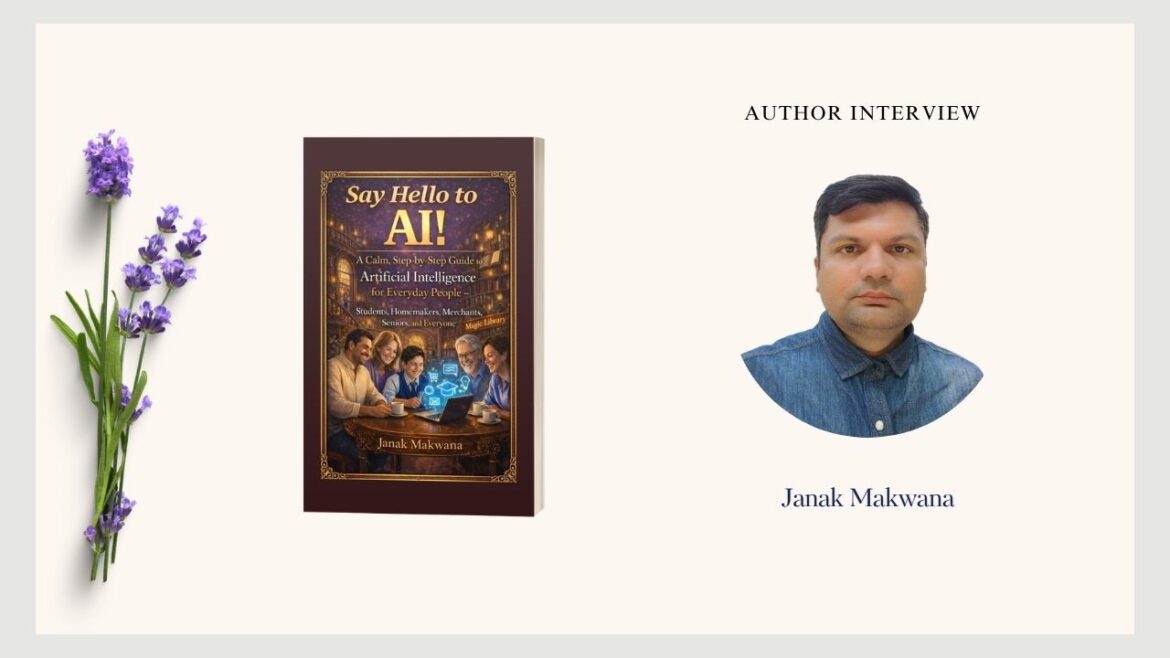
The Literature Times: What inspired you to write Say Hello to AI! and present artificial intelligence in such a calm and accessible manner?
Janak Makwana: The inspiration did not come from technology. It came from a quiet moment. I was sitting with someone who manages life beautifully, makes thoughtful decisions every day, and holds a family together with incredible strength. Yet when the topic of AI came up, she softly said, “This is not for people like me.” There was no resistance in her voice, only distance. That moment stayed with me because it revealed a deeper gap. It was not about intelligence. It was about access, confidence, and belonging. AI had been introduced as something powerful, but not something approachable. I realized people did not need more information. They needed a calmer entry point. This book was written to become that space where no one feels rushed, judged, or left behind.
The Literature Times: Your book is written for a wide range of readers including students, homemakers, merchants, and seniors. What motivated you to make AI understandable for such a diverse audience?
Janak Makwana: I once observed three people on the same week. A student struggling with a concept, a shopkeeper trying to attract customers, and a senior trying to understand a piece of information. Their lives were different, but their need was the same. They all needed clarity. And yet when it came to AI, all of them stepped back as if it belonged to someone else. That is when I realized the real gap. AI had reached people’s lives, but it had not reached their comfort. I did not want to write for a specific group. I wanted to write about real life. Because AI does not belong to experts alone. It belongs to anyone who thinks, decides, and navigates daily challenges.
The Literature Times: Many people feel intimidated by technology and AI. What are the most common fears you have observed, and how does your book address them?
Janak Makwana: The fears I saw were not loud. They were quiet and deeply human. A small business owner once asked me, “What if I press the wrong button?” He was not afraid of failure. He was afraid of looking foolish. Another person told me, “I think I am too late to learn this.” Not because they lacked ability, but because they felt left behind. These are emotional barriers, not technical ones. So, I did not start by explaining AI. I started by addressing how people feel. Through stories, I show that you are not late, you are not incapable, and you are not alone. Once fear begins to soften, learning does not need to be forced. It begins naturally.
The Literature Times: In your view, why is it important for everyday people to understand artificial intelligence today?
Janak Makwana: I once saw someone holding a medical report, reading it again and again. They could read the words, but they could not understand what those words meant for their life. They had information, but no clarity. That created quiet anxiety. This is exactly where we stand with AI today. It is already shaping how we search, decide, and communicate. But without understanding, people begin to withdraw instead of engaging. And when people withdraw, they still make decisions, but with less confidence. Understanding AI is not about becoming an expert. It is about staying aware and confident in a changing world. It allows people to participate instead of feeling carried by something they do not understand.
The Literature Times: You emphasize that technology should serve people rather than intimidate them. How has this philosophy shaped your career and your writing?
Janak Makwana: Early in my career, I noticed something that did not feel right. The more advanced the system became, the more hesitant the user appeared. Technology was progressing, but confidence was not. That contradiction stayed with me. I began asking myself whether true innovation lies in complexity or in clarity. Over time, I chose to focus on making technology feel usable and human. This philosophy shaped not only my work but also my writing. Every page of this book is written with one intention. To ensure that the reader never feels small in front of something that is meant to help them.
The Literature Times: With your background in software engineering and emerging technologies, what challenges did you face while simplifying complex AI concepts for general readers?
Janak Makwana:The real challenge was not simplifying AI. It was stepping out of my own understanding of it. When you know something deeply, you tend to explain it from your level. But that creates distance. I had to slow down and ask how this would feel to someone encountering it for the first time. That shift required me to replace technical explanations with everyday experiences. Conversations, kitchens, classrooms, and simple moments of life. The idea of the Magic Library came from this need. It was not just a concept. It was a way to make AI feel familiar, calm, and approachable.
The Literature Times: How can individuals who are completely new to technology begin their journey toward understanding and using AI confidently?
Janak Makwana:I remember someone sitting in front of a blank screen for several minutes. Not because they did not know what to ask, but because they were afraid of asking incorrectly. Then they typed one simple sentence. “Help me plan my day.” The response came back clear and helpful. They smiled. In that moment, something shifted. Not in the machine, but in the person. They realized they could do this. The first step is not about knowledge. It is about giving yourself permission to begin. Confidence does not come before action. It grows quietly after the first step.
The Literature Times: As AI continues to evolve rapidly, what ethical responsibilities do individuals and organizations have when using these technologies?
Janak Makwana:
I once saw AI give an answer that sounded perfect. It was structured, confident, and convincing. But it was not entirely correct. That moment is important because AI does not question itself. It does not pause or reflect. That responsibility belongs to us. Ethical use of AI is not just about systems or policies. It is about awareness in everyday use. Individuals must question and verify. Organizations must ensure fairness and transparency. AI can assist thinking, but it should never replace human judgment. The balance must remain clear. AI suggests, but humans decide.
The Literature Times: What do you hope readers will feel or learn after finishing Say Hello to AI!?
Janak Makwana:I do not measure success by how much someone learns from the book. I measure it by how they feel after reading it. If they feel calmer, more confident, and included, then the book has served its purpose. If someone closes the book and thinks, “I can start,” that is enough. Because learning does not begin with knowledge. It begins with belief in oneself. Once that belief is present, everything else becomes easier.
The Literature Times: What advice would you give to readers who are curious about AI but still hesitant to explore or use it in their daily lives?
Janak Makwana:I would ask them to imagine standing outside a quiet library. The door is open. There is no rush and no judgment. You are not expected to understand everything inside. You are simply invited to step in. AI is very similar. It does not demand perfection. It responds to curiosity. You do not need to be ready. You just need to take one small step. And once you do, you will realize that the door is always open for you.