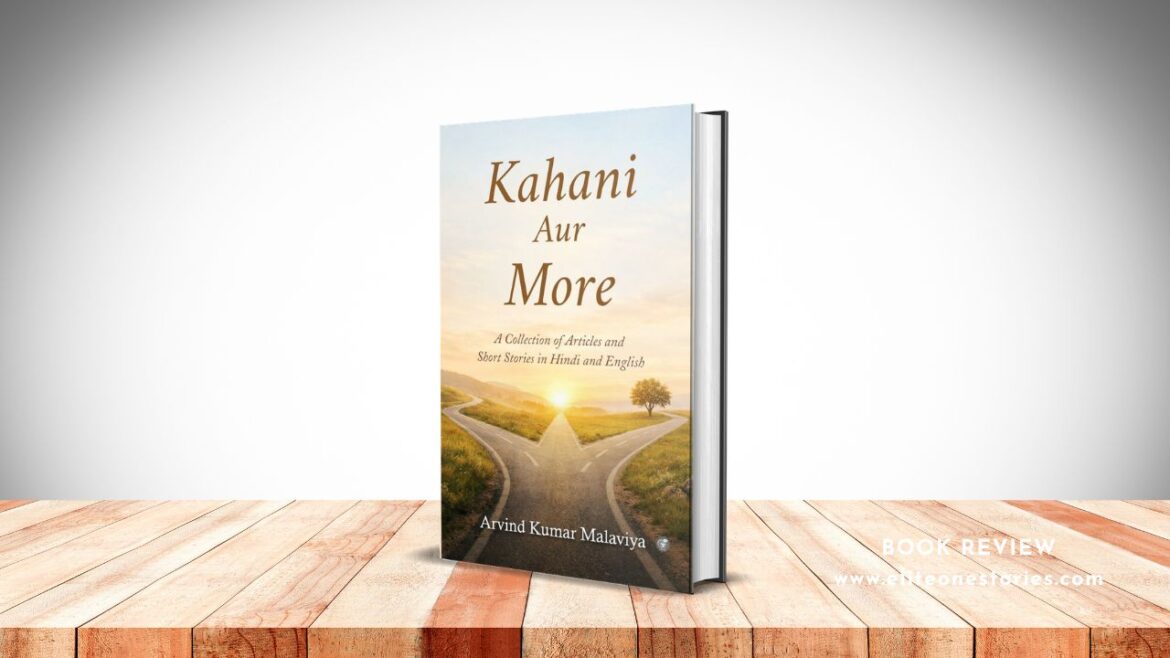
The true value of a literary collection lies not merely in the subjects it explores, but in its ability to preserve the spirit of an era and the evolution of a writer’s mind. Kahani Aur More: A Collection of Articles and Short Stories in Hindi and English by Dr. Arvind Kumar Malaviya succeeds admirably in this regard. More than a compilation of essays and stories, the book serves as a literary archive that captures the intellectual, social, and emotional landscape of a significant period in modern Indian history.
One of the most distinctive aspects of this collection is its bilingual nature. The seamless coexistence of Hindi and English reflects the author’s authentic thought process rather than a calculated literary experiment. Readers encounter a natural flow of ideas where language becomes a vehicle of expression rather than a barrier. Hindi brings warmth, cultural depth, and emotional resonance, while English lends precision and analytical clarity. This linguistic duality enriches the reading experience and broadens the book’s appeal to diverse audiences.
The collection offers a remarkable variety of themes. The articles reflect keen observation, social awareness, and intellectual engagement with issues relevant to their time. At the same time, the short stories provide glimpses into human relationships, emotions, societal values, and everyday experiences. Together, these pieces create a rich tapestry of thoughts and narratives that reveal the author’s multifaceted personality. Whether discussing cultural concerns, social developments, personal reflections, or philosophical ideas, Dr. Malaviya demonstrates an ability to connect with readers through sincerity and insight.
A notable strength of the book is its historical significance. The writings were originally composed between 1970 and 1985, a period marked by considerable social, political, and cultural transformation in India. As a result, the collection functions not only as literature but also as a record of contemporary attitudes and concerns. Modern readers gain an opportunity to understand how intellectual discourse evolved during those decades and how writers engaged with the changing realities around them.
Dr. Malaviya’s writing style is characterized by clarity, simplicity, and thoughtfulness. He avoids unnecessary complexity and instead focuses on communicating ideas effectively. His essays encourage reflection without becoming overly academic, while his stories remain engaging through their human-centered approach. There is an honesty in his writing that makes the collection accessible and relatable, even when addressing serious subjects.
The author’s distinguished professional background adds further depth to the work. As a scholar of Hindi journalism, a contributor to language development initiatives, and a dedicated advocate of Hindi literature, Dr. Malaviya brought both intellectual rigor and practical experience to his writing. His association with eminent literary figures, including the legendary poet Harivansh Rai Bachchan, undoubtedly enriched his literary perspective. Readers can sense this depth of literary culture throughout the collection.
Another commendable aspect of the book is its preservation of the author’s legacy. Published according to modern literary standards, these writings allow a new generation of readers to engage with ideas that might otherwise have remained confined to archives and old publications. The collection serves as a tribute to a writer who devoted his life to the promotion of Hindi language, literature, and public discourse.
While some articles may reflect the context and concerns of a previous generation, this does not diminish their relevance. Instead, it highlights the continuity of many social and human issues across time. Readers interested in literature, journalism, cultural studies, and the history of modern Indian thought will find considerable value in these pages.
Kahani Aur More is ultimately a journey through memories, ideas, and literary expression. It captures the voice of a dedicated writer who observed the world with curiosity, analyzed it with intelligence, and documented it with sincerity. The collection stands as both a meaningful literary contribution and a valuable historical document, offering readers an opportunity to witness the growth of a writer and the spirit of an era through the power of words. It is a thoughtful, enriching, and memorable read that honors the enduring legacy of Dr. Arvind Kumar Malaviya.