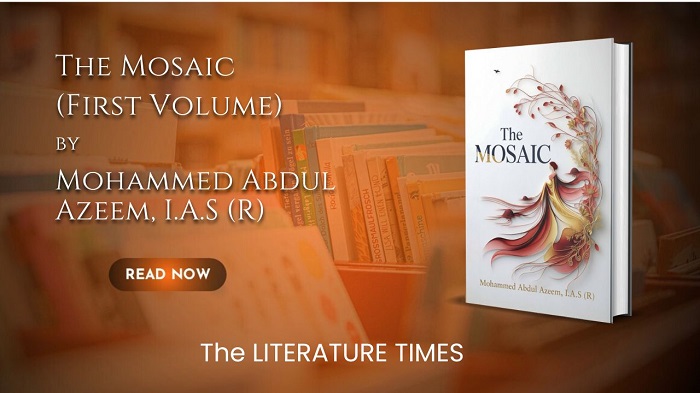
I did not write The Mosaic to explain how to build a startup in ten steps, nor to promise success through clever tactics or shortcuts. I wrote it because, after years of observing entrepreneurship across industries and geographies, I realised something deeply unsettling: much of what we say about entrepreneurship oversimplifies it. We reduce it to slogans, valuations, and isolated success stories, while ignoring the complex systems that actually allow ideas to survive, grow, or fail.
Entrepreneurship, in the real world, does not move in straight lines. It unfolds through cycles, contradictions, timing, and human judgment. It is shaped as much by belief and patience as by capital and ambition. As I watched founders rise and fall, investors succeed and misjudge, and entire industries transform, one image kept returning to me again and again — a mosaic. Not a painting created by a single artist, but a larger picture formed by many distinct pieces, each essential, each imperfect on its own, yet powerful together.
That is where The Mosaic begins.
Entrepreneurship, as I see it, is not driven by one dominant idea or one superior funding model. It is shaped by venture capitalists who take risks before certainty exists, angel investors who believe in people long before proof appears, governments that create enabling or restrictive environments, communities that nurture trust, and markets that move in cycles rather than guarantees. Each of these forces has its own rhythm and logic. When they align, extraordinary outcomes emerge. When they do not, even the most promising ideas struggle to survive.
To explain this balance, I often return to a simple fable rooted in Taoist philosophy. Two families run similar businesses in the same village. One moves aggressively, chasing every opportunity. The other moves patiently, building relationships and refining quality. When competition intensifies, only one endures. The lesson is not about speed or ambition. It is about timing, trust, and restraint. Over decades of observing business ecosystems, I have seen this story repeat itself in different forms, across countries, sectors, and generations.
One of the most influential pieces in this entrepreneurial mosaic is venture capital. Few institutions illustrate its power better than Sequoia Capital. When Don Valentine founded Sequoia in 1972, he was not merely funding companies — he was backing people long before the market understood them. Early investments in Apple, Cisco, and Google were not obvious or safe. They were acts of conviction rooted in foresight and human judgment. Later investments in Airbnb, Stripe, and WhatsApp followed the same philosophy: seeing potential before it was visible.
What fascinates me most is that venture capital is not about money alone. It is about belief applied at the right moment. Capital does not create potential; it amplifies it. Google began as a modest student project. WhatsApp turned a relatively small investment into one of the most remarkable venture outcomes in history. These stories remind us that timing and trust often matter more than scale or speed.
As the global economy evolved, so did venture capital itself. It expanded beyond a narrow geographic and sectoral focus into artificial intelligence, fintech, healthcare, education, gaming, and blockchain. This evolution also extended to India — a country defined by ambition, scale, contradiction, and resilience. In India, companies like Zomato, Meesho, Freshworks, and BookMyShow emerged not in spite of constraints, but often because of them. At the same time, cautionary stories such as Byju’s rise and subsequent decline remind us that growth without discipline can be fragile. India’s startup ecosystem shows us both sides of entrepreneurship: extraordinary success and painful correction, often existing side by side.
Alongside venture capital stands angel investing, another vital piece of the mosaic. Angels step in when ideas are raw and uncertainty is highest. They often invest not in certainty, but in character. Many of today’s successful companies exist because someone chose belief over hesitation at the earliest stage. Angel investing is not just financial support; it is mentorship, guidance, and trust extended when there are no guarantees. Yet belief without verification carries risk. The Theranos episode stands as a reminder that conviction must always be matched with responsibility. Courage without diligence can be costly.
As I studied these modern journeys, I noticed how closely they echo ancient strategic wisdom. Sun Tzu’s Art of War speaks not of aggression alone, but of terrain, timing, adaptability, and restraint. These principles translate seamlessly into business. Companies like Netflix, Amazon, Patagonia, and Tesla did not succeed by chasing short-term wins or inflated valuations. They succeeded by thinking long-term, absorbing setbacks, reinvesting patiently, and understanding when to advance and when to wait. Their success was not accidental; it was strategic.
Even industries known for instability, such as aviation, reinforce this truth. Airlines rise, fall, and rebuild. Survival depends not on avoiding crises, but on learning how to recover from them. Setbacks are not exceptions in entrepreneurship; they are part of its natural rhythm. The difference lies in how individuals and institutions respond to them.
But The Mosaic is not limited to venture capital and angels. It looks beyond Silicon Valley and India to include the quieter yet equally powerful systems that shape entrepreneurship worldwide. Sovereign Wealth Funds invest with long horizons, often seeking national resilience rather than quick returns. Microfinance institutions empower individuals with loans that may seem small in size but are transformative in impact. Self-Help Groups and Special Purpose Vehicles pool trust and resources, reducing risk through collective strength. International development banks provide patient capital and technical support where traditional finance often cannot reach.
From billion-dollar investments to micro-loans of a few hundred dollars, entrepreneurship thrives at every scale. What changes is not the spirit, but the structure supporting it.
At the centre of all this is timing — the invisible thread that connects success and failure. Two entrepreneurs can share the same idea, the same talent, and the same determination, yet experience vastly different outcomes. One arrives when the market is ready; the other arrives too early or too late. The difference is not intelligence or effort. It is context. Success, I have learned, is rarely about being right. It is about being right at the right moment.
This is why The Mosaic felt like the only possible title. Entrepreneurship is diversity within unity. No single model works everywhere. No single strategy guarantees success. Venture capital, angel investing, microfinance, sovereign funds, and collaborative networks are not competitors; they are complementary pieces. Each serves a purpose depending on geography, time, and circumstance. The real danger lies in assuming that one path fits all.
I wrote this book for entrepreneurs who are just starting out and for those who have already faced failure. I wrote it for investors, management students, policymakers, civil servants, and curious readers who want to understand how innovation truly takes shape. I have kept the language clear and accessible because insight should come from ideas, not jargon. This book is meant to be read thoughtfully, not rushed.
The book is structured as a journey — from the rise of Silicon Valley to India’s startup transformation, from angel investing to strategic philosophy, from global giants to volatile industries like aviation. Readers can enter at any point, follow the threads that interest them, and still see how the pieces connect. Entrepreneurship does not demand a single path, and neither does this book.
At its heart, The Mosaic is about people. Investors succeed because they believe before the world does. Founders succeed because they endure uncertainty, rejection, and repeated failure. Ecosystems succeed because societies choose innovation over stagnation. Progress is not linear. It is built slowly, often invisibly, through patience and resilience.
This first volume focuses on venture capital and angel investing — the core pillars of modern entrepreneurial ecosystems. A forthcoming second volume will expand the canvas further. Together, they aim to present entrepreneurship not as a myth of overnight success, but as a living, evolving mosaic.
This book is my attempt to bring those pieces together — not to offer certainty, but to offer clarity.