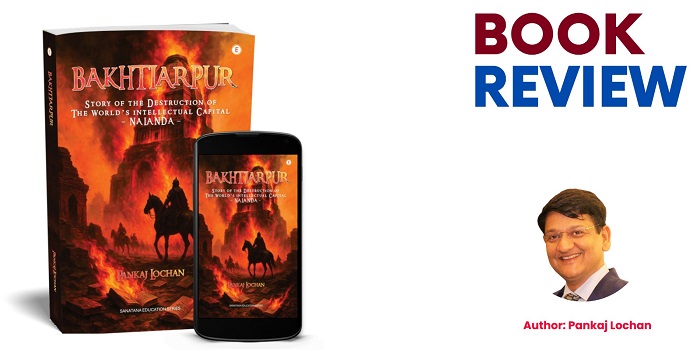
Book Title: BAKHTIARPUR
By Pankaj Lochan
ISBN: 9789363558342
Publisher: Evincepub Publishing
Introduction
History is not just a collection of dates and dead kings it is the echo of voices long silenced, of civilizations buried beneath indifference, and of questions that continue to throb like a scar passed down through generations. In Story of the Destruction of the World’s Intellectual Capital – Nalanda, Pankaj Lochan achieves something more powerful than a mere retelling of the past he reignites a civilizational memory that was nearly erased.
Published by Evincepub on the auspicious occasion of Sri Krishna Janmashtami in 2025, this book BAKHTIARPUR is not just an account of the destruction of Nalanda University. It is a personal pilgrimage, a cultural reckoning, and a bold appeal to remember what has been forgotten.
Summary
At first glance, this book BAKHTIARPUR may appear to be a historical narrative, but it is deeply personal and profoundly introspective. Structured over seven chapters with a prologue and epilogue, the book BAKHTIARPUR moves chronologically yet meditatively from a child’s innocent question about a railway station signboard to an adult’s quest for answers buried under centuries of silence.
The story begins with the author’s journey as a young boy returning to his maternal village in Bihar during the 1980s. At Bakhtiyarpur railway station, he notices a signboard that triggers discomfort: why is this sacred land named after a man who destroyed it Bakhtiyar Khilji? That moment sparks a lifelong inquiry. What begins as a child’s puzzlement evolves into a searing exploration of history, culture, identity, and collective amnesia.
Themes and Insights
1. Memory, Identity, and Erasure
One of the most compelling themes of the book is the loss of memory—both personal and collective. Lochan highlights how deeply ingrained names like “Bakhtiyarpur” have overwritten more ancient and culturally meaningful ones like “Baikathpur,” home to an ancient Shiva temple. The author doesn’t preach or rant. Instead, he mourns, reflects, and questions—why do we continue to live under names that represent our destruction?
In today’s era of identity politics, this book BAKHTIARPUR offers a refreshingly sincere perspective. It does not vilify a religion or community but questions the decisions of a society that allowed its soul to be overwritten without protest.
2. The Power and Fragility of Oral History
Much of what the author learns comes not from textbooks, but from people: a retired schoolmaster on a platform, his own Mami’s religious books, local villagers. The oral traditions the whispers of grandmothers, the pauses of schoolteachers, the unspoken silences of elders carry more history than the NCERT textbooks ever dared to teach.
Pankaj Lochan recognizes this and treats every moment of shared memory with reverence. His writing honors these custodians of memory and brings them to life vividly. Guruji, the elderly teacher on the railway platform, becomes a central character an embodiment of wisdom, humility, and living history.
3. The Lost Glory of Ancient India
The core of the book BAKHTIARPUR revolves around the destruction of Nalanda University in 1193 CE, allegedly by Bakhtiyar Khilji. Lochan outlines not just the historical facts, but also the intellectual loss the world suffered. Nalanda was more than a university—it was the Harvard, NASA, and Silicon Valley of its time. Lochan powerfully weaves in how the destruction of Nalanda and other Mahaviharas like Vikramshila, Odantapuri, and Telhara was not just physical—it was civilizational.
The burning of nine million manuscripts, the murder of thousands of monks, and the annihilation of a way of thinking, teaching, and living was a cultural genocide that still haunts India.
And yet, the book BAKHTIARPUR doesn’t rely solely on anger. It turns pain into resolve. The author wants readers to remember, not to hate. This distinction is crucial and shows the emotional maturity of the work.
Literary Style and Narrative Technique
Lochan’s writing is poetic, immersive, and filled with emotional undertones. His storytelling mixes memoir, travelogue, history, and introspection seamlessly. The early chapters evoke nostalgia of village life, mango orchards, temple bells, and grandmother’s stories. As the narrative matures, so do the emotions: from innocence to confusion, from curiosity to commitment.
Lochan excels in juxtaposing innocence and brutality. A child’s longing to bathe in the Ganga stands next to the memory of burning libraries. A station signboard becomes the doorway to India’s greatest forgotten tragedy.
Each chapter is carefully constructed to evoke thought and feeling. Sentences are short and crisp when expressing confusion. They grow lyrical when touching upon beauty or loss. The rhythm of his prose mirrors the rhythm of his journey from stillness to storm, from sorrow to strength.
Cultural Critique
One of the boldest aspects of the book BAKHTIARPUR is its cultural critique. Lochan asks difficult but necessary questions:
- Why do we name places after destroyers, not creators?
- Why do Indian children not know about their own intellectual ancestors like Nagarjuna, Aryabhata, Charaka, or Chanakya?
- Why are historical truths filtered or omitted in our education system?
- Why is there so little effort to rename places like Bakhtiyarpur to something rooted in our heritage?
Yet, he raises these questions without falling into jingoism. He makes space for nuance. He repeatedly asserts that his critique is not about Islam or Muslims but about historical awareness and cultural self-respect.
Personal and Emotional Resonance
What makes this book unique is its soul. This is not an academic’s textbook or a politician’s propaganda. It is the heart-wrenching journey of a curious, sensitive, and patriotic Indian who simply wants to understand: Why did we forget who we were?
The emotional highs and lows of the book come from Lochan’s personal evolution. From a fourth-grade boy to a thoughtful adult, his journey is ours. The frustrations he feels in asking “Why is it called Bakhtiyarpur?” and getting no answers from teachers, parents, or textbooks mirror the frustration many Indians feel about their misunderstood history.
The Role of Education
Another major theme in the book is the failure of our education system. Lochan repeatedly exposes how modern history textbooks sideline major empires and icons like Raja Bhoj, Rani Durgavati, Ahilyabai Holkar, Krishnadeva Raya, and even the mighty Cholas and Pallavas.
He also questions the absence of Buddhist acharyas from public memory, despite their global contributions to logic, medicine, mathematics, and metaphysics.
Through conversations, anecdotes, and reflections, he builds a strong case for educational reform one rooted not in politics, but in pride and truth.
Relevance to Modern India
This book couldn’t be more timely. In an India struggling to balance tradition and modernity, identity and inclusiveness, memory and progress, Lochan’s work serves as both a wake-up call and a healing balm.
As the debate over place names, curriculum reform, and cultural representation intensifies, Story of the Destruction of the World’s Intellectual Capital – Nalanda offers a thoughtful, emotional, and historically grounded roadmap.
It encourages readers not to blindly erase the past but to confront it honestly—to understand what was lost, what still remains, and what must be revived.
Minor Criticisms
The book’s deep personal tone, while its strength, may not appeal to readers expecting a detached, academic treatise. There are moments where emotional intensity may overwhelm historical detail.
Also, while Lochan makes a passionate case for renaming Bakhtiyarpur, some may argue that the book could include more comparative analysis of global examples—how other cultures have renamed cities and rebuilt memory.
However, these are minor points in a work of such emotional richness and cultural importance.
Conclusion
Story of the Destruction of the World’s Intellectual Capital – Nalanda is not just a book, it’s a call to awaken. A call to remember, reclaim, and reimagine what it means to be Indian. Pankaj Lochan does not shout; he whispers. But those whispers echo louder than most slogans.
This book is a gift for anyone who has ever felt the ache of erasure, the confusion of lost identity, or the yearning to reconnect with India’s true civilizational soul.
For students, educators, historians, and patriots. It is essential reading.
A powerful blend of memoir, history, and cultural commentary, Pankaj Lochan’s work is a tribute to Nalanda and a testimony to India’s forgotten brilliance. Highly recommended.