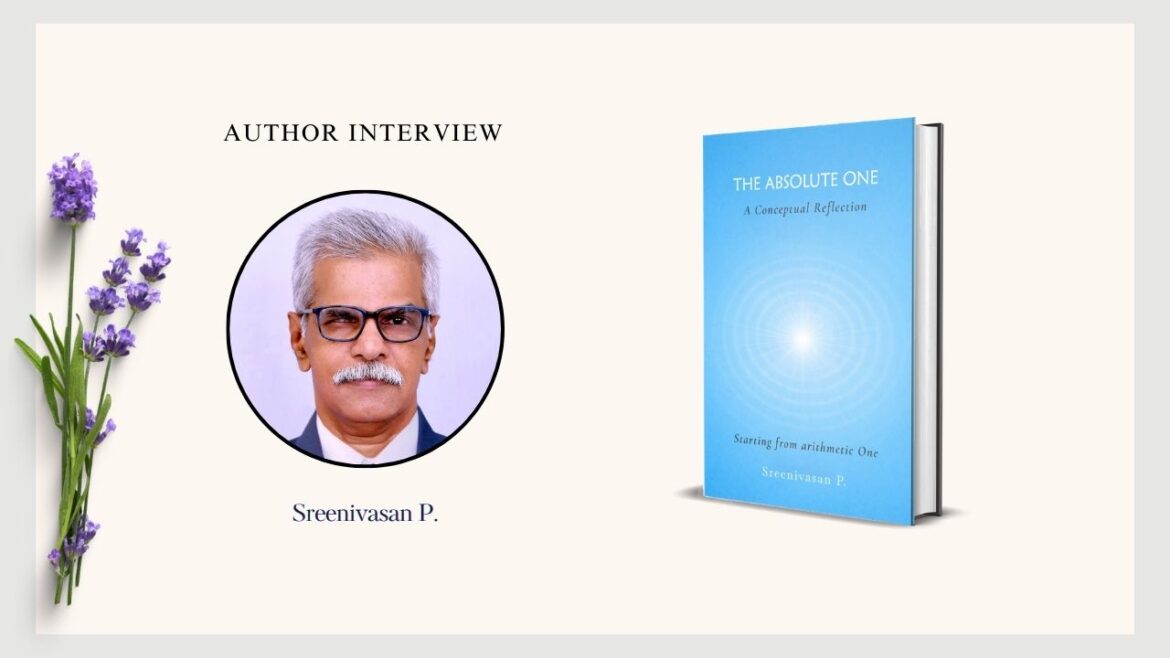
The Literature Times: What inspired you to begin your philosophical inquiry with the arithmetic concept of “1” in The Absolute One?
Sreenivasan P.: It was not planned. I raised a simple question out of curiosity. During the dialogue that followed, I realised that what we usually treat as a basic arithmetic idea may contain deeper conceptual meaning. That conversation gradually evolved into a structured inquiry.
The Literature Times: Your book explores the relationship between unity and multiplicity. What drew you toward this profound subject?
Sreenivasan P.: As the logical dialogue progressed, it became increasingly clear to me that “one” appears absolute in a deeper sense. Naturally, this raised another question: if unity is absolute, then how does multiplicity emerge without erosion of that unity? That is where the inquiry became profound.
The Literature Times: How do you differentiate between quantitative operations and ontological presence in your work?
Sreenivasan P.: Quantitative operations belong to arithmetic and remain valid within that domain. Ontological presence, however, does not necessarily follow arithmetic operations. My work explores the distinction between symbolic calculation and existential reality.
The Literature Times: As someone without formal training in advanced mathematics or theoretical physics, what gave you the confidence to explore such complex themes?
Sreenivasan P.: To me, these ideas are not truly complex; they are often so fundamental and simple that we mistake them for complexity. My confidence came from identifying inconsistencies and circular explanations. I believe those two things often obstruct clear logical exploration.
The Literature Times: What challenges did you face while translating deeply abstract ideas into clear and accessible language for readers?
Sreenivasan P.: Honestly, ChatGPT helped me greatly in refining expression and clarity. At the same time, many of the ideas discussed in the book—such as holographic reference, radial generation, and ontological subtraction—are not commonly explored in everyday discussions, so presenting them simply was both challenging and interesting.
6The Literature Times: Do you believe modern science and philosophy have overlooked certain fundamental questions about existence and origin?
Sreenivasan P.: Yes, I believe some foundational questions remain insufficiently explored. Science itself accepts that energy can neither be created nor destroyed, yet the deeper conceptual implications of that principle are not always pursued fully. I also feel that the idea of radial generation as a mode of emergence has not received sufficient attention in either science or philosophy, even though nature and technology frequently employ radial modes of transmission and expression. Everyday examples such as radio and television broadcasting demonstrate how multiplicity of reception can arise from a single source without division of the origin. I believe such observations deserve deeper conceptual reflection.
The Literature Times: Your writing emphasizes reasoning through first principles and analogy. Why is this approach important to you?
Sreenivasan P.: First principles are fundamental and therefore extremely important. When reasoning begins from simple and stable foundations, understanding becomes clearer and easier to defend logically. Analogies also help connect abstract ideas with everyday experience, making the inquiry more accessible to ordinary readers.
The Literature Times: Were there any philosophers, thinkers, or personal experiences that influenced your conceptual reflections in this book?
Sreenivasan P.: Yes. I felt that many gurus and philosophical traditions were indirectly pointing toward ideas related to radial generation, even if not explicitly describing it. Vedic thought and Advaita strongly emphasize unity within multiplicity and the idea of ontological continuity. I was also fascinated by the concept of holography as early as 1985, and that impression stayed with me for many years.
The Literature Times: What kind of response do you hope readers will have after finishing The Absolute One?
Sreenivasan P.: This question requires a slightly elaborate answer. Human understanding, science, and technology have always progressed by observing and aligning with nature. Much of what humanity has achieved is inspired by natural phenomena through what is often called bio mimicry — for example, aviation inspired by birds and fishes, forceps inspired by the crab, the bullet train inspired by the kingfisher, and Velcro inspired by plant seeds. Nature appears to possess remarkably efficient and intelligent ways of structuring reality.
What fascinated me deeply is how multiplicity seems to emerge while unity remains unbroken under what I describe as radial generation. At the same time, unity appears to persist regardless of what happens to its manifestations.
I do not consider the idea of radial generation an endpoint, but rather a beginning. I humbly invite readers — both ordinary people and intellectuals — to observe, discuss, debate, question, and refine these ideas so that our collective understanding, along with science and technology, may continue to grow. I sincerely hope the book encourages open discussion, including criticism and thoughtful inquiry.
The Literature Times: Are there any future works or ideas you wish to explore further after this book?
Sreenivasan P.: Definitely, God willing. I am already working on a second project, and I have also conceived a third, though it is still at an early stage. I believe there is much more to explore regarding foundational questions in mathematics, physics, logic, and existence.