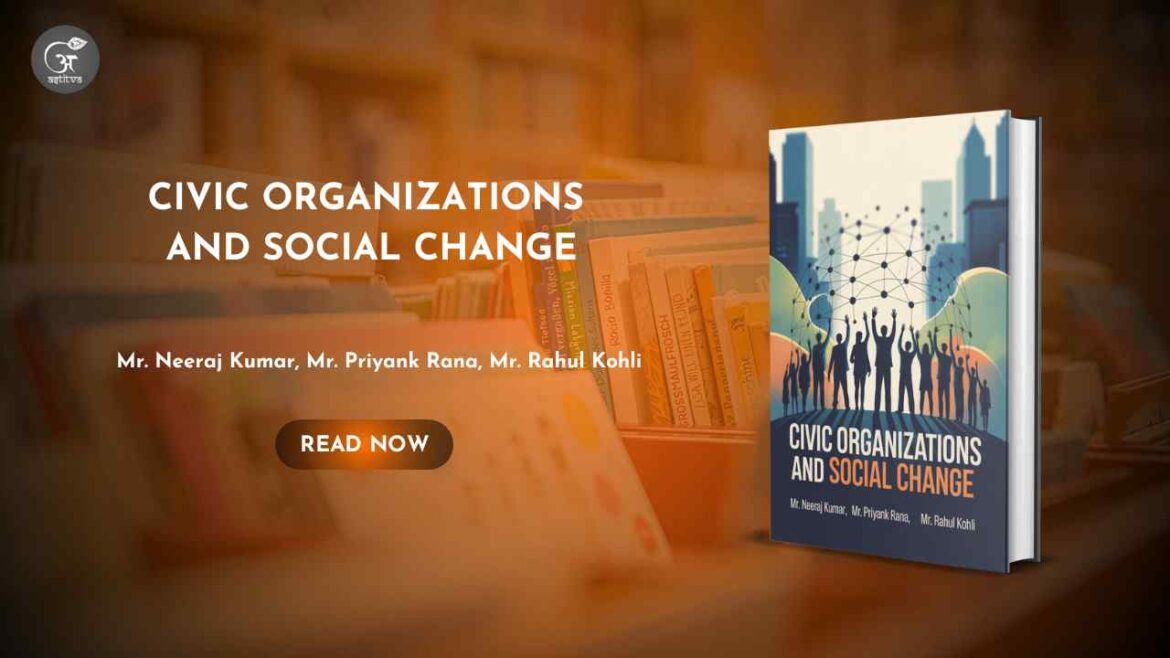
In a world undergoing rapid political, social, and cultural transformation, civic participation stands as the cornerstone of democracy and equality. The newly released book, Civic Organizations and Social Change, authored by Mr. Neeraj Kumar, Mr. Priyank Rana, and Mr. Rahul Kohli, is a timely and comprehensive exploration of how civic bodies and non-governmental organizations influence and shape the dynamics of modern society. Published by Astitva Prakashan, this work serves as both an academic contribution and an inspiring guide to those interested in understanding the mechanisms of societal progress.
The book presents an in-depth study of the relationship between civic organizations and the evolving structures of social change. Beginning with the roots of modern social stratification and diversity, the authors trace how traditional systems like Varnashrama Dharma evolved into today’s fluid, class-based societies. Through a blend of historical insight and modern analysis, the book paints a compelling picture of humanity’s ongoing struggle for equality, justice, and inclusivity.
As the chapters unfold, readers are introduced to the expanding role of Non-Governmental Organizations (NGOs) in contemporary civil society. The text carefully examines how NGOs have emerged as powerful agents of transformation—bridging gaps left by governments and championing causes like human rights, environmental protection, education, and poverty alleviation. The discussion on modern democracy, ethical governance, and human rights highlights how civic participation empowers citizens and strengthens democratic institutions.
One of the most remarkable aspects of the book is its focus on community empowerment and social movements. The authors detail how civic organizations mobilize collective action, turning individual voices into forces that challenge inequality and injustice. Furthermore, the book delves into digital-age activism, showing how technology, social media, and data-driven advocacy have revolutionized civic engagement worldwide.
The later chapters provide a robust theoretical framework for understanding social change. They connect global issues—like economic inequality, cultural diversity, and globalization—to local movements and community-based organizations. This makes the book especially relevant to students of sociology, political science, public administration, and social work, as well as professionals working in NGOs and development sectors.
What sets this book apart is its accessible style. The authors skillfully balance academic depth with readability, making complex social concepts engaging and relatable. Their writing emphasizes that real social progress does not solely depend on government institutions, but on the active participation of citizens and civic bodies that strive to make the world more just, inclusive, and sustainable.
In today’s era of global interconnectedness, Civic Organizations and Social Change reminds readers that true progress lies in cooperation, compassion, and collective responsibility. It encourages readers to recognize their potential as changemakers within their communities.
This book is now available through Astitva Prakashan and major online platforms. It stands as an essential resource for anyone who believes in the power of civic engagement to bring lasting and meaningful social transformation.