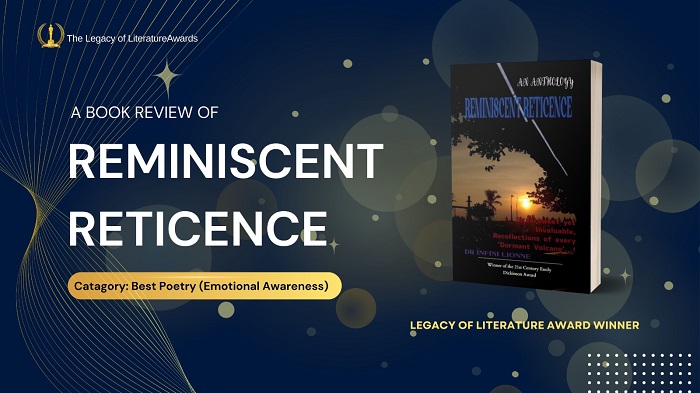
Reminiscent Reticence is a quiet, introspective, and deeply personal work—one that emerges not from a desire for visibility but from the courage to confront internal silence. The book’s origin story, as hinted in its description, is as compelling as the work itself: a shy, reserved writer who rarely gives voice to her inner world finally chooses to externalize it, not for acclaim or attention, but as a gesture of solidarity for others who share her struggle. This very genesis imbues the collection with authenticity. It feels less like a polished performance and more like a journal gently, hesitantly opened to the world. That vulnerability becomes the book’s defining strength.
The title, Reminiscent Reticence, perfectly encapsulates the thematic essence of the work. It is a book deeply rooted in memory—lingering on old days, revisiting moments softened or sharpened by time, and acknowledging the ways past experiences shape one’s present self. Yet it is also shaped by reticence: the instinct to hold back, to remain unseen, to guard one’s inner life from exposure. The interplay between these forces creates a narrative voice that is simultaneously delicate and resolute. The author writes as someone who has spent years in quiet observation, internalizing the world rather than performing for it. This inward-facing perspective gives the work a reflective stillness that is refreshing in a literary landscape saturated with urgent declarations and overt emotionality.
Stylistically, the writing carries a conversational intimacy. There is no attempt to adopt an elevated literary persona; instead, the prose flows with the natural rhythms of thought—sometimes meandering, sometimes abrupt, sometimes imperfect, but always genuine. The author openly acknowledges the ease of typing a few thoughts in solitude, contrasted with the difficulty of articulating them aloud. This contrast becomes a thematic undercurrent throughout the book. The pieces often feel like fragments of the writer’s inner monologue: candid, unfiltered, and unconcerned with impressing an audience. This quality will resonate deeply with quiet readers—those who write more than they speak, reflect more than they act, and feel more than they express.
The emotional tone throughout the book balances wistfulness with gentle encouragement. While the author revisits memories and moments of self-doubt, the reflections are not weighed down by melancholy. Instead, they serve as stepping stones toward acceptance and self-compassion. The recurring message—“Be you”—is not delivered with the saccharine tone often found in self-help rhetoric. Rather, it emerges organically from the author’s own struggle to live authentically. The advice feels earned, not prescribed. Readers can sense that the writer has wrestled with shyness, insecurity, and internalized expectations, and is extending a hand not from above but from alongside.
In many ways, the book functions as a quiet manifesto for introverted souls. It pushes back against the idea that expression must be loud, dramatic, or public to be meaningful. Here, expression is soft and unhurried. It takes the form of short reflections, nostalgic recollections, and gentle reminders. The power of the book lies in its subtlety; its messages settle into the reader gradually rather than striking with force. This subtlety may be seen by some as a weakness—readers seeking bold stylistic experimentation or emotionally high-stakes narratives may find the collection understated. Yet this restraint is deliberate, matching the personality and voice of the author herself. To demand more intensity would be to ask the writer to be someone she is not, which would contradict the book’s central message.
The thematic focus on “old and new days” places memory at the heart of the work. The author seems to view memory not as a burden but as a teacher. The reflections invite readers to consider their own archives of lived moments—both joyful and painful—and recognize how these fragments contribute to identity. This theme is handled with tenderness; the book does not dwell on regret or longing but treats the past as a collection of lessons, reminders, and quiet epiphanies. This approach gives the book a timeless quality, as though the writer is stitching together pieces of her inner world not to preserve them but to understand them.
One of the book’s most compelling aspects is its audience: the writer explicitly addresses others who struggle with shyness, self-doubt, or complex internal battles. There is a sense of community created through shared silence. The writer’s vulnerability becomes an offering, a way of telling readers that their hesitations, fears, and uncertainties are valid and shared. This emotional outreach elevates the collection beyond mere personal diary; it becomes a space for mutual recognition. Readers who have felt socially invisible or internally conflicted will likely find comfort in the author’s words.
If there is a critique to be made, it is that the fragments sometimes feel too fleeting. The book skims the surface of profound emotional landscapes but occasionally hesitates to dive deeper. Yet this very hesitation may be true to the writer’s nature. The book’s reticence is part of its identity, and its emotional restraint is not a flaw but a form of honesty. The collection stays true to the voice of someone who has learned to speak softly—someone still learning to inhabit her own presence on the page.
In the end, Reminiscent Reticence is a tender, introspective offering that values sincerity over spectacle. It invites readers to revisit their own stories with gentleness and encourages them to embrace their authentic selves, however quiet or hesitant they may be. It is a book that whispers rather than shouts, and in that whisper, many readers will hear the echoes of their own souls.