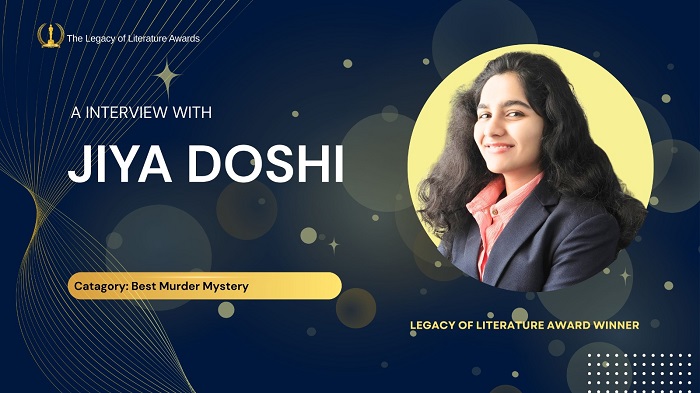
Jiya Doshi is a rising young voice in contemporary fiction, known for blending psychological depth with cinematic suspense. With a vivid imagination and a flair for high-stakes storytelling, she crafts intense, emotionally charged worlds where danger and desire walk hand in hand.
Her latest thriller plunges readers into a deadly five-day chase, pairing two complex characters—Dalia and Bennett—whose shared past is as dark as the secrets they’re running from. Jiya’s writing is sharp, immersive, and driven by a deep love for storytelling that began in early childhood. Whether she is creating fantastical realms or unravelling human psychology, her work is marked by passion, daring, and a uniquely youthful perspective.
The Literature Times: What sparked the idea for this thrilling, high-tension reunion between Dalia and Bennett?
Jiya Doshi: The idea of writing a novel from the POV of a serial killer was something that had been on my mind for years. I just never found the right catalyst to hit it off. Then one day, in English class, the idea struck me. Exchanging murders. Deceitful eyes. Friction mixed with chemistry, and chemistry met with resistance. I hadn’t decided on the reunion just yet, but I was so certain about the contradictory feelings and the irresistible tension of a murder mystery and a romance. That night, it all came to me. Somewhere between sleeping and dreaming, I saw this scene in my head – low lights, live off-tune Mozart, and of course, our to-be-favorite duo meeting after 7 years. The reunion was something I hadn’t planned for – it just unfolded as I dreamt of the two of them bickering like an old married couple. And as every remark was met with a counter and every argument with a bite back answer, the dialogues just sprang. 7 years. No contact. An oath to never see each other. And yet, knowing each other a little too well, even after almost a decade. There was something in that feisty exchange, a dream a little too vivid, the voices a little too memorable, that pushed me to write it. Reunions are usually supposed to be… nostalgic, wistful, emotional, maybe. But this… it just hit different.
The Literature Times: Dalia and Bennett share a complicated mix of mistrust, trauma, and magnetic chemistry. How did you craft such a layered dynamic?
Jiya Doshi: Dalia and Bennett were never meant to be simple. And in a way, none of us are. Their dynamic grew from the idea of twin swords – on their own, they can destroy each other, but together, they can fight against the world. The best part about them was how they were never straightforward. They originated from a single question: what happens when two people carry wounds that recognize each other before others do? It was fear of being understood, mistrust of having that used against you, and the past that taught them that people will always betray you. What Bennett artfully masked was what Dalia privately bore, and what Dalia kept denying was what Bennett grew frustrated carrying. They saw the worst parts of each other before the best, and that itself screamed chemistry.
I wanted to give justifications for the mistrusts that blossomed from the aspects of their past that never got closure, the same incidents that made killing their first instinct – over their own selves. Even if it meant killing feelings. What absolutely amused me was pitting it against a chemistry that was HIGHLY inconvenient for both of them – something they felt, but never expressed.
Their relationship was built on who they were at their most guarded versus who they could be if they allowed themselves to be seen and understood.
At a point, I realized I wasn’t crafting a dynamic; I was following a trail of inspiration from dreams, ideas, and musings, listening closely for moments their masks slipped even by a little bit, their voices faltered even if no one noticed, and their heartbeats sped even though it was by a millisecond.
The Literature Times: The opening scene is chilling and intimate. What emotions did you want readers to feel in that moment?
Jiya Doshi: I wanted the readers to feel the sense of walking into the middle of something. It wasn’t just a reunion, but a collision, a supernova explosion, the end of an era, and the start of something brand new that was long in the making. It was unsettling and gripping, but more than that, I wanted my readers to feel the familiarity. The recognition that strikes a chord deep within. The inescapable inevitability of fate dragging them back together after a period of blood and broken promises, the dread and fear that weighs heavily on them, the chilling sense of murder, the reluctant tenderness and “knowing” they show, and the dizzying proximity that feels like confessing crimes in the candlelight.
The Literature Times: How did you balance the elements of mystery, suspense, and emotional vulnerability throughout the story?
Jiya Doshi: Juggling that emotional vulnerability, mystery, and suspense felt like dealing with flaming rocks. One of my main goals for this novel was to peel back the psyche of someone who was considered monstrous and stereotypically merciless and show a softer, bruised side to them. Not to justify their actions – this isn’t a villain origin story – but I feel somewhere beneath those bloodstained knives and prison cells, there’s a pulse in it that’s found in all of us.
Bringing those elements together brought a cinematic duality of external chaos and inner demons, each heightening the other.
So many times, it felt like holding a mirror up to all of us – to show the impulses we suppress, the secrets we hide, and the versions we don’t admit to. No one is wholly good or bad – we’re all just complex mosaics. This novel helped me explore that kaleidoscope through sharp edges and soft light, making it three-dimensional and feel real.
The Literature Times: You’re already the author of a novel and a poetry collection. How did writing this thriller differ from your previous works?
Jiya Doshi: I remember writing the fantasy and adventure novel – it had taken me weeks to craft maps, mythologies and political systems, defining the very culture and climate of the place. Poetry, on the other hand, was distilled emotions captured on a page, encapsulating vivid imagery and raw storytelling.
This one was slightly different. It not only demanded a lot of worldbuilding, ensuring the textures and plots of the story flowed seamlessly, but also an emotional edge to it that captured the feeling underneath the cold-hearted exteriors. With that, I also had to work on a lot of character development, because the essence of the novel lay not just in the events, but also in overcoming inner demons. Crafting those character arcs, meticulously piecing them together with the storyline, and trying to strike a balance between the outward and inward tension was like walking on a tightrope. With the adrenaline came the razor-sharp edge of overdoing it. Because in a thriller, every gesture is loaded, every silence is a plot point, and every decision is a ticking bomb disguised as emotional nuance. It was the collision of Hemingway’s iceberg and Chekhov’s gun, the intricacies and beauty in the details.
Sometimes, it meant going both the macro and the micro: the architecture of the story and the fractures within the characters. Balancing it became the heart of the process, and it gave me a thrill that words cannot express.
The Literature Times: Many of your stories stem from dreams and everyday experiences. Did any real-life moment inspire a specific scene or character in this book?
Jiya Doshi: Absolutely – though, to put it in true writer fashion, it all falls within the casefiles of plausible deniability, enclosing truth in fiction, hiding Easter eggs, knowing that someone someday will piece it together (maybe that’s what I want – or do I?). Certain parts of the book slipped in from cinematic daydreams on my desk or on long car rides that unspooled so vividly, I could swear it belonged to a Netflix Original. And yes, a few aspects were inspired by personal experiences and people, some of which, ironically, I decoded after writing (just my brain processing the emotional debris of my heart). Many incidents – tiny gestures, short conversations, brief interactions – did leak in. As for the specifics… they’re locked in a vault meant (for now) only for me and those unsuspecting humans, something for me to know and the readers to experience without me admitting or denying anything on the record.
The Literature Times: As a teenage writer, what challenges have you faced in crafting such dark, mature themes—and how did you overcome them?
Jiya Doshi: As an avid reader, some of the stories I’ve read have dealt with mature themes – especially Edgar Allan Poe and Sylvia Plath. Their worlds were dark, intricate, and beautifully unsettling, so I already had a foot (or, let’s be honest, a whole leg) in the realm of heavy themes before I ever sat down to write my own. While writing this novel, I did read a LOT to better grasp the crux of these themes. Sometimes, it meant stepping out of my comfort zone to write. Writing through the pain really helped me – even if it meant peeling back layers of my own skin to experience the sting of old wounds and burning scars. Sometimes, I tapped into memories I wished I never revisited, read old diaries that had followed meltdowns, and researched so thoroughly my Google search history looked… questionable.
So, the challenge wasn’t the darkness itself – it was giving it depth, meaning, and a heartbeat of its own. And nothing does it better than reminding yourself “it’s just fiction” even when it screams like truth.
The Literature Times: The story unfolds over only five days. What made you choose such a tight timeframe, and how did it affect the pacing?
Jiya Doshi: So, the five-day window is really just for the climax. The novel itself stretches over a broader timeline, but those five days are the critical turning points where everything either combusts or suddenly starts to make sense.
I actually loved the ultimatum, the sense of urgency, and the fire that danced with that time duration. It felt like hearing a clock tick – each hour is audible, echoing, and mysterious. It forced every emotion and plot twist to hit harder and faster, with fewer detours and leisurely details. It built on the pressure and thrill of the novel, sharpening the pacing and stirring a little bit of trouble now and then.
The Literature Times: Dalia and Bennett are surrounded by old friends, new enemies, and unsolved murders. Which side character was the most fun—or the hardest—to write?
Jiya Doshi: I enjoyed writing about Lana, who is that one popular girl in every school, every university, every program. The party girl, the Miss Perfect, the human embodiment of a shampoo commercial who glides through life without a single hair out of place. Writing scenes with her character felt like letting my inner snark out – gently (and sometimes not-so-gently) – poking fun at those qualities and the insecurities it sometimes brought out from Dalia’s far more cynical lens. Writing Nancy, the best friend, was painful, and the reason behind it is something I believe is for the readers to find out!
The Literature Times: If readers could take away one message about trust, danger, or human connection from this novel, what would you hope it is?
Jiya Doshi: “And suddenly everything was RED… Murder, Rage, Risk, Love & Ruin.” Red is a very unique color – its shades can mean a lot of things. You never know when one shade cascades into another, but that’s the beauty of it. The hues blur into each other without warning. What I hope the readers take away is that human connection works in the same way. Dynamics change. The people who once would do anything for you are often the ones who break you in the most unfixable ways. Sometimes, audacity can make you fall (whether it is for someone or simply down a rabbit hole), adamance can make you sharper, and letting go can bring you back home. The most potent bonds are forged in all those places we’re afraid to look. And right when everything feels like it’s burning down, the love that finds you is BURNING RED.