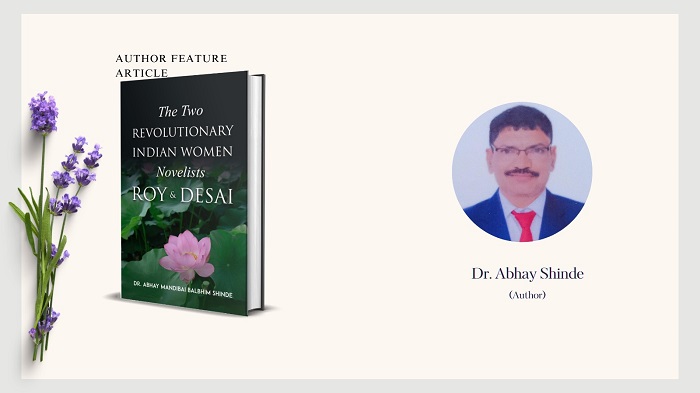
Dr. Abhay Mandibai Balbhim Shinde presents a thoughtful and scholarly contribution to Indian English literary criticism with his latest work, THE TWO REVOLUTIONARY INDIAN WOMEN NOVELISTS: ROY AND DESAI. This book offers a critical appreciation of two landmark novels in contemporary Indian literature—The God of Small Things by Arundhati Roy and The Inheritance of Loss by Kiran Desai—both recipients of the prestigious Booker Prize.
Through this study, Dr. Shinde brings readers closer to the literary, social, and political landscapes shaped by these iconic women writers. Arundhati Roy’s The God of Small Things (Booker Prize, 1997) is examined as a powerful narrative that interrogates social laws, the caste system, communism, forbidden love, and patriarchal family structures. Dr. Shinde highlights how Roy’s background as an architect and screenwriter, along with her personal experiences and her mother’s real-life struggles, deeply inform the emotional and political core of the novel.
The book also offers a nuanced reading of Kiran Desai’s The Inheritance of Loss (Booker Prize, 2006), situating it within the context of the Gorkhaland movement, the lingering effects of colonialism, and the pressures of globalization and immigration. Themes of identity loss, poverty, guilt, and displacement are explored with sensitivity and academic rigor, revealing the novel’s relevance to both Indian and global realities.
By placing these two novels in dialogue, Dr. Shinde underscores their shared engagement with postcolonial identity, the tension between tradition and modernity, and the intersections of gender and class. The book draws attention to the autobiographical undercurrents that enrich both narratives, positioning Roy and Desai as revolutionary voices who challenge dominant structures through fiction.
THE TWO REVOLUTIONARY INDIAN WOMEN NOVELISTS: ROY AND DESAI is an insightful resource for students, researchers, and readers of Indian English literature, offering a deeper understanding of how literature becomes a site of resistance, reflection, and social critique.