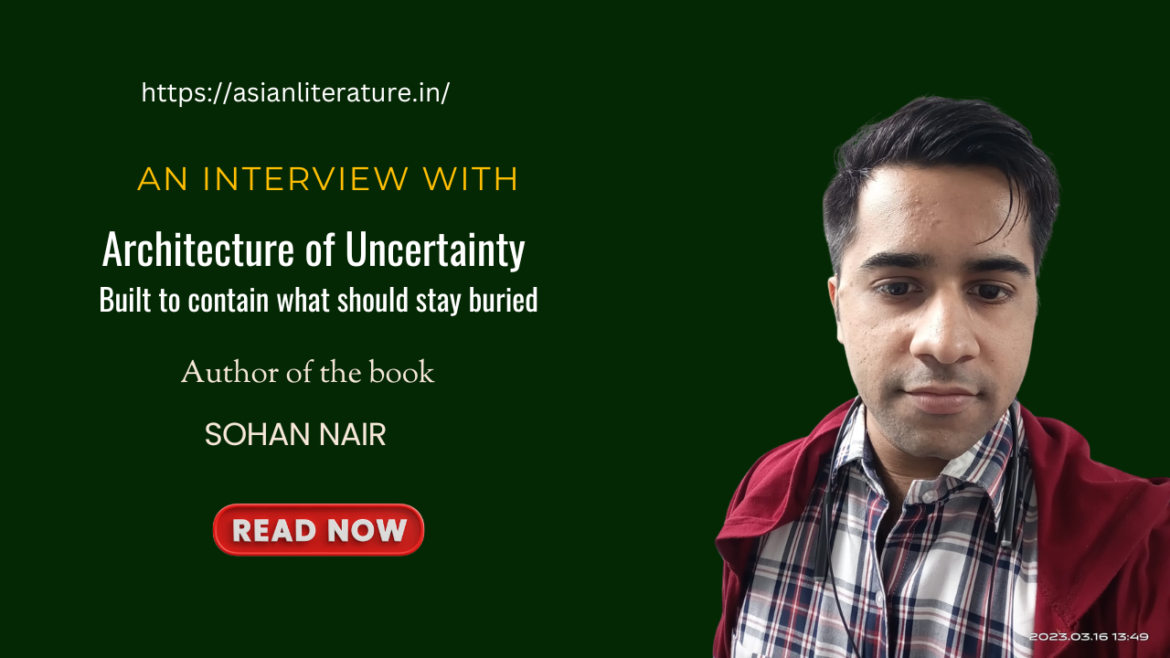
Title: Architecture of Uncertainty
Subtitle: Built to contain what should stay buried
Author: Sohan Nair
ISBN: 978-93-47263-13-2
Publisher: Inksight Publishing
About the author: In “Architecture of Uncertainty”, Elysia awakens to a nightmarish reality: a crumbling complex where human consciousness is manipulated and replicated. Haunted by distorted versions of herself and tormented by a sinister past, Elysia must unravel the facility’s dark secrets and dismantle the lies that have defined her existence. With every step, she has to shed the illusions that bind her, but the ultimate question remains: can she forge a new identity, free from the toxic roots of her past or will she forever be trapped in the equations that created her?
About The Book: In “Architecture of Uncertainty”, Elysia awakens to a nightmarish reality: a crumbling complex where human consciousness is manipulated and replicated. Haunted by distorted versions of herself and tormented by a sinister past, Elysia must unravel the facility’s dark secrets and dismantle the lies that have defined her existence. With every step, she has to shed the illusions that bind her, but the ultimate question remains: can she forge a new identity, free from the toxic roots of her past or will she forever be trapped in the equations that created her?
Neel Preet: What inspired you to write Architecture of Uncertainty?
Sohan Nair: I was inspired by how people trade truth for certainty, and how systems quietly design that exchange.
Neel Preet: How did your academic or professional background influence the ideas explored in this book?
Sohan Nair: My exposure to systems, institutions, and human behaviour under pressure shaped my focus on how environments manipulate thoughts.
Neel Preet: Why did you choose “uncertainty” as the central theme of your work?
Sohan Nair: Since uncertainty is the most honest human condition, while the rest is a coping mechanism
Neel Preet: Was there a particular event, theory, or observation that triggered this book?
Sohan Nair: A recurring observation I noticed was that people surrender freedom not to power, but to clarity, whether it is real or created
Neel Preet: Who did you envision as the primary audience while writing this book?
Sohan Nair: Readers who question authority, narratives, and their own certainty
Neel Preet: How do you define “uncertainty” in the context of your book?
Sohan Nair: Uncertainty is the space between perception and reality where control is negotiated.
Neel Preet: What does the term “architecture” symbolize in relation to uncertainty?
Sohan Nair: Architecture refers to the invisible structure — systems, routines, beliefs that shape how uncertainty is experienced and contained.
Neel Preet: How is your approach to uncertainty different from traditional theoretical frameworks?
Sohan Nair: I consider uncertainty not as a problem to solve but as a tool used by the powerful people to control minds
Neel Preet: Which chapter or concept do you consider the backbone of the book?
Sohan Nair: The concept that healing and control often wear the same face.
Neel Preet: How does your book bridge theory with real-world applications?
Sohan Nair: By grounding abstract ideas in lived psychological experiences—institutions, relationships, and internal conflicts.